Showing posts with label cyclicals. Show all posts

Saturday, 20 December 2025

The 2 types of Cyclical Businesses: "Pure Cyclicals" (No Growth / Range-Bound) and "Growth Cyclicals" (Secular Growers).

 This is a crucial concept for investors navigating cyclical sectors. Let's elaborate on these two types, which we can call "Pure Cyclicals" (Range-Bound) and "Growth Cyclicals" (Secular Growers).

Type 1: The Pure Cyclical (No Growth / Range-Bound)

Core Thesis: These companies are essentially proxies for a commodity price or a purely cyclical end-market. They have no organic growth engine outside the cycle. Their competitive advantage, if any, is in being a low-cost operator, but they cannot significantly expand their total addressable market (TAM).

  • Business Model: Mature, commodity-based, or in a declining/static industry. Examples include:

    • Basic Materials: A generic steel producer, a mid-tier iron ore miner.

    • Energy: A pure-play offshore drilling contractor (rig rates follow oil prices), a small independent E&P company with a fixed reserve base.

    • Industrials: A manufacturer of basic industrial components for capital spending (e.g., standard pumps, valves) with no pricing power.

    • Classical Autos: A legacy automaker in a saturated market (unit sales don't grow over decades).

  • Financial & Price Behavior:

    • Revenue & Earnings: Fluctuate violently with the cycle, but the mid-point of each cycle is roughly the same. Peak earnings in 2008, 2014, and 2022 might all be similar.

    • Share Price: Charts show a long-term horizontal channel. Investors successfully buy near the lower boundary (when losses are peaking, sentiment is worst) and sell near the upper boundary (when earnings are peaking, headlines are euphoric).

    • Valuation: Often valued on P/B (Price-to-Book) or P/Peak Earnings, as "normal" earnings are hard to define. The market assigns a higher P/E at the bottom (on depressed earnings) and a lower P/E at the top (on inflated earnings).

    • Capital Allocation: Dividends are often cyclical. Share buybacks and capex are highly irregular, following cash flow peaks and troughs. Debt can be a major risk in downturns.

  • Investment Mindset: Trading the Cycle. It's a timing game. The goal is to identify where you are in the cycle using leading indicators (e.g., inventory levels, future commodity curves, capacity utilization) and act contrary to sentiment. Long-term "buy and hold" typically results in zero returns over a full cycle.


Type 2: The Growth Cyclical (Secular Growth Trend)

Core Thesis: These companies operate in a cyclical industry but have a powerful, embedded growth engine that lifts their underlying business trajectory cycle-over-cycle. The cycle causes volatility around a clearly upward-trending path.

  • Business Model: They combine cyclical exposure with a durable growth driver:

    • Market Share Gains: A superior product, brand, or cost structure allows them to consistently take share from Type 1 competitors (e.g., a premium steelmaker for specialized automotive or aerospace).

    • Structural Demand Growth: Their end-market is cyclical but has a strong secular tailwind. Example: ASML (cyclical semiconductor capex, but long-term growth in computing demand). Airbus/Boeing (cyclical airline profits, but long-term air travel growth).

    • Innovation & New Markets: They use the cash from cyclical peaks to invest in new products or geographic expansion. Example: Meta/Facebook in its earlier days (cyclical advertising spending, but explosive user and ad load growth).

    • Accretive M&A: They use downturns to acquire weaker competitors at attractive prices, consolidating the industry and growing their asset base.

  • Financial & Price Behavior:

    • Revenue & Earnings: Peaks and troughs are evident, but each successive cycle's peak is higher than the last peak, and each trough is higher than the last trough. The trend line is up and to the right.

    • Share Price: Charts show a volatile but clear upward trend. You see "higher highs and higher lows." A long-term holder is rewarded, though timing entries during cyclical downturns dramatically enhances returns.

    • Valuation: Often valued on a blend of cyclical metrics and growth metrics (like PEG ratio). The market may award it a higher "through-cycle" P/E than a pure cyclical because of its growth profile.

    • Capital Allocation: More strategic and consistent. They often maintain or gently grow dividends through cycles. They use strong balance sheets to invest counter-cyclically in R&D and capacity.

  • Investment Mindset: Owning a Growing Business. The cycle creates entry points. The goal is to identify a company with a durable competitive advantage (moat) in a cyclical industry and buy when the cycle temporarily obscures the long-term growth story (usually during a downturn with bad news). Holding for multiple cycles can yield exceptional returns.


Key Comparisons & Why The Distinction Matters

FeaturePure Cyclical (Range-Bound)Growth Cyclical (Secular Grower)
Primary DriverCommodity price or economic cycleSecular growth trend + cycle
Earnings TrendFlat across cyclesUpward across cycles
Price PatternFluctuates within a rangeHigher highs and higher lows
Ideal StrategyTactical, contrarian tradingStrategic buying on cyclical weakness
RiskMis-timing the cycle; permanent impairment in downturnsPaying a "growth" price at the peak of the cycle
Valuation FocusP/B, P/Peak-E, NAVThrough-cycle P/E, PEG, long-term DCF
Management SkillOperational efficiency, survivalCapital allocation, innovation, gaining share
ExamplesUnited States Steel (historically), dry bulk shippers, chemical fertilizer companies.NVIDIA (cyclical semiconductors + AI growth), Caterpillar (cyclical construction + global infrastructure growth), Linde (cyclical industrial gases + ESG growth).

Critical Insight for Investors:
The market often mis-prices Growth Cyclicals as Pure Cyclicals at the bottom (extreme pessimism) and mis-prices them as perpetual growth stocks at the top (extreme optimism). The astute investor recognizes which type they are dealing with.

  • For a Pure Cyclical, you ask: "Where are we in the cycle? Are valuations at extremes?"

  • For a Growth Cyclical, you ask: "Is the long-term growth thesis intact? Is the cyclical downturn providing a rare chance to buy a great business at a fair price?"

Understanding this difference separates simple cycle-traders from investors who build wealth by owning exceptional businesses with cyclical characteristics.

Friday, 19 December 2025

The raw truth of the performance of the plantation sector over the last decade.

Plantation Sector

The core business of palm oil plantations is brutally cyclical. Profits are a direct function of volatile global commodity prices (CPO, PK). The 10-year financial charts of plantation companies show this perfectly: massive profit swings from high to low and back. This makes the business unpredictable and difficult to value.

The market treats the plantation companies as a commodity producer, assigning them low valuation multiples: low P/E and P/B ratios. Many are often seen as value traps.

ESG & Regulatory Headwinds: The plantation sector faces persistent environmental, social, and governance (ESG) scrutiny, which can limit investor appetite and increase operational costs.

A few plantation companies shine and differentiate themselves from a purely gruesome commodity play. They have excelled in financial management. They have built what might be called a "Financial Moat."

This Moat provides Financial Resilience: In a gruesome, cyclical industry, the company with an unmatched balance sheet strength has a competitive advantage. When the next inevitable downturn hits, it will not just survive; it will thrive. It can:

  • Continue investing and paying dividends while competitors struggle.
  • Acquire distressed assets at low prices.
  • Navigate low-price periods without existential risk.


Share prices at 2016 and 2025 of various plantation companies.

Company  2016      2025

KLK         23.00     20.00

Utd Plt       12.5      29.84 

UMCCA     6.05      5.910

KLoong      0.70      2.380

Matang      0.130      0.075

NSOP        4.00       5.750

RSawit       0.505     0.185

TDM         0.655      0.175

THPlant    1.190      0.555

TSH          1.930      1.230

Cepat        0.723      0.720

GENP      10.20       4.950

HSPlant     2.40       2.160

IOI            4.30       4.080

JTiasa      1.320      1.060

SOP         4.350      3.720


All these 16 companies show marked volatility and cyclicity in their share prices over the last 10 years.  The share prices of 13 of these 16 stocks were higher in 2016 than their today's price 19.12.2025.  Only 3 have prices today that are higher than their prices in 2016.  (These 3 stocks are highlighted in yellow.) Utd Plt and KLoong are obvious stars among this group.  

Perhaps, comparing 2025 with 2016 might not be a fair comparison.  

There are 2 types of cyclical stocks:  cyclicals stocks and cyclical growth stocks.  Utd Plt and KLoong are cyclical growth stocks.

Would you be happy holding onto Plantation Stocks for the long term?   If you are a buy and hold forever investor, perhaps, this sector is not your playground.  

Thursday, 14 March 2024

Cyclicals

 CYCLICALS

Traits
• Sales and profits rise and fall in regular, if
not completely regular fashion, as business
expands and contracts.
• Timing is everything. Coming out of a
recession into a vigorous economy, they
flourish more than Stalwarts. In the opposite
direction, they can lose >50% very quickly
and may take years before another upswing.
• Most misunderstood type, and investors can
lose money in stocks considered safe. Large
Cyclicals are falsely classified as Stalwarts.
• If a defensive Stalwart loses 50% in a slump,
then Cyclicals may lose 80%.
• It’s much easier to predict upswing, vs, a
downturn, so one has to detect early signs of
business changes. You get a working edge if
you’re in the same industry – to be used to
your advantage. Most important in Cyclicals.
• Unreliable dividend payers. If they’ve
financial problems, then they become
potential Turnaround candidates.
• Inventory build-up = bad sign. Inventory
growth > Sales growth = red flag. Inventory
build-up with companies having fluctuating
end product pricing causes larger problems.
• Monitor inventory to figure out business
direction. If inventory is depleting in a
depressed company, it’s the first evidence of
a possible business turnaround.
• High Operating Profit Margin (OPM) = Lowest
Cost producer, who’s got a better chance of
survival if business conditions deteriorate.
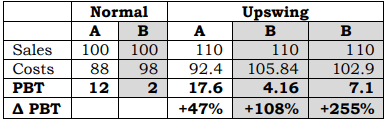
• Upswing favours companies with Low
OPM’s. Therefore, what you want to do is to
Hold relatively High OPM companies for long
term and play relatively Low OPM companies
for successful Turnarounds / cycle turns.

• The best time to get involved with Cyclicals
is when the economy is at its weakest,
earnings are at their lowest, and public
sentiment is at its bleakest. Even though
Cyclicals have rebounded in the same way 8
times since WWII, buying them in the early
stages of an economic recovery is never easy.
• Every recession brings out sceptics who
doubt that we will ever come out of it, who
predict a depression and the country going
bankrupt. If there’s any time not to own
Cyclicals, it’s in a depression. “This one is
different,” is the doomsayer’s litany, and, in
fact, every recession is different, but that
doesn’t mean it’s going to ruin us.
• Whenever there was a recession, Lynch paid
attention to them. Since he always thought
positively and assumed that the economy
will improve, he was willing to invest in
Cyclicals at their nadir. Just when it seems
it can’t get any worse, things begin to get
better. A comeback of depressed Cyclicals
with strong balance sheets is inevitable.
• Cyclicals lead the market higher at the end
of a recession – how frequently today’s
mountains turn into tomorrow’s molehills,
and, vice versa.
• Cyclicals are like blackjack: stay in the game
too long and it’s bound to take back all your
profits. Things can go from good to worse
very quickly and it’s important to get out at
the right time.
• As business goes from lousy to mediocre,
investors in Cyclicals can make money; as it
goes from mediocre to good, they can make
money; from good to excellent, they may
make a little more money, though not as
much as before. It’s when business goes
from excellent back to good that investors
begin to lose; from good to mediocre, they
lose more; and from mediocre to lousy,
they’re back where they started.
• So, you have to know where we are in the
cycle. But it’s not quite as simple as it
sounds. Investing in Cyclicals has become a
game of anticipation, making it doubly hard
to make money. Large institutions try to get
a jump on competitors by buying Cyclicals
before they’ve shown any signs of recovery.
This can lead to false starts, when stock
prices run up and then fall back with each
contradictory statistic (we’re recovering,
we’re not recovering) that is released.
• The principal danger is that you buy too
early, then get discouraged, and, sell. To
succeed, you’ve to have some way of
tracking the fundamentals of the industry
and the company. It’s perilous to invest
without the working knowledge of the
industry and its rhythms.
• Timing the cycle is only half the battle.
Other half is picking companies that will
gain Most from an upturn. If Industry pick =
Right, but Company pick = Wrong, then you
can lose money just as easily as if you were
wrong about the industry.
• If investing in a troubled industry, buy
companies with staying power. Also, wait for
signs of revival. Some troubled industries
never came back.
• If you sell at 2x, you won’t get 10x. If the
original story is intact or improving, stick
around to see what happens and you’ll be
amazed at the results.

Examples
• Auto, airlines, steel, tyres, chemicals,
aerospace & defence, non-ferrous metals,
nursing, lodging, oil & gas
• Autos: 3-4 up years, after 3-4 down years.
Worse Slump = Better Recovery. An extra
bad year brings longer and more sustainable
upside. People will eventually replace their
cars, even if put off for 1-2 years.
o Units of pent up demand – compare
Actual Sales vs Trend, ie, estimate of
how many units should’ve been sold
based on demographics, previous year
sales, age of cars on road etc.
o 1980-83 = sluggish economy + people
saving up, therefore pent up demand =
7mm. 1984-89 boom, sales exceeded
trendline by 7.8mm.
o After 4-5 years below trend, it takes
another 4-5 years above trend, before
the car market can catch upto itself. If
you didn’t know this, you might sell your
auto stocks too soon. After 1983, sales
increased from 5mm to 12.3mm and you
might sell fearing the boom was over.
But if you follow the trend, you’d know
the pent up demand was 7mm, which
wasn’t exhausted until 1988, which was
the year to sell your auto stocks, since
pent up demand from early 80’s got used
up. Even though 1989 was a good year,
units sold fell by 1mm.
o If industry had 5 good years, it means
it’s somewhere in the middle of the cycle.
Can predict upturn, not downturn.
o Chrysler EPS for 1988, ’89, ’90 & ’91
was $4.7, $11.0, $0.3 & Loss,
respectively. When your best case is
worse than everyone’s worst case, worry
that the stock is floating on fantasy.
• At one point, high yield Utilities were 10% of
Magellan’s AUM. This usually happened
when interest rates were declining and the
economy was in a splutter. Therefore, treat
Utilities as interest rate Cyclicals and time
entry and exit accordingly. Can also treat
Fannie / NBFC’s as interest rate Cyclicals
benefitting from rate cuts.
• In the Gold Rush, people selling picks and
shovels did better than the miners. During
periods when mutual funds are popular,
investing in the fund companies is more
rewarding than putting money into their
funds. When interest rates are falling, bond
& equity funds attract most cash. Money
market funds prosper when rates rise.
• In US /Europe insurance companies, the
rates go up months before earnings show
any improvement. If you buy when the rates
first begin to rise, you can make a lot of
money. It’s not uncommon for a stock to
become 2x after a rate increase and another
2x on the higher earnings that result from a
rate increase.

People Examples
• Make all their money in short bursts, then
try to budget it through long, unprofitable
stretches. Farmers, resort employees, camp
operators, writers, actors. Some may also
become Fast Growers.

PE Ratio
• Slow Growers (7-9x) < Cyclicals (7-20x) <
Fast Growers (14-20x)
• Assigning PE’s: Peak EPS (3-4x) < Decent
EPS (5-8x) < Average EPS (8-10x)
• Stock Pattern: 1990 EPS = $6.5, Price Range
= $23 - $36, PE Range = 3.6-5.5x. 1991 EPS
= $3.9, Price drops to $26. PE = 6.7x, higher
than previous year PE, that had higher EPS.
• With most stocks, a Low PE is regarded as a
good thing, but not with Cyclicals. When
Low, it’s usually a sign that they are at the
end of a prosperous interlude.
• Unwary investors hold onto their shares
since business is still good & the company
continues to show higher earnings, but this
will change soon. Smart investors sell their
shares early to avoid the rush.
• When a large crowd begins to sell, the Price
and PE drops, making a Cyclical more
attractive to the uninitiated. This can be an
expensive misconception. Soon, the economy
will falter and earnings will decline at a
breathtaking speed. As more investors head
for the exit, price will plummet. Buying
Cyclicals after years of record earnings and
when PE has hit a low point is a proven
method to lose ~50% in a short time.
• Conversely, a High PE may be good news for
a Cyclical. Often, it means that a company is
passing through the worst of the doldrums
and soon its business will improve, earnings
will exceed expectations, and investors will
start buying the stock.

2 Minute Drill
• Script revolves around business conditions,
inventories and prices.
• There’s been a 3 year slump in autos but
this year things have turned around. I know
that because car sales are up across the
board for the first time in recent memory.
GM’s new models are selling well and in the
last 18 months GM closed down 5 inefficient
plants, cut 20% labour and earnings are
about to turn higher.

Checklist
• Inventories: keep a close eye on inventory
levels, changes, and, the supply & demand
relationship.
• Competition: new entrants / added supply =
dangerous development, because they may
cut prices to capture market share.
• Know your Cyclical: if you do, then you have
an advantage in figuring things out and
timing the cycles.
• Balance Sheet: strong enough to survive the
next downturn? Can it outlast competitors?
Is capex on upgradation / expansion a cause
for concern? How much of a drag is it on
FCF? Is CF > Capex, even in bad years? Are
plant & machinery in good shape?

Portfolio Allocation %
• 10-20% Allocation

Risk/Reward
• Low Risk – High Gain; or
High Risk – Low Gain, depending on
investor adeptness at anticipating cycles.
• +10x / (80-90% loss)
• Get out of situations where Price overtakes
Fundamentals and rotate into Fundamentals
> Price

Sell When
• Understand strange rules to play game
successfully, because Cyclicals are tricky.
Sell towards the end of the cycle, but who
knows when that is? Who even knows what
cycles they’re talking about? Sometimes, the
knowledgeable vanguard sells 1 year before
any signs of decline, so price falls for no
apparent reason.
• Whatever inspired you to buy after the last
bust, will help clue you in that the latest
boom is over. If you’d enough of an edge to
buy in the first place, then you’ll notice
changes in business and price.
• Company spends on new technological
expansion, instead of cheaper expenditures
on modernizing old plants.
• Sell when something has actually gone
wrong. Rising costs, 100% utilization but
spending on capacity expansion, labour asks
for increased wages, which were cut in the
previous bust etc.
• Final product demand slows down.
Inventory builds up and the company can’t
get rid of it. If storage is full of finished
goods, you may already be late in selling.
• Falling commodity prices, Futures < Spot
Price. Oil, steel prices turn lower much
earlier than EPS impact.
• Strong competition for market share leads to
price cuts. Company tries cost cuts but can’t
compete against cheap imports.


The Peter Lynch Playbook

Twitter@mjbaldbard 7 mayur.jain1@gmail.com

Sunday, 20 August 2017

The 3 Killer Cs - Cyclical, Capital-intensive and Commoditised

"The 3 Killer Cs"

Not one but three 'killer Cs' lurk around the darkest corners of the business world. 

If any one of them grips a business, it makes life hell for the managers and profits elusive for the owners. What are they? 

The first is 'cyclical'. 


  • When a business is cyclical, it sees large and unpredictable swings in its revenues, margins, and profits. Everything that matters is all over the place. 

The second is 'capital-intensive'. 


  • Businesses afflicted by high capital-intensity require a lot to produce little. They s u  c k investors dry as they need large amounts of capital to make profits. 

The third is 'commoditised'. 


  • Companies here can do very little to prove to customers that their product or service is better than their competitor's. 

The presence of even one of these killer Cs is bad news for a business. 

Tuesday, 30 May 2017

Valuing Cyclical Companies

A cyclical company is one whose earnings demonstrate a repeating pattern of increases and decreases.

The earnings of such companies fluctuate because of large

  • changes in the prices of their products or 
  • changes in volume.


Volatile earnings introduce additional complexity into the valuation process, as historical performance must be assessed in the context of the cycle.


The share prices of companies with cyclical earnings tend to be more volatile than those of less cyclical companies.

However their discounted cash flow (DCF) valuations are much more stable.


Why are the share prices of cyclical companies more volatile?

Earnings forecasts may be the reason that the former is more volatile than the latter.

Analysts' projections of the profits of cyclical companies are not very accurate, in that they tend not to forecast the downturns and generally have positive biases.

Analysts may produce biased forecasts for these cyclical firms from fear of retaliation from the managers of the firms they analyse.


The behaviour of the managers may play a role in the cyclicality.

They tend to increase and decrease investments at the same time (i.e., exhibit herd behaviour).

Three explanations for this behaviour are:

  • cash is generally more available when prices are high,
  • it is easier to get approval from boards of directors for investments when profits are high, and 
  • executives get concerned about the possibilities of rivals growing faster than their firms.


An approach for evaluating a cyclical firm

The following steps outline one approach for evaluating a cyclical firm:

  • construct and value the normal cycle scenario using information about past cycles;
  • construct and value a new trend line scenario based on the recent performance of the company;
  • develop the economic rationale for each of the two scenarios, considering factors such as demand growth, companies entering or exiting the industry, and technology changes that will affect the balance of supply and demand; and 
  • assign probabilities to the scenarios and calculate their weighted values.


Tuesday, 7 June 2016

KESM 7.6.2016

KESM Charts


Cyclical business

PE has expanded and contracted over the years.

Revenue growth is anaemic.

PBT and EPS have grown fast recently due to margin expansions for various reasons.

Its price was below RM 1 in recent years and has climbed to 6 before dropping to present levels recently.


Best time to be enthusiastic on cyclical stocks:


1.  When their PE is the highest in the cycle

2.  When their profit margins are the lowest in the cycle.

The company has about 50 m debts but is net cash positive.

Large capital expenditure expended last year.  

ROE is improving, was a single digit and now about 12%.

Its dividend is minuscule, DPO is about 15%.

DY at its present high price of 4.90 is about 1.6%.

Wednesday, 18 September 2013

Summary of Peter Lynch’s “One up on Wall Street”

Peter Lynch ran the Fidelity Magellan between 1977 and 1990. During this time he created the most enviable US mutual fund track record by averaging returns of 29% per year. To give you an idea of the compounding effect, he would have turned $10,000 into just over $270,000 in 13 years.

General Market observations
• The advance versus decline number paint better picture then the performance
of the market than index movements.
• Do not make comparisons between current market trends and other points in
history.
• For five years after July 1st 1994, $100,000 would have turned into $341,722.
If you missed the best 30 days, would have been worth $153,792.
• "The bearish argument always sounds more intelligent"
• Superior companies succeed and mediocre companies will fail. Investors in
each will be rewarded accordingly.
• Investing in stocks is an art not a science.
• If seven out of ten stocks perform, then I am delighted, if six out of ten stocks
perform, I am thankful. Six out of ten stocks is all it takes to create an enviable
record on Wall Street.
• Stand by your stocks as long as the fundamental story of the company has not
changed.
• There was a 16 month recession between July 81 and Nov 82. This time was
the scariest in memory. Sensible professionals wondered if they should take
up hunting and fishing, because soon we'd all be living in the woods, gathering
acorns. Unemployment was 14% and inflation was 15 %. A lot people said
they were expecting this but nobody mentioned it before the fact. Then
moment of greatest pessimism, when 8 out of 10 swore we where heading
into the 1930s the stock market rebounded with a vengeance and suddenly all
was right with the world.
• No matter how we arrive at the latest financial conclusions, we always prepare
ourselves for the last thing that happened.
• The day after the market crashed on Oct 19th 1987 people started worrying
that the market was going to crash.
• The great joke is that the next time is never like the last time.
• Not long ago people were worried that oil would drop to $5 and we would have
a depression. Two years later the same people were worried that oil would
rise to $100 and we would have a depression.
• When ten people would rather talk to a dentist about plaque then to a fund
manager about stocks, then it is likely the market is about to go up.
• “The stock market doesn't exist, it is there as a reference to see of anybody is
offering to do anything foolish” - Warren Buffett
• If you rely on the market to drag your stock along, then u might as well go to
Atlantic City and bet on red or black.
• Investing without research is like playing stud poker without looking at the
cards.

Categorising stocks
When you buy into stocks you need to understand why you are buying. In doing
this, it helps to categorise the company in determining what sort of returns you
can expect. Catergorising also enforces some discipline into your investment
process and aids effective portfolio construction. Peter Lynch uses the six
categories below
Sluggards (Slow growers) – Usually large companies in mature industries
with earnings growth below or around GDP growth. Such companies are
usually held for dividend rather than significant price appreciation.
Stalwarts (Medium growth) - High quality companies such as Coca-Cola,
P&G and Colgate that can still churn out high single digit/low teens growth.
Earnings patterns are not cyclical meaning that these stocks will protect
you recession.
Fast growers – Companies whose earnings are growing at 20%+ and have
plenty of runway to attack e.g. think Google, Apple in their early days. It
doesn’t have to be a company as “sexy” as those mentioned.
Cyclicals – Companies whose fortunes are closely linked to the economic
cycle e.g. automobiles, financials, airlines.
Turn-arounds – Companies coming out of a depressed phase as a result of
change in management, strategy or corporate restructuring. Successful
turnarounds can deliver stunning returns.
Asset plays – Firm has hidden assets which are undervalued or not
recognized at all on the balance sheet or under appreciated by the market
e.g. cash, land, property, holdings in other company.
General observations about different types of stocks
• Wall Street does not look kindly on fast growers that run out of stamina and
turn into slow growers and when that happens the stock is beaten down
accordingly.

Three phases of growth:
Start-up phase: during which it works out kinks in the business model.
Rapid expansion phase: moves into new locations and markets.
Mature phase: begins to prepare for the fact there's no easy to continue to
expand.
• Each of these phases may last several years. The first phase of the riskiest
for the investor, because the success of enterprise isn't yet established.
The second phase in safest, and also where the most money is made,
because the company is going to think about duplicating it's successful
formula. The third phase is when challenges arise, because of company
runs into its limitations. Other ways must be found to increase earnings.
• You can lose more than 50 percent of your investment quickly if you buy
cyclicals in the wrong part of the cycle.
• You just have to be patient, keep up with the news and read it with dispassion.
• After it came out of bankruptcy, Penn Central had a huge tax loss to carry
forward which meant when it had to start earning money it wouldn't have to
pay taxes. It was reborn with a 50% tax advantage.
• It's impossible to say anything about the value of personal experience in
analysing companies and trends.
• Companies don't stay in the same category forever. Things change. Things
are always changing.
• It's simply impossible to find a generic formula that sensibly applies to all the
different kinds of stocks.
• Understand what you are expecting from the stock given its categorisation. Is
it the sort of stock you let run, or do you sell for a 30-50% gain.
• Ask if any idiot can run this joint, because at some point an idiot will run it.
• If you discover an opportunity early enough, you will probably get a few dollars
off its price for its dull name.
• A company that does boring things with a boring name is even better.
• High growth and hot industries attract a very smart crowd that want to get into
the business. That inevitably creates competition which means an exciting
story could quickly change.
• Try summarise the stock story in 2 minutes.
• Ask if the company is able to clone the idea.
• For companies that are meant to be depressed you will find surprises in one
out of ten of these could be a turnaround situation. So it always pays to look
beyond the headlines of depressing companies to find out if there is any thing
potentially good about the stock.

Financial analysis
• When cash is increasing relative to debt that is an improving balance sheet.
The other way around is a deteriorating balance sheet.
• When cash exceeds debt it's very favourable.
• Peter Lynch ignores short-term debt in his calculations. He assumes the
company that other assets can cover short term debt.
• With turnarounds and troubled companies, I pay special attention to debt.
Debt determines which companies survive and which will go bankrupt in a
crisis. Young companies with heavy debts are always a risk.
• Bank debt is the worst kind is due on demand.
• Commercial paper is loaned from one company to another for short periods of
time. It's due very soon and sometimes due on call. Creditors strip the
company and there is nothing left for shareholders.
• Funded debt is the best kind from a shareholders point of view. It can never be
called no matter how bleak the situation is.
• Pay attention to the debt structure as well as amount of debt when looking at
turnarounds. Work if the company has room for maneuver.
• Inventory - The closer you get to a finished product the less predictable the
resale value.
• Overvalued assets on the left of the balance sheet are especially treacherous
when there is a lot of debt on the right. Assets can easily fall in value whilst
debt is fixed.
• Keep a careful eye on inventories and think about what the value of
inventories should be. Finished goods are more likely to be subject to
markdowns then raw materials. In the car industry new cars are not prone to
severe markdowns compared to say the clothes industry.
• Looks for situations where there is high cash flow and low earnings. This may
happen because the company is depreciating a piece of old equipment which
doesn't need to be replaced in the immediate future.

The final checklist
• P/E ratio. Is it high for this particular company other similar companies in the
same industry?
• The percentage of institutional ownership. The lower the better.
• The record of earnings to date and whether the earnings are sporadic or
consistent. The only category where earnings may not be important is in the
asset play.
• Whether the company has a strong balance sheet or a weak balance sheet
and how it's rated for financial strength

When to Sell
Slow Grower
• I try sell when there's been a 30 to 50% appreciation or when the
fundamentals have deteriorated, even if the stock has declined in price.
• The company has lost market share for two consecutive years and is hiring
another advertising agency.
• No new products are being developed, spending research and development is
curtailed, and the company appears to be resting on its laurels.
Stalwart
• These are the stocks that I frequently replace for others in the category. There
is no point expecting a quick tenbagger in stalwarts and if the stock price get
above the earnings line, or if the P/E strays to far beyond on the normal range,
you might think about selling it and waiting to buy back later at a lower price or
buying something else as I do.
Cyclicals
• Extended run in upturn means a downturn could be nearing.
• One of the sell signal is inventories are building up in the company and can't
get rid of them, which means low prices and low profits down the road.
Fast grower
• If the company falls apart and the earnings shrink, and so will the P/E multiple
that investors have bid up on the stock. This is a very expensive double
whammy for the loyal shareholders.
• The main thing to watch for is the end of the second phase of rapid growth.
Turnaround
• The best time to sell a turnaround is after its turned - around. All troubles are
over and everybody knows it. The company has become the old self that was
before it fell apart: growth companies or cyclical or whatever. you have to do
reclassified stock.
Asset Play
• When the stock price has risen to the estimated value of the assets.

Silliest things people say about stocks
• If it's gone down this much already it can't go much lower
• You can always tell when a stocks hit bottom
• If it's gone this high already, how can it possibly go higher?
• It's only three dollars a share: what can I lose?
• Eventually they always come back

Things I have seen and general advice
• Most of the money I make is in the third of fourth-year that I've held the stock.
• In most cases it is better to buy the original good company at the high-priced
than it is to jump on the next “Apple or Microsoft” at a bargain price.
• Trying to predict the direction of the market over one year, or even two years,
is impossible.
• You can make serious money by compounding a series of 20 to 30% gains in
stalwarts.
• Just because the price goes up doesn't mean you are right.
• Just because the price goes down doesn't mean you're wrong.
• Stalwarts with heavy institutional ownership and lots of Wall Street covered
that outperform the market are due for arrest or a decline.
• Buying a company with mediocre prospects just because the stock is cheap is
a losing technique.
• Selling an outstanding fast-growing because the stock seems slightly
overpriced is a losing technique.
• Don't become so attached to a winner that complacency sets in and you stop
monitoring the story.
• By careful pruning and rotation based on fundamentals, you can improve your
results. If stocks are out of line with reality and better alternatives exist, sell
and switch into something else
• There is always something to worry about.
• Stick around to see what happens – as long as the original story continues
make sense, or gets better – and you'll be amazed at the result in several
years.
• One of the biggest troubles with stock-market advice is that good or bad it
sticks in your brain. You can't get it out of there, and someday, sometime, you
may find yourself reacting to it.
• I almost didn't buy La Quinta because in important insider had been selling
shares. Not buying because an insider have started selling can be as big a
mistake as selling because an outsider had stopped buying. In La Quinta's
case I ignored the nonsense, and I'm glad I did.
• You don't have to "kiss all the girls". I've missed my share of 10 baggers and
hasn't kept me from beating the market.


http://twitdoc.com/upload/funalysis/summary-of-one-up-on-wall-street-peter-lynch.pdf

Sunday, 15 April 2012

If you are investing for long term, try to avoid cyclical stocks. But, it is ok to trade these stocks.


Acknowledge its Industry Nature

Companies have its own business cycle. This especially true to cyclical stocks. Businesses like housing properties, airlines or automobiles are more susceptible to the overall economy.
When the economy is riding the bull market, customers tend to spend more on luxuries thingy like cars, housing and holidays to overseas. But when economy experience slight downturn, people are more likely to avoid spending on the luxury things. 


Just imagine, when more employees been laid off and higher cost of living (as effect of inflationary pressures), buying new homes or brand new cars are most probably the last things in their mind. Struggling their lives through the turbulence time thought them how important cash saving is. If you are investing for long term, try to avoid this type of stock. But, it is ok to trade these stocks.

Monday, 5 December 2011

Characteristics of Commodity and Cyclical companies and their Value Drivers.


Characteristics of commodity and cyclical companies

            While commodity companies can range the spectrum from food grains to precious metals and cyclical firms can be in diverse business, they do share some common factors that can affect both how we view them and the values we assign to them.
  1. The Economic/Commodity price cycle: Cyclical companies are at the mercy of the economic cycle. While it is true that good management and the right strategic and business choices can make some cyclical firms less exposed to movements in the economy, the odds are high that all cyclical companies will see revenues decrease in the face of a significant economic downturn. Unlike firms in many other businesses, commodity companies are, for the most part, price takers. In other words, even the largest oil companies have to sell their output at the prevailing market price. Not surprisingly, the revenues of commodity companies will be heavily impacted by the commodity price. In fact, as commodity companies mature and output levels off, almost all of the variance in revenues can be traced to where we are in the commodity price cycle. When commodity prices are on the upswing, all companies that produce that commodity benefit, whereas during a downturn, even the best companies in the business will see the effects on operations.
  2. Volatile earnings and cash flows: The volatility in revenues at cyclical and commodity companies will be magnified at the operating income level because these companies tend to have high operating leverage (high fixed costs). Thus, commodity companies may have to keep mines (mining), reserves (oil) and fields (agricultural) operating even during low points in price cycles, because the costs of shutting down and reopening operations can be prohibitive.
  3. Volatility in earnings flows into volatility in equity values and debt ratios: While this does not have to apply for all cyclical and commodity companies, the large infrastructure investments that are needed to get these firms started has led many of them to be significant users of debt financing. Thus, the volatility in operating income that we referenced earlier, manifests itself in even greater swing in net income.
  4. Even the healthiest firms can be put at risk if macro move is very negative: Building on the theme that cyclical and commodity companies are exposed to cyclical risk over which they have little control and that this risk can be magnified as we move down the income statement, resulting in high volatility in net income, even for the healthiest and most mature firms in the sector, it is easy to see why we have to be more concerned about distress and survival with cyclical and commodity firms than with most others. An extended economic downturn or a lengthy phase of low commodity prices can put most of these companies at risk.
  5. Finite resources: With commodity companies, there is one final shared characteristic. There is a finite quantity of natural resources on the planet; if oil prices increase, we can explore for more oil but we cannot create oil. When valuing commodity companies, this will not only play a role in what our forecasts of future commodity prices will be but may also operate as a constraint on our normal practice of assuming perpetual growth (in our terminal value computations).
In summary, then, when valuing commodity and cyclical companies, we have to grapple with the consequences of economic and commodity price cycles and how shifts in these cycles will affect revenues and earnings. We also have to come up with ways of dealing with the possibility of distress, induced not by bad management decisions or firm specific choices, but by macro economic forces.


Commodity and Cyclical companies: Value Drivers

Normalized Earnings

If we accept the proposition that normalized earnings and cash flows have a subjective component to them, we can begin to lay out procedures for estimating them for individual companies. With cyclical companies, there are usually three standard techniques that are employed for normalizing earnings and cash flows:
1.     Absolute average over time: The most common approach used to normalize numbers is to average them over time, though over what period remains in dispute. At least in theory, the averaging should occur over a period long enough to cover an entire cycle. In chapter 8, we noted that economic cycles, even in mature economies like the United States, can range from short periods (2-3 years) to very long ones (more than 10 years). The advantage of the approach is its simplicity. The disadvantage is that the use of absolute numbers over time can lead to normalized values being misestimated for any firm that changed its size over the normalization period.  In other words, using the average earnings over the last 5 years as the normalized earnings for a firm that doubled its revenues over that period will understate the true earnings.
2.     Relative average over time: A simple solution to the scaling problem is to compute averages for a scaled version of the variable over time. In effect, we can average profit margins over time, instead of net profits, and apply the average profit margin to revenues in the most recent period to estimate normalized earnings. We can employ the same tactics with capital expenditures and working capital, by looking at ratios of revenue or book capital over time, rather than the absolute values.
3.     Sector averages: In the first two approaches to normalization, we are dependent upon the company having a long history. For cyclical firms with limited history or a history of operating changes, it may make more sense to look at sector averages to normalize. Thus, we will compute operating margins for all steel companies across the cycle and use the average margin to estimate operating income for an individual steel company. The biggest advantage of the approach is that sector margins tend to be less volatile than individual company margins, but this approach will also fail to incorporate the characteristics (operating efficiencies or inefficiencies) that may lead a firm to be different from the rest of the sector.

Normalized commodity prices

            What is a normalized price for oil? Or gold? There are two ways of answering this question.
1.     One is to look at history. Commodities have a long trading history and we can use the historical price data to come up with an average, which we can then adjust for inflation. Implicitly, we are assuming that the average inflation-adjusted price over a long period of history is the best estimate of the normalized price.
2.     The other approach is more complicated. Since the price of a commodity is a function of demand and supply for that commodity, we can assess (or at least try to assess the determinants of that demand and supply) and try to come up with an intrinsic value for the commodity.
Once we have normalized the price of the commodity, we can then assess what the revenues, earnings and cashflows would have been for the company being valued at that normalized price. With revenues and earnings, this may just require multiplying the number of units sold at the normalized price and making reasonable assumptions about costs. With reinvestment and cost of financing, it will require some subjective judgments on how much (if any) the reinvestment and cost of funding numbers would have changed at the normalized price.
            Using a normalized commodity price to value a commodity company does expose us to the critique that the valuations we obtain will reflect our commodity price views as much as they do our views on the company. For instance, assume that the current oil price is $45 and that we use a normalized oil price of $100 to value an oil company. We are likely to find the company to be undervalued, simply because of our view about the normalized oil price. If we want to remove our views of commodity prices from valuations of commodity companies, the safest way to do this is to use market-based prices for the commodity in our forecasts. Since most commodities have forward and futures markets, we can use the prices for these markets to estimate cash flows in the next few years. For an oil company, then, we will use today's oil prices to estimate cash flows for the current year and the expected oil prices (from the forward and futures markets) to estimate expected cash flows in future periods. The advantage of this approach is that it comes with a built-in mechanism for hedging against commodity price risk. An investor who believes that a company is under valued but is shaky on what will happen to commodity prices in the future can buy stock in the company and sell oil price futures to protect herself against adverse price movements.


Little Book of Valuation
Aswath Damodaran