Showing posts with label market volatility. Show all posts

Saturday, 13 December 2025

Volatility of returns decreases and outcomes become more predictable as the holding period lengthens

 The Volatility of Returns by Holding Period

 (Stocks, Bonds and 60% Stocks / 40% Bonds Portfolio)


This image presents a compelling visual argument for long-term investing by showing how volatility decreases and outcomes become more predictable as the holding period lengthens.

Key Analysis & Observations:

1. The Central Message: Time Smooths Volatility

  • 1-Year Rolling Returns: Extreme variability (stocks: -29% to 43%, bonds: -20% to 30%). This represents the "noise" and emotional challenge of short-term investing.

  • 5-Year Rolling Returns: Range narrows significantly (stocks: -2% to 24%). Negative periods become less severe and less frequent.

  • 10-Year Rolling Returns: Range tightens further (stocks: 6% to 18%). No 10-year period lost money in stocks during this 75-year timeframe.

2. Asset Class Comparison

  • Stocks (S&P 500): Highest long-term return (11.6%) but with greatest short-term volatility.

  • Bonds: Lower return (5.2%) with less extreme swings, though still significant 1-year volatility.

  • 60/40 Portfolio: Excellent compromise—captures most equity upside (9.4% return) while dramatically reducing downside risk across all time horizons.

3. The Compounding Power Demonstrated

The ending portfolio values starting from $10,000 in 1950 are staggering:

  • Stocks: $895,754 (89.5x growth)

  • 60/40: $600,708 (60x growth)

  • Bonds: $276,382 (27.6x growth)

This visually reinforces why accepting stock market volatility pays off over decades.

4. Behavioral Finance Implications

The chart essentially argues against market timing:

  • In any single year, you might experience -29% returns

  • But if you wait 10 years, the worst-case was still +6% annualized

  • This explains why "time in the market beats timing the market"

Critical Commentary & Context:

Strengths of This Presentation:

  1. Effective Data Visualization: The shrinking ranges perfectly illustrate the diversification benefit of time.

  2. Historical Perspective: 1950-2024 covers multiple cycles (inflationary 70s, dot-com bubble, 2008 crisis, COVID).

  3. Practical Application: Directly shows why retirement investors should focus on decade-long horizons, not quarterly statements.

Important Caveats & Limitations:

  1. Survivorship Bias: U.S. markets were exceptionally successful post-WWII. This isn't guaranteed globally.

  2. The "End Date" Problem: 2024 is near market highs. Starting in 1929 or 2000 would show different 10-year outcomes.

  3. Interest Rate Regime: The bond bull market (falling rates from 1980-2020) boosted returns. Future bond returns may differ.

  4. Psychological Realism: While 10-year returns were always positive, experiencing 5+ years of poor returns tests investor discipline.

Portfolio Construction Insights:

  • The 60/40 portfolio shows remarkable efficiency: capturing 81% of stock returns with dramatically reduced risk.

  • For most investors, this supports classic balanced portfolio construction.

  • The data suggests rebalancing discipline during bad years would have been rewarded.

Conclusion & Takeaways:

This chart delivers a powerful, evidence-based narrative: Volatility is the price of admission for long-term growth.

For investors:

  1. Holding period dictates risk more than asset allocation alone

  2. Time horizon should match portfolio construction (money needed in <5 years shouldn't be in stocks)

  3. The 60/40 portfolio remains remarkably resilient across market conditions

  4. The biggest risk may be overreacting to short-term volatility rather than the volatility itself

The most striking visual is the transformation of stocks from "high-risk gamble" (1-year view) to "reliable wealth-builder" (10-year view)—a fundamental lesson in investment perspective.


Saturday, 22 November 2025

Volatility is not risk. Risk is the permanent loss of capital.

Volatility is not risk. Risk is the permanent loss of capital. 

When market drops 20%, that is volatility, not risk. The risk only materializes if you sell at the bottom and lock in the loss.

If you hold good companies through the volatility, you'll be fine. In fact, volatility creates opportunity for those with emotional control to buy at lower prices. Never worry about volatility.


The real risk in investing is not in volatility. 
  • It is buying a bad business at any price. 
  • It is overpaying even for a good business. 
  • It is using borrowed money that you might need to repay at the worst possible time. 
  • It is letting fear or greed make your decisions for you.


Focus on what you can control. 

What you can't control
  • You can't control whether the market goes up or down tomorrow. 
  • You can't control whether we enter a recession next year. 
  • You can't control what other investors do, but you can control several critical things. 

What you can control
  • You can control which companies you invest in.  Choose businesses you understand.  With strong competitive advantages, run by honest and capable management, selling at reasonable prices. 
  • You can control how much you pay. Never overpay, even for a great business. 
  • You can control your time horizon. Give your investments time to compound. 
  • You can control your emotions. This is the hardest and most important thing you can control. When you focus on what you can control, you worry less about what you can't. 

The market will do what it does. Your job is to make smart decisions and stick with them.


Keep a journal of your investment decisions. 

Write down why you are buying a stock, what price you are paying, what you expect the business to do over the next 5 to 10 years. Then periodically review your journal. 

This practice does several things. 
  • First, it forces you to think clearly about your decisions before making them. You can't write I am buying because everyone says it is going up. You have to articulate a real investment thesis. 
  • When you look back at your decisions, you'll see patterns. Maybe you always buy when you are feeling euphoric and the market is high. Maybe you always sell when you are scared and the market is low. Recognizing these patterns is the first step to changing them. 
  • Third, it helps you learn from both successes and failures. When an investment works out, you can look back and see what you got right. When it doesn't, you can see what you missed. Over time, you'll become a better investor by learning from your own experience.

Tuesday, 18 November 2025

Do not fear volatility; be prepared to see it as a potential opportunity.

When a highly leveraged, speculative asset like Bitcoin experiences a sharp decline, it can indeed trigger a chain reaction that spills over into the broader stock market.   This is very plausible and well-understood cascade effect, often referred to as a "liquidity crunch" or "contagion." 

Your mindset of preparation is the correct one for a seasoned investor. Instead of fearing volatility, the prepared see it as a potential opportunity to acquire high-quality assets at a discount.

Here is a structured framework and a list of hypothetical stock categories and examples that investors often have on their watchlists for a market downturn. This is for informational and educational purposes only and is not a recommendation to buy any specific security.

The Prerequisite: Your "Shopping List" Criteria

Before looking at any names, it's crucial to have a set of criteria. In a panic, emotion can take over. Your list should be your rational guide.

  1. Strong Balance Sheet: Look for companies with low debt (or manageable debt), high cash reserves, and strong free cash flow. This allows them to weather an economic storm and even gain market share.

  2. Durable Competitive Advantages (Moat): Companies with powerful brands, patents, network effects, or cost advantages that are unlikely to disappear in a recession.

  3. Proven Profitability: A history of consistent earnings, not just revenue growth. Profitability is a sign of a sustainable business model.

  4. Essential Products/Services: Businesses that sell things people need, not just want. Demand for their products is "inelastic."

  5. Attractive Valuation: Even a great company can be a bad investment if you overpay. A market downturn is the time when these companies might finally hit your target buy price.


A Hypothetical "Watchlist" for a Market Downturn

Here are categories of stocks, with well-known examples, that often fit the criteria above. This is a starting point for your own research.

Category 1: The "Defensive" Pillars

These companies are considered non-cyclical. Their businesses are relatively immune to economic cycles.

  • Consumer Staples:

    • Procter & Gamble (PG): Sells everyday essentials like Tide detergent, Pampers diapers, and Crest toothpaste.

    • Coca-Cola (KO): A globally recognized brand with a vast distribution network. People don't stop drinking beverages in a recession.

    • Walmart (WMT): Benefits from its "low-price" leader position as consumers become more price-conscious.

  • Healthcare:

    • Johnson & Johnson (JNJ): A diversified healthcare giant with pharmaceuticals, medical devices, and consumer health products. Healthcare is a necessity.

    • UnitedHealth Group (UNH): The largest health insurer in the U.S. Its services are integral to the healthcare system.

    • Pfizer (PFE): A leading pharmaceutical company with a portfolio of essential drugs and a strong pipeline.

Category 2: High-Quality Tech & Innovation (At a Reasonable Price)

A downturn could be a chance to buy into the long-term winners of the digital age that were previously too expensive.

  • Cloud & Infrastructure:

    • Microsoft (MSFT): A behemoth with diverse revenue streams (Cloud via Azure, Office, Windows, LinkedIn). Its products are deeply embedded in the global economy.

    • Amazon (AMZN): Dominant in e-commerce and cloud computing (AWS). AWS is a profit engine, and the core e-commerce business is increasingly essential.

  • Semiconductors (The "Picks and Shovels"):

    • ASML Holding (ASML): Has a virtual monopoly on the extreme ultraviolet (EUV) lithography machines needed to make the world's most advanced chips. A incredible technological moat.

    • Taiwan Semiconductor (TSM): The world's leading semiconductor foundry. They manufacture chips for Apple, NVIDIA, AMD, and many others.

Category 3: Strong Financials

A healthy financial sector is crucial for economic recovery. Focus on the best-capitalized institutions.

  • Berkshire Hathaway (BRK.B): Not a bank, but a diversified conglomerate and insurance giant run by Warren Buffett. It's famous for holding massive cash reserves to deploy exactly during market downturns. Buying BRK.B is like hiring Buffett to invest for you.

  • JPMorgan Chase (JPM): Considered one of the best-managed and most resilient large banks in the U.S.

Category 4: The "Compounders"

These are companies known for consistently growing and sharing their profits with shareholders.

  • Dividend Aristocrats: Companies that have increased their dividends for at least 25 consecutive years. This is a sign of incredible financial discipline and stability. You can find lists of these companies online (e.g., AbbVie (ABBV), Lowe's (LOW), Target (TGT)).

How to Execute Your Plan When the Time Comes

  1. Do Your Research Now: Don't wait for the crash to start learning about these companies. Understand their business models, financials, and competitors now.

  2. Set Price Alerts: Use your brokerage platform to set alert prices for the stocks on your list. This takes the emotion out of the decision.

  3. Dollar-Cost Average (DCA): In a true downturn, it's impossible to catch the absolute bottom. Consider buying in tranches (e.g., 25% of your planned position at a time) as the price falls. This averages your cost basis and reduces risk.

  4. Keep a Cash Reserve: Always maintain a strategic cash reserve. The worst feeling in a market crash is to be fully invested with no "dry powder" to buy the dip.

In summary, by preparing a watchlist based on sound fundamental criteria, you are positioning yourself not just to survive a downturn, but to potentially thrive in its aftermath by acquiring wonderful businesses at fair prices.

Sunday, 29 March 2020

THE MAJOR INDICES REMAIN MILES BELOW THEIR PRE-PANDEMIC LEVELS.


Despite an unprecedented response from global governments and central banks, the major indices remain miles below their pre-pandemic levels. 
 
While the late-session selloff on Friday wasn’t pretty, the major indices held on to most of their mid-week gains, giving hope for bulls that last week’s lows might be successfully defended.  
We saw a textbook risk-off shift on Friday, with utilities and healthcare stocks performing well and tech issues and industrials struggling together with the energy sector, but technically speaking, last week’s lows look safe, for now, which is already a huge plus for bulls.
The major indices all finished significantly lower following one of the strongest three-day rallies in history, despite the approved U.S. stimulus bill, as the global COVID-19 situation continued to deteriorate. 
The Dow Jones Industrial Average (INDEXDJX:.DJI) was down 915, or 4.1%, to 21,637, the Nasdaq (INDEXNASDAQ:.IXIC) lost 295, or 3.8%, to 7,502, while the S&P 500 (indexsp:.inx) fell by 89, or 3.4%, to 2,541. Decliners outnumbered advancing issues by a 3-to-1 ratio on the NYSE, where volume was extremely high again.


Bulls Make A Comeback

Following one of the worst week's for stocks in history, bulls staged an epic comeback this week, with the Dow gaining over 16% in three days. Despite the rally, which was fueled by an unprecedented response from global governments and central banks, the major indices remain miles below their pre-pandemic levels. 
The uncertainty regarding the length of the necessary, but economically damaging global lockdowns continues to weigh on risk assets, and equities finished the week on a negative note. Volatility will likely remain very high for several weeks, and bulls hope that we will get positive reports from Europe, and there won't be secondary outbreaks in China and South Korea.
The Fed’s unlimited QE program and emergency rate cut helped investor sentiment this week, but the economic uncertainty led to continued pressure on credit market. 
The key economic releases were mixed yet again this week, but several indicators still didn't fully reflect the effects of the pandemic. 
The week will likely be remembered because of the record number of new jobless claims, as the measure came in at 3.283 million eclipsing even the pessimistic consensus estimate of 1.5 million. 
Services PMIs hit record lows in Europe and Australia, with the U.S. Market services PMI also coming in well below expected, but the key manufacturing PMIs beat expectations, just as durable goods orders, personal income, and new home sales.

There will likely be some sharp pullbacks, but I think they should be bought.


Whitney Tilson’s email to investors

Alan Gula's Comments

5) Alan Gula, a senior analyst at Stansberry Research, shared these comments with me yesterday and gave me permission to share them:
Funny how unlimited [quantitative easing] and a stimulus package equivalent to 10% of GDP (CASH CANNON) cause stocks to rise.
I agree with your assessment. There will likely be some sharp pullbacks, but I think they should be bought.
The credit markets remain open... 18 investment-grade issuers priced $35 billion across 33 tranches [on Thursday]. NVDA, HD, TGT, ED, CSX, MS, and CVS all issued bonds. Pessimists will say that these companies are just rushing to issue while they can. But I think the issuance is positive considering that we didn't see this in late 2008.
Total U.S. corporate bond issuance was only around $80 billion in the entire fourth quarter of 2008. There was more investment-grade issuance than that this week.
And if investment-grade and high-yield spreads tighten, it will be bullish for equities. (I have long believed that the most important second-order effect of quantitative easing is spread tightening.)
Right now, high-yield sector spreads are all wider than 600 [basis points] (in particular, high-yield spreads in the energy sector blowing out to wider than 2,000 basis points shows devastation reminiscent of the global financial crisis).


Dissecting Volatility


POSTED BY: PROF. BRADFORD CORNELL, CORNELL CAPITAL GROUP MAR 27, 2020,
https://www.valuewalk.com/2020/03/level-of-volatility-stocks/


It is one thing to say that the market is volatile. It is quite another to appreciate fully what that really means. So let’s spend a moment to dissect the level of volatility.


The Current Level Of Volatility

The first thing to make clear is how is volatility measured. One way is to use historical data. The data necessary to estimate historical volatility is not a series of past prices, but past daily returns. The return is the percentage change in price adjusted for any payouts. Because payouts during that last couple of months have minuscule compared to price fluctuations, you can think of the return as the percentage change in price. To measure volatility, you cannot average past returns because positive and negative returns cancel each other leading to a vast underestimate of volatility. Therefore, volatility is measured by either the standard deviation of the returns, or more simply by the average of the absolute values of the returns. In most cases, the two estimates are quite similar.

By these measures, how volatile has the aggregate value of all U.S. publicly traded stocks been over the last three weeks? The average daily absolute price change comes to about 6.5% (with some negative and some positive). This level of volatility means that every day you can expect the market to move 6.5%. To appreciate how astonishing this is it is helpful to keep two observations in mind. First, remember that the value of the aggregate stock market is the present value of the cash flows to equity owners expected to be produced by all listed companies in all future years.

Second, that present value is a big number. At the end of 2019, the data base maintained by the Center for Research in Securities Prices calculates it to be $41.14 trillion. Of course, it has declined since then by an amount that depends on the day you do the calculation, but to keep things easy let’s use $35 trillion.


How To Measure Volatility

Based on that number, the current level of volatility implies that every day the market value of publicly traded American business can be expected to change by about $2.25 trillion. It takes a moment for that number to sink in. On average, based on whatever information comes in that day, the market is revaluing total equity by $2.25 trillion – and it is doing it day after day. While one may think that on a day or two, in response to major news, a move of this magnitude might be warranted, to have it occur day after day, often without the arrival of much in the way of value relevant new information is remarkable.

All that said, there is one factor, news about which may be driving the market up and down and that is the term of the lockdown associated with the virus. In a previous post, The Market and the Virus: Deconstructing the Drop, I calculated that the impact of the virus should be less than 10%. Ironically, if we use January 1, 2020 as the starting point, we are getting back to that level after the run-up of the last three days. The good news is that this interpretation implies that the market should sustain this level, but the offsetting bad news is that no further increase would be warranted. Of course, all of this depends on the assumptions used in modeling the duration of the virus-related economic shutdown, a number which, like the market, changes daily.


VIX Index Has Risen 5x

It is also possible to calculate forward looking measures of volatility. By far the best known is the VIX index which calculates the volatility implied by the prices of options on the S&P 500 index. Between the beginning of the year and the close on Thursday, the VIX index has risen by a factor of about five times. Options on individual stocks have seen their implied volatilities rise by similar factors. For those who employ hedging strategies using options, as we do at Cornell Capital, the pickings were slim prior to the virus crisis because volatility, and therefore option premia, were near historic lows. Needless to say that has changed dramatically. Option premia are at levels last seen at the height of the 2008 financial crisis.


In closing, it may seem that investing based on fundamental valuation is fruitless during times when the large daily price changes seem to have little relation to changes in value, but the reverse is true. Given the unpredictability of the massive short-term price movements, attempting to play a pricing game is ill advised. The best an investor can do is take positions based on his or her fundamental valuations and maintain sufficient reserves to ride out the bumps in both direction that are highly likely to occur. Those bumps can be softened by careful use of options, particularly in light of the current high option premia.


Thursday, 16 January 2020

Stay in Touch with the Market: Opportunities and Dangers

Some investors buy and hold for the long term, stashing their securities in the proverbial vault for years. While such a strategy may have made sense at some time in the past, it seems misguided today. This is because the financial markets are prolific creators of investment opportunities. 

  • Investors who are out of touch with the markets will find it difficult to be in touch with buying and selling opportunities regularly created by the markets. 
  • Today with so many market participants having little or no fundamental knowledge of the businesses their investments represent, opportunities to buy and sell seem to present themselves at a rapid pace. 
  • Given the geopolitical and macroeconomic uncertainties we face in the early 1990s and are likely to continue to face in the future, why would abstaining from trading be better than periodically reviewing one's holdings? 


Being in touch with the market does pose dangers, however.
  • Investors can become obsessed, for example, with every market uptick and downtick and eventually succumb to short-term-oriented trading. 
  • There is a tendency to be swayed by recent market action, going with the herd rather than against it. 
  • Investors unable to resist such impulses should probably not stay in close touch with the market; they would be well advised to turn their investable assets over to a financial professionaL 


Another hazard of proximity to the market is exposure to stockbrokers.

  • Brokers can be a source of market information, trading ideas, and even useful investment research. 
  • Many, however, are in business primarily for the next trade. 
  • Investors may choose to listen to the advice of brokers but should certainly confirm everything that they say. 
  • Never base a portfolio decision solely on a broker's advice, and always feel free to say no.

Sunday, 12 January 2020

The Relevance of Temporary Price Fluctuations (unrelated to Underlying Value)

Permanent loss versus Interim Price Fluctuations

In addition to the probability of permanent loss attached to an investment, there is also the possibility of interim price fluctuations that are unrelated to underlying value. (Beta fails to distinguish between the two.)

Many investors consider price fluctuations to be a significant risk: if the price goes down, the investment is seen as risky regardless of the fundamentals.


But are temporary price fluctuations really a risk? 

Not in the way that permanent value impairments are and then only for certain investors in specific situations. 

It is, of course, not always easy for investors to distinguish temporary price volatility, related to the short-term forces of supply and demand, from price movements related to business fundamentals. The reality may only become apparent after the fact.

While investors should obviously try to avoid overpaying for investments or buying into businesses that subsequently decline in value due to deteriorating results, it is not possible to avoid random short-term market volatility. 

Indeed, investors should expect prices to fluctuate and should not invest in securities if they cannot tolerate some volatility. 


If you are buying sound value at a discount, do short-term price fluctuations matter? 

In the long run they do not matter much; value will ultimately be reflected in the price of a security.

Indeed, ironically, the long-term investment implication of price fluctuations is in the opposite direction from the near-term market impact. 

For example, short-term price declines actually enhance the returns of long-term investors.' 


Near-term price fluctuations matter to certain investors

There are, however, several eventualities in which near-term price fluctuations do matter to investors.

1.   Security holders who need to sell in a hurry are at the mercy of market prices.
  • The trick of successful investors is to sell when they want to, not when they have to.
  • Investors who may need to sell should not own marketable securities other than U.S. Treasury bills.

2.   Near-term security prices also matter to investors in a troubled company. 
  • If a business must raise additional capital in the near term to survive, investors in its securities may have their fate determined, at least in part, by the prevailing market price of the company's stock and bonds. (This effect, known as reflexivity.)


3.  Volatility is the friend of the long term value investor.
  • The third reason long-term-oriented investors are interested in short-term price fluctuations is that Mr. Market can create very attractive opportunities to buy and sell. 


Monday, 13 August 2018

Volatility and Leverage: A vicious circle?

Where leverage is involved, a small loss is magnified into a big one.

That bigger loss creates considerable indigestion for the losers.

They see what's happening and rush to deleverage; that is, to sell assets to reduce exposure to volatility.

That rush to the exits creates more volatility.

The cycle continues.

This deleveraging cycle goes a long way to explain the 2008 financial crisis:  the volatility that created it and that it created.

When we look at the causes and consequences of volatility, we can see how it frequently can become a self-fulfilling prophecy, particularly where leverage is involved.

Thursday, 4 May 2017

Investing has a whole new set of rules.

If we are to be successful, we need to play by these new rules.


Why the average equity fund investor underperforms the market?

From 1993 to 2012, the S&P Index 500 averaged a gain of 8.21% per year.

However, during that same 20 year period, the average equity fund investor had an average annual gain of only 4.25%.  

Had the average equity fund investor just bought a low-cost S&P 500 Index fund and held it, he/she would have almost doubled their rate of return.

The underperformance was due to investor behaviour such as market timing and chasing hot funds.

Had these investors been long-term, buy-and-hold investors, they would have earned close to the market's returns.

When the average investor underperforms the index by such a significant amount, it is clear that most are playing with a bad set of guidelines or none at all.

A one-time investment of $10,000 invested at 8% compounds to $46,610 in 20 years.

The same $10,000 invested over the same period at 4.25% compounds to only $22,989.


Short-run performance of the stock market is random, unpredictable and very volatile

The short-run performance of the stock market is random, unpredictable and for most people, nerve-racking.

The next time you hear someone saying that he/she knows how the stock market or any given stock is going to perform in the next few weeks, months, or years, you can be sure they are either lying or self-delusional.


The long-term trend of the stock market is up and its performance consistent

There is more than 200 years of U.S. stock market history and the long-term trend is up.  

Over the long term, stock market performance has been rather consistent.

During any 50-year period, it provided an average after-inflation return of between 5 and 7 percent per year.

If you invested in a well-diversified basket of stocks and left them alone, the purchasing power of your investment would have doubled roughly every 12 years.


Stocks over the long-run offer the greatest potentials return of any investment

Although long-term returns are fairly consistent, short-term returns are much volatile.  

Stocks over the long-run offer the greatest potential return of any investment, but the short-run roller-coaster rides can be a nightmare for those who don't understand the market and lack a sound investment plan to cope with it.  

The 1990s were stellar years for stocks but the 1930s were a disaster.

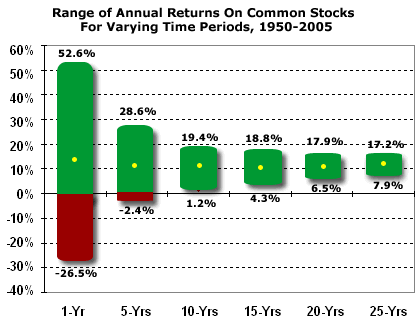
Monday, 7 March 2016

Time is your friend. Time smooths out volatility.

Historically, time smooths out volatility.

The longer you stay in the market, the more likely you are to see your investment do what it should.

The range of returns narrows when we hold our investments for a longer period of time.


Even the most volatile asset class, that is, stocks, becomes relatively stable when you take the long view.

If you have a reasonable time horizon, you have an excellent chance of high average returns over many years.
That translates into a comfortable portfolio with plenty of cushioning along the way.

What if you are approaching retirement or you are already in retirement?

How can you get the returns you want while minimizing the volatility you don't want?

The answer:  diversify.

Friday, 5 December 2014

Don't just sit there, invest!

Foolish takeaway

To be scared out of the market - or to not start investing - because of periods of market uncertainty, volatility or even steep declines, has been a very expensive mistake.

Ignore market fluctuations. Buy great companies at good prices.

It's an approach that has stood the test of time - and made small fortunes for those who follow that path.


Read more: http://www.smh.com.au/business/motley-fool/dont-just-sit-there-invest-20141128-11w2cy.html#ixzz3L1X4ccRv