Showing posts with label ringgit. Show all posts

Monday, 9 February 2026

Ringgit Strengthening impacts on importers and exporters in Malaysia: a boon for importers and consumers, and a headwind for exporters.

The statement captures the fundamental dynamics of how exchange rates affect different segments of an open economy like Malaysia's. Let's break it down, analyze, discuss, and provide commentary.

Analysis: The Core Mechanism

The relationship is driven by purchasing power:

  • For Importers: A stronger Ringgit (e.g., MYR appreciating from 4.70 to 4.40 per USD) means each Ringgit buys more US dollars. Consequently, the Ringgit cost of importing goods priced in USD (e.g., raw materials, machinery, consumer goods, oil) decreases. This directly:

    1. Lowers input costs for manufacturers reliant on imported components.

    2. Increases profit margins if selling prices remain stable.

    3. Reduces costs for consumers on imported goods, helping to curb inflation.

    4. Makes foreign debt servicing cheaper for companies/countries with USD-denominated debt.

  • For Exporters: The opposite occurs. A stronger Ringgit makes Malaysian goods and services more expensive for foreign buyers paying in USD. This can:

    1. Reduce price competitiveness in international markets compared to rivals from countries with weaker currencies.

    2. Squeeze profit margins if they choose to keep USD prices stable to retain market share, as the converted Ringgit revenue will be lower.

    3. Particularly affect key Malaysian export sectors like electronics & electrical (E&E), palm oil, liquefied natural gas (LNG), and rubber products.

Discussion: Nuances and Broader Context

The simple "importers win, exporters lose" narrative is correct but requires deeper discussion.

1. The "Net Effect" on Malaysia's Economy:
Malaysia is a highly trade-oriented nation, with exports and imports each accounting for over 60% of GDP. The net impact depends on:

  • Trade Structure: Malaysia has historically run a trade surplus (exports > imports). Therefore, a broad-based Ringgit strengthening could, in theory, hurt the aggregate economy more in the short term by dampening the larger export sector.

  • Commodity Prices: Malaysia is a major exporter of commodities like palm oil and LNG. If the Ringgit strengthens because global commodity prices are high (increasing USD inflows), the benefit to exporters from high prices may offset the currency disadvantage. The Ringgit is, in fact, often correlated with oil prices.

  • Import Content of Exports: A significant portion of Malaysian exports (especially E&E) requires imported components. Cheaper imports lower production costs for exporters, partially mitigating the negative impact of a stronger currency on their final product's price.

2. Type of Importer/Exporter Matters:

  • Hedging: Large corporations often use financial instruments to hedge against currency risk, smoothing out the impact of fluctuations.

  • Pricing Power: Exporters with unique, high-value products (e.g., specialized semiconductors) may have the pricing power to pass on costs without losing significant market share.

  • Domestic Market Focus: Companies focused on the domestic market but using imported inputs are clear beneficiaries.

3. Sources of Ringgit Strengthening:
The cause of the appreciation is crucial for a full assessment:

  • If due to strong fundamentals: (e.g., higher interest rates attracting investment, sustained trade surpluses, strong economic growth) – the positive signal might outweigh sectoral pains.

  • If due to a weak USD: (broad USD weakness against all currencies) – the competitive disadvantage for Malaysian exporters is less pronounced relative to regional competitors if their currencies are also appreciating.

  • If due to speculative capital flows: ("Hot money") – the benefits may be fleeting and introduce financial stability risks if the flows reverse suddenly.

Commentary: Policy Dilemmas and Strategic View

1. Central Bank's Balancing Act: Bank Negara Malaysia (BNM) faces a classic dilemma. A stronger Ringgit helps control imported inflation (a major concern post-pandemic and during supply chain crises) and makes essential goods/food imports cheaper for citizens. However, BNM must also be mindful of protecting export competitiveness and the manufacturing sector, which is a huge employer. Their interventions in the forex market are often aimed at preventing excessive volatility, not targeting a specific level.

2. Long-Term Strategic Shift: The debate highlights Malaysia's need to move up the value chain. Instead of competing solely on price (which is vulnerable to currency moves), developing more high-tech, knowledge-intensive exports with inelastic demand provides more resilience against currency fluctuations. The government's focus on E&E, digital economy, and aerospace aligns with this.

3. Current Context (2023-2024): The Ringgit has experienced significant pressure, weakening to multi-decade lows against the USD, driven by aggressive US Fed rate hikes and geopolitical shifts. In this environment, the call is often for Ringgit strengthening. The discussed "pain" for exporters is a secondary concern compared to the broader national benefits of:

  • Reducing the cost-of-living crisis via cheaper imports.

  • Slowing capital outflows.

  • Restoring investor confidence in the Malaysian economy.

Conclusion

The statement is fundamentally correct in its direct mechanical impact. A stronger Ringgit is a boon for importers and consumers while presenting a headwind for exporters.

However, the overall national impact is multifaceted and depends on the magnitude, cause, and persistence of the appreciation, as well as the structure of the economy. For Malaysia today, a move towards a fairly valued and stable Ringgit is likely the optimal outcome, allowing for predictable business planning. While exporters may voice concern during appreciation phases, a deliberately weak currency is a flawed long-term strategy. The ultimate goal should be building an economy so productive and competitive that it can thrive with a strong currency, translating to greater purchasing power and a higher standard of living for its people.

Friday, 24 April 2015

Future of the Ringgit

The exchange rate of the currency in which a portfolio holds the bulk of its investments determines that portfolio’s real return. A declining exchange rate obviously decreases the purchasing power of income and capital gains derived from any returns. Moreover, the exchange rate influences other income factors such as interest rates, inflation and even capital gains from domestic securities. While exchange rates are determined by numerous complex factors that often leave even the most experienced economists flummoxed, investors should still have some understanding of how currency values and exchange rates play an important role in the rate of return on their investments.

There are positive factors that still support the ringgit: decent economic growth expected for 2015, low Government external debt and a credible monetary authority that has led to relatively low inflation over the years,’’ said Zahidi.

From a yield perspective in 2015, the US dollar will continue to sustain its appeal as the Federal Reserve is preparing to normalise the prolonged ultra low interest rates, albeit in baby steps in the months ahead.

“While the ringgit is expected to stabilise once negative sentiment towards it fades, investors will be focusing on Malaysia’s medium-term growth prospects and also assess whether the ringgit will continue to provide attractive returns from both a yield and appreciation standpoint in the face of higher US interest rates, going forward.

In another report, CIMB Investment Bank did a study in March 2004 when the ringgit was still pegged to the US dollar and at that time, found the ringgit to be undervalued by around five per cent.

‘’Since then, Malaysia’s fundamentals have strengthened further. As such, I would think that the ringgit deserves a much higher value from current levels,’’ said CIMB Investment Bank director/regional economist Julia Goh.

Negative perception and sentiment can really damage the value of a currency, which would cause concern among businesses and investors.

While those businesses that receive their payment in US dollars may celebrate, the net effect may not be that great as there could be high import costs of components and raw materials.

The current depreciation of the ringgit should remain for a year. However due to low debt to GDP ratios and high saving rates the immediate effects are on exports and inflation.

For a country with a depreciated currency, exports will increase in relation to imports as exports become cheaper and imports become more expensive.

Fortunately Malaysia’s trade surplus is RM2.86 billion and it is going to increase due to currency depreciation. The depreciation of the ringgit might increase the inflation rate and raise the cost of living somewhat, but the good news is that Malaysia has been maintaining a ‘safe-side inflation level’ of below two per cent for quite some time.

The exchange rate, whether appreciating or depreciating, was not the issue but volatility of the currency which rendered conduct of business extremely difficult and affected the capital market and the banking sector when it came to mortgages and shares.


Read more: http://www.theborneopost.com/2015/04/11/impact-of-the-depreciating-ringgit/#ixzz3YDDZ7qX2

Thursday, 31 March 2011

Goldman Sachs says buy ringgit

Goldman Sachs says buy ringgit
Published: 2011/03/31

Goldman Sachs Group Inc says buy Malaysia’s ringgit against the US dollar on speculation the central bank will favor currency appreciation to help fight inflation.

The ringgit strengthened 1.3 per cent this quarter to 3.0256 versus the greenback as of 11:47 a.m. in Kuala Lumpur, according to data compiled by Bloomberg, less than one sen short of a 13- year high of 3.0210 reached on March 25. A government report that day showed consumer prices rose 2.9 per cent last month from a year earlier, the fastest pace since April 2009.

The US bank recommended buying 12-month non-deliverable forwards, betting the contracts will rise 5.8 per cent to 2.9 per dollar from today’s rate of 3.0695, according to a research note today from Goldman Sachs’ currency analysts including London- based Thomas Stolper. A stop-loss order should be placed at 3.08 to guard against losses in the trade, it said.

“Inflation in emerging markets remains one of the most important themes in foreign exchange,” the report said. “We think Bank Negara Malaysia will respond primarily by allowing the ringgit to strengthen, a stance that is also supported by strong activity growth and a large balance-of-payments surplus of about 15 per cent of gross domestic product.”

Goldman Sachs revised its forecasts for the ringgit’s spot price in three, six and 12 months to 2.98, 2.90 and 2.85. -- Bloomberg


Read more: Goldman Sachs says buy ringgit http://www.btimes.com.my/Current_News/BTIMES/articles/20110331144824/Article/index_html#ixzz1IAoDt51K


Comment:  Maybe this is the reason for the strong performance of the Bursa today.

Sunday, 26 December 2010

Strong Ringgit - Implications To Malaysia's Bond Market

April 27, 2010

The Ringgit Malaysia (RM) is one of Asia’s best performing currency,, appreciating by 7.0% year-to-date against the USD (As at 26 April 2010). In this article, we will take a look on the strong performance and its implications for investors.

INTRODUCTION
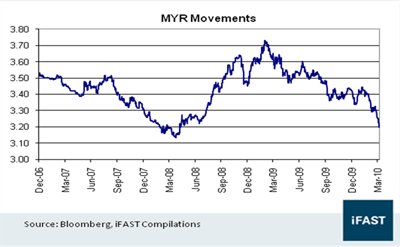
Ringgit was the best performing Asian currency. On a year-to-date basis, ringgit gained 7.0% against USD as compared to other Asian currencies. There were several reasons that we believe were likely behind ringgit’s strength. These includes a better than expected GDP growth in the fourth quarter and most importantly, Bank Negara’s unexpected move in being the first central bank in Asia to raise interest rate.

KEY POINTS


  • Ringgit was the best performing Asian currency with a 7.0% gain y-t-d
  • Better-than-expected 4Q 09 GDP growth & rate hike contributed to strong performance
  • We expect ringgit to further appreciate on speculation of Yuan appreciation
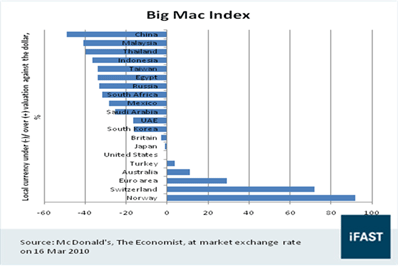
  • Big Mac Index indicates ringgit is undervalued
  • Lesser bond issuance & higher demand for ringgit-denominated bond also help to support
  • Malaysian investors should hold ringgit-denominated bonds and avoid global bonds


http://www.fundsupermart.com.my/main/research/viewHTML.tpl?articleNo=565


Ringgit expected to stay on uptrend

The ringgit is expected to stay steady next week, supported by year-end window dressing activities, dealers said.

They said more companies were now exchanging foreign currencies for the local unit to balance their year-end accounts.

"Positive economic news in the country and the region will also attract more capital inflows that will support the local currency to trade higher," a dealer said.

He also said that a weaker dollar performance has also encouraged players to unload their dollar position.

The ringgit is expected to trade above the 3.00 level against the US dollar next week.

During the week, the ringgit was firmer backed by gains in other regional currencies as well as window-dressing activities.

On Friday-to-Friday basis, the local unit was higher at 3.0930/0980 from 3.1340/1370 last week.

Against the Singapore dollar, it was firmer at 2.3783/3827 compared with 2.3862/3905 last Friday. It was also steadier against the yen at 3.7306/7384 from 3.7314/7354 previously.

The ringgit appreciated against the British pound to 4.7781/7870 compared with 4.8947/9000 last week and strengthened against the euro to 4.0636/0708 from 4.1670/1716 previously. --Bernama

Read more: Ringgit expected to stay on uptrend http://www.btimes.com.my/Current_News/BTIMES/articles/20101225094029/Article/index_html#ixzz19D2ircoa

Friday, 10 December 2010

Ringgit a favorite pick of Morgan Stanley

Ringgit a favorite pick of Morgan Stanley
Published: 2010/12/10


Malaysian ringgit and Singapore dollar are likely to outperform among Asian currencies next year, say Morgan Stanley strategists in research note.

They added that one of their top 2011 FX trade ideas is long MYR/JPY with target of Y29.0, about 8.6 per cent above current level near Y26.70.

“SGD and MYR are our favourite picks in Asia, as both are great reflation trades ... and both have hawkish central banks, strong economic fundamentals and very healthy balance of payments positions.”

Morgan Stanley economists see growth in Asia ex-Japan reaching 8.2 per cent in 2011, slowing only moderately from 9.5 per cent expected for 2010.

Another plus for MYR is potential benefits from rising commodity prices, since Malaysia is the only net commodity exporter in the region, say the strategists, who think INR, THB and IDR look overvalued and may lag in 2011 among Asian currencies.

Risks to Asian currencies include global “risk-off” events, potential for lagged policy responses to regional inflation and risk of more capital controls, they add. -- Reuters


Read more: Ringgit a favorite pick of Morgan Stanley http://www.btimes.com.my/Current_News/BTIMES/articles/20101210102032/Article/index_html#ixzz17hWyBjT4

Thursday, 11 March 2010

Stronger ringgit boosts Bursa


Thursday March 11, 2010

Stronger ringgit boosts Bursa

By IZWAN IDRIS and YVONNE TAN


PETALING JAYA: The ringgit is on a roll after Bank Negara raised interest rates last week amid mounting evidence the nation’s economic recovery is gaining traction.
And the currency strength has rubbed off on the share market, propelling the FTSE Bursa Malaysia KL Composite Index (FBM KLCI) to a fresh two-year high of 1,328.22 points at the close yesterday.
“Many thought that Indonesia or South Korea would be the first to hike interest rates but Malaysia was the one which started the ball rolling in the Asian region,” Datuk Lee Kok Kwan, deputy chief executive officer, group treasury and investments at CIMB Group, told StarBiz yesterday.
As a result, “funds are flowing back in,” he said.
The ringgit had risen 1.5% against the US dollar since March 4 to 3.321 yesterday after Bank Negara increased its key overnight policy rate (OPR) from its historic low by 25 basis points to 2.25%.
Year-to-date, the local currency had shot up 3.18% yesterday and was the best performing currency in Asia ahead of the Korean won’s 2.9% gain over the same period.
The local unit’s performance against embattled European currencies was even more impressive, up 10% against the British pound and 8.7% against the euro since the start of the year.
Royal Bank of Scotland Group Plc, in a recent report, advised investors to buy the ringgit against the won and yen on expectations of further interest rate hikes here.
Its strategist Chia Woon Khien told Bloomberg yesterday that Bank Negara “could do a few more” rate hikes. “The question is whether they want to go straight to neutral level or stay a little dovish along the way,” he said.
OSK Investment Bank Bhd director and head of treasury Yeo Chin Tiong expects rates to “gradually” rise as the economy recovers. “Our house target for the ringgit is 3.20 versus the US dollar by year-end,’’ he toldStarBiz yesterday.
Meanwhile, RAM Ratings Services Bhd in its 2010 edition of its CreditPulse report said the ringgit was expected to strengthen to 3.20-3.30 against the greenback by end-2010.
It said there would be a “gradual” currency appreciation boosted by high current account surplus, international reserves and low inflation.
The stronger outlook for the ringgit, fuelled by rising rates and improving economy, has also boosted the appeal of local assets, especially for foreign investors.
At yesterday’s close, the FBM KLCI was up 4.36% since the start of the year. But the stronger ringgit means returns calculated in US dollar terms have shot up to 8.4% over the same period.
This made the local bourse the second best performer in the region behind Indonesia’s Jakarta Composite Index which gained 9%.

Friday, 8 January 2010

Effect of possible Ringgit appreciation

By end-2010, we expect the ringgit to appreciate about 5% against the US dollar (to RM 3.24/USD). 

Beneficiaries will include:
  • aviation (MAS, Air Asia) and
  • the steel sector (Southern Steel, Kinsteel),
where there is a high proportion of USD-denominated costs.

Losers will include:
  • exporters (Evergreen Fibreboard) and
  • MISC.
Rubber glove manufacturers (Top Glove, Kossan) price their products in USD.  However, we understand glove players usually adjust prices to factor in currency movements. 

The prospect of an appreciating ringgit could further boost returns for foreign investors.


Ref:  HwangDBS Vickers Research

Sunday, 11 October 2009

Ringgit weakest in more than a year versus Aussie

Ringgit weakest in more than a year versus Aussie

Tags: Australian dollar | Azrul Azwar | Bank Islam Malaysia Bhd | Bank Negara Malaysia | Canada | New Zealand | Ringgit | Weakest level

Written by Chong Jin Hun
Thursday, 08 October 2009 11:00

KUALA LUMPUR : The ringgit traded at its weakest level against a firmer Australian dollar in more than a year yesterday, after policymakers in Australia unexpectedly raised its key interest rate to 3.25% from 3%, prompting demand for the Australian dollar.

Investors tend to park their money in countries with higher lending rates to capitalise on higher returns.

The ringgit weakened as low as 3.0619 versus the Australian dollar at 5.10am yesterday before strengthening to 3.0432 at 10.16am. A day earlier, the ringgit was traded at 3.0587 against the Australian dollar, the weakest in 14 months since August 2008, compared to the 2.2824 level seen in February this year

Economists said the surprise move by Australian lawmakers could result in similar initiatives among other commodity-based economies such as New Zealand and Canada.

“Countries that may follow suit could be other commodity-based economies, “ Bank Islam Malaysia Bhd senior economist Azrul Azwar told The Edge Financial Daily yesterday.

In Malaysia, while commodities like palm oil, and oil and gas, constitute a crucial component of the nation’s economy, Azrul said the country should not be regarded as a commodity-based entity.

Meanwhile, an improving economic climate in Malaysia is expected to see a stronger a ringgit versus a weakening US dollar.

Azrul said as recovery in the broader landscape was still tentative, a rapid appreciation of the ringgit might have a negative impact on the nation’s export competitiveness. However, a stronger ringgit could be one of the contributing factors in containing imported inflation.

“With increasing signs of improving economic conditions in Malaysia, and expectation of a resumption of positive GDP (gross domestic product) growth by the fourth quarter of 2009, the way forward for the ringgit is to strengthen.
“I think it is prudent to let market forces dictate the level of the ringgit but at the same time we should exercise an orderly and gradual strengthening of the ringgit,” he said.

Bank Negara Malaysia had pegged the ringgit at 3.80 against the US dollar on Sept 2, 1998 during the Asian financial crisis then. The fixed-exchange rate policy was scrapped on July 21, 2005, and replaced by a managed-float system which allows the central bank to monitor the ringgit’s value against a basket of currencies.

An interest rate hike in the US would trigger a sharp rebound in the US dollar. In its latest “Standard Chartered Global Focus” report, the bank said it did not foresee US policymakers initiating a rate hike throughout 2010.

“We think this is unlikely. We also believe that the US and the UK will continue to run wide fiscal deficits through 2010 — far larger as a share of GDP than those in the EM (emerging-market) economies. This, combined with ultra-loose monetary policy, may put continued negative pressure on both currencies,” Standard Chartered said.


This article appeared in The Edge Financial Daily, October 8, 2009.