Showing posts with label topglove. Show all posts

Saturday, 20 December 2025

Growth stocks as a class has a striking tendency toward wide swings in market price (II)

Growth stocks as a class has a striking tendency toward wide swings in market price (II)

https://myinvestingnotes.blogspot.com/2010/02/growth-stocks-as-class-has-striking.html


The striking thing about growth stocks as a class is their tendency toward wide swings in market price. But is it not true, that the really big fortunes from common stocks have been garnered by those who made a substantial commitment in the early years of a company in whose future they had great confidence and who held their original shares unwaveringly while they increased 10-fold or 100-fold or more in value? The answer is "Yes." But the big fortunes from single company investments are almost always realised by persons who have a close relationship with the particular company - through employment, family connection, etc. - which justifies them in placing a large part of their resources in one medium and holding on to this commitment through all vicissitudes, despite numerous temptations to sell out at apparently high prices along the way. An investor without such close personal contact will constantly be faced with the question of whether too large a portion of his funds are in this one medium. Each decline - however temporary it proves in the sequel - will accentuate his problem; and internal and external pressures are likely to force him to take what seems to be a good profit.


Based on the provided text, here is a summary:

The passage makes a key distinction between two types of successful growth stock investing:

  1. The Reality of Growth Stocks: As a category, growth stocks are inherently volatile and prone to wide price swings.

  2. The Source of "Big Fortunes": Truly large fortunes from single-company investments are almost exclusively made by insiders (e.g., employees, founders, family) who:

    • Have an intimate, justified confidence in the company.

    • Can commit a large portion of their wealth to it.

    • Hold their shares unwaveringly through all market fluctuations and temptations to sell.

  3. The Challenge for the Outside Investor: An investor without this close personal connection faces significant psychological and practical pressures:

    • They will constantly worry about having too much concentrated in one risky asset.

    • Every price decline, even a temporary one, will intensify this doubt.

    • These pressures will likely force them to sell for a "good profit" long before the stock achieves its maximum, multi-fold growth potential.

In essence: While holding a single growth stock through immense volatility is how vast fortunes are built, this strategy is sustainable practically only for insiders. The typical outside investor is psychologically and rationally compelled to diversify and sell early, missing the largest gains.


Summary

In conclusion, the provided text highlights the core paradox of growth investing:

  • As a class, growth stocks are characterized by high volatility ("wide swings in market price") due to their dependence on uncertain future prospects.

  • However, the only way to capture the legendary, life-changing returns from the stock market is to identify specific companies from within this volatile class, invest meaningfully in them early, and possess the rare combination of foresight and fortitude to hold them through extreme market fluctuations until they multiply in value many times over.

The critical takeaway is that the second path, while true and proven by historical examples, is far more difficult, risky, and rare than the romantic narrative suggests. It is the exception, not the rule. For every investor who achieves a 100-bagger return, countless others see their early-stage "conviction" bets evaporate. Therefore, while the strategy of buying and holding growth stocks is a valid path to extreme wealth, it should be pursued with a clear understanding of the immense risks, the powerful role of luck, and the psychological challenges involved. For most, a diversified approach that acknowledges the "striking tendency" of growth stocks to be volatile may be a more prudent long-term strategy.


=====

There is a fundamental tension in growth investing. While the only proven way to achieve extraordinary wealth from stocks is to make a concentrated, early bet on a specific high-growth company and hold it through extreme volatility, this path is exceptionally rare and risky.

It emphasizes that for every legendary success, there are many failures. Therefore, while valid, this high-stakes strategy requires acknowledging immense risk, luck, and psychological fortitude. For most investors, a diversified approach is a more prudent and realistic alternative to chasing outsized returns from volatile growth stocks.


Saturday, 17 December 2022

Topglove

Fiscal year is February-January. All values MYR Millions.
2022 2021 2020 2019 2018
5-year trend 

INCOME STATEMENT 
Sales/Revenue 5,572 16,361 7,237 4,801 4,221 
Gross Income 953 11,102 2,850 884 842 
SG&A Expense 612 1,153 604 402 308 
EBIT 341 9,949 2,248 482 - 
Interest Expense 4 4 34 80 37 
 Pretax Income 362 10,031 2,167 424 523 


CASH FLOW STATEMENT
 Net Income before Extraordinaries 358 10,034 2,166 424 523 
Net Operating Cash Flow 153 7,837 3,454 537 353 
 Capital Expenditures (954) (1,335) (816) (624) (459) 
 Free Cash Flow (800) 6,502 2,638 (31) (106) 

 Cash Dividends Paid - Total (529) (5,474) (372) (217) (196) 
Net Financing Cash Flow (690) (6,851) (17) (35) 1,281 


BALANCE SHEET
 Cash & Short Term Investments 951 2,508 2,883 253 359 
ST Debt & Current Portion LT Debt 309 318 316 1,041 883 
Long-Term Debt 1,284 1,459 1,531 1,379 1,330 

 Total Current Assets 2,111 4,346 4,288 1,539 1,607 
Total Current Liabilities 996 2,198 2,133 1,592 1,452 

 Total Equity 5,618 5,925 4,896 2,554 2,398
 Liabilities & Shareholders' Equity 8,117 9,782 8,706 5,688 5,297


Average Growth Rates 
Top Glove Corp. Bhd 
Past Five Years Ending 01/01/0001 (Fiscal Year) 
Revenue +6.44%
 Net Income -9.61%
 Earnings Per Share -10.04% 
Capital Spending +21.53%
 Gross Margin +36.35%
 Cash Flow +133.03% 


 KEY STOCK DATA 
P/E Ratio (TTM) N/A 
EPS (TTM) RM-0.01 
Market Cap RM5.89 B 
Shares Outstanding 8.21 B 
Public Float 4.57 B 
Yield 1.66%(12/16/22) 
Latest Dividend RM0.252000004(04/06/21) 
Ex-Dividend Date 03/23/21

Wednesday, 15 July 2020

Glove stocks uniform trading pattern sparks intrigue


Justin Lim
theedgemarkets.com

July 15, 2020


KUALA LUMPUR (July 15): All seven glove stocks on Bursa Malaysia took a nail-biting roller-coaster ride together during the final trading hours yesterday.

The seven counters plummeted simultaneously shortly after 4pm, but rebounded soon after, right before the closing bell. Share price charts show a uniform V-shape pattern among the rubber glove makers (see charts), whose share prices have rocketed at least several folds since March.


What was intriguing was that there was no negative news flow about the rubber glove industry that could possibly have swung the share prices in such a drastic and uniform fashion.

The sudden plunge among the seven glove stocks during the final trading hours was in the range of 15% to 25%. The big drop on Top Glove Corp Bhd and Supermax Corp Bhd dragged the FBM KLCI down by 1.8% to its intraday low of 1,577.33 before it bounced back to above 1,600-level to close at 1,598.75 points, down 7.68 points.

Investment analysts were baffled by the share price trend.

Some experts suspected that algorithmic trading activities could be at play. Algorithmic trading is a method of executing orders using automated pre-programmed trading instructions that account for variables such as time, price, and volume.

Malacca Securities Sdn Bhd head of research Loui Low did not rule out the possibility that algorithmic trading activities could be involved.

Another possibility, he believed, could be that the glove counters had triggered the stop limit for various investors and brokers.

MIDF Research senior analyst Imran Yassin Md Yusof, meanwhile, commented that investors had started to take profits following the strong share price rallies.

Top Glove, Supermax and Hartalega Holdings Bhd shares all settled in the negative territory yesterday, after closing at their record highs on Monday.

Supermax experienced the steepest drop with a 25.2% plunge to a low of RM12.52. It closed at RM15.90.

Similarly, Top Glove sank 15.4% to its intraday low of RM20.50, but bounced back to close at RM23.16. Hartalega sank 15.02% to a low of RM15.28, but later pared most of its losses to finish at RM17; Kossan Rubber Industries Bhd slid 14.2% to RM12, before closing at RM13.50.

Comfort Gloves Bhd's share price also tumbled 19.2% to RM3.33, before settling at RM3.84. Careplus Group Bhd fell 21.7% to RM1.48, then rebounded to close at RM1.76, while Rubberex Corp (M) Bhd dropped nearly 18% to RM3.22, to eventually settle at RM3.65.


https://www.theedgemarkets.com/article/glove-stocks-uniform-trading-pattern-sparks-intrigue

Tuesday, 14 July 2020

The glove put warrants poser


Lai Ying Yi 
 theedgemarkets.com 

 July 14, 2020 KUALA LUMPUR 

(July 13): It is undeniably a bull market for the glove makers currently. 

However, an interesting trend has also emerged in the local market on Monday — an equally frenzied buying of two newly-listed structural put warrants on Top Glove Corp Bhd (Top Glove-HA) and Supermax Corp Bhd (Supermax-HB). 

The strong interest in the derivatives that hedge against a fall in share prices of Top Glove and Supermax has made many in the investing fraternity perplexed. 

The prices of the two derivatives, a bear market tool, rocketed over 200%.

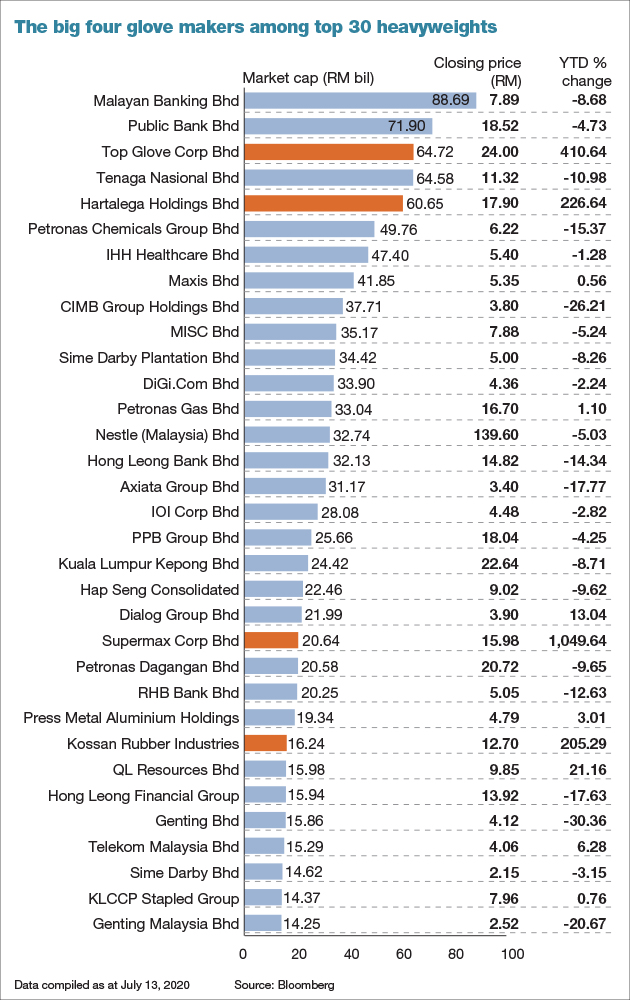
Top Glove-HA soared by 207% and Supermax-HB by 291%, on the day when the two underlying stocks climbed to their all-time highs. Supermax saw its biggest ever share price leap of RM2.36 to RM15.98. Top Glove’s share price gained RM2.08 or 9.5% to RM24. 

The large trading volumes recorded were another evidence of the strong interest in the two derivatives. TOPGLOV-HA was the most traded securities on Bursa on Monday, with 613.47 million units having changed hands, while Supermax-HB was the third most traded counter with 567.9 million units done. 

In a nutshell, put warrants grant holders the right to sell the underlying shares at a specified price (exercise price) within a limited period of time (maturity). Structured put warrants are hedging tools. Investors tend to use structured put warrants to hedge against any big drop in the underlying share prices. 

Some market observers commented that the surge in interest in the two put warrants, which made their debut just two weeks ago, could be attributed to the increasing number of glove bears in the market, although the bulls still swarm the market in general. 

“No one could deny that the downside risk on those glove counters are heightening, as their share prices are trading at such hefty premiums. Such put warrants would allow investors to hedge their long position on the underlying shares,” said a market observer. 

Even so, the spike in the prices of the two put warrants has been astonishing, to say the least. Given that the premium of the two derivatives are near 100% based on the closing price on Monday, the hedging tools themselves have also become highly risky. 

Based on the exercise price and conversion ratio, the put warrants are pricing the mother shares at RM2 for Top Glove and 30 sen for Supermax. 

“Investors will only make money if the underlying mother share drops below these two levels (assuming the investors hold onto the derivatives until the expiry dates). Is that possible?” explained a warrant specialist. 

 Nonetheless, structured warrants are a trading instrument so investors are unlikely to hold onto the derivatives until expiry date. In this case, the warrant holders who bought in earlier would have made handsome gains after the price rally on Monday, if they locked in their profits.


Thursday, 5 March 2020

Analysts see rubber glove stocks bouncing off

TheEdge Thu, Mar 05, 2020


KUALA LUMPUR: The Covid-19 epidemic has pushed investors into stocks of rubber glovemakers, which have seen an uptick in demand.

The Healthcare Index climbed 13.77 points or 1.03% to close at 1,344.72 yesterday, with the Big Four rubber glove players dominating the list of most active counters on Bursa Malaysia.

Among the most active stocks was Careplus Group Bhd, which saw 62.9 million shares change hands. The stock closed up 12.73% at 31 sen with a market capitalisation (cap) of RM165 million.

Shares in Adventa Bhd gained 10.77% to settle at 72 sen, bringing a market cap of RM110 million.

Supermax Corp Bhd rose 5.59% to end the day at RM1.70, while Hartalega Holdings Bhd and Kossan Rubber Industries Bhd were up 3.48% and 1.46% to close at RM6.24 and RM4.85 respectively. Top Glove Corp Bhd shares were unchanged at RM5.70.

Analysts said the stage is now set for a solid growth in the rubber gloves sector in 2020 following three quarters of anaemic quarterly earnings growth.

“From a low base due to the lacklustre demand of the past 12 months, the sector will benefit from restocking activities, ramping up demand as the current outbreak of Covid-19 enforces higher hygiene standards,” Kenanga Research analyst Raymond Choo Ping Khoon said in a sector report on Feb 7.

He noted that even before the Covid-19 crisis set in, the third quarter of 2019 (3Q19) results season had indicated a positive recovery in demand and hence, volume growth of industry leaders such as Top Glove and Hartalega. Both players recorded 6% and 14% sequential volume growth, respectively.

“From our ground checks, demand for nitrile gloves is picking up again with players’ new capacities swiftly taken up. We believe this uptick in demand is turning positive and should be reflected in players’ bottom line in subsequent quarters.

“For illustration purposes, going forward, assuming nitrile:latex [ratio] of 80:20 (currently 67:37) and based on estimated global demand of 308 billion pieces in 2020 (forecast for 2019 is 300 billion pieces and assuming an 8% growth rate in 2020), this implies nitrile growth rate of 30% or an additional 51 billion pieces from switching to nitrile gloves,” he added. Kenanga Research has an “overweight” rating on the sector.

Affin Hwang Investment Bank said earnings growth for rubber glovemakers declined slightly in the just-ended 4Q19 as some of the manufacturers were still feeling the negative impact from the labour shortage issue.

“However, most of them have started to deliver stronger quarter-on-quarter earnings growth due to stronger demand from the US, as buying patterns have started to normalise since the tariff hike in China gloves in 3Q19. We believe that as most manufacturers are already operating at high utilisation rates, the recent surge in demand due to Covid-19 would provide them more flexibility in setting selling prices,” it said in a strategy note on Tuesday.

On Jan 24, Malaysian Rubber Glove Manufacturers Association president Denis Low announced that its members are prepared to gear up to produce more gloves to meet the requirements if the Covid-19 outbreak becomes pandemic.

At press time, the number of confirmed cases of Covid-19 totalled 93,500, with at a death toll of at least 3,204 people worldwide.

Confirmed cases have also been ballooning in other parts of the world, including in advanced and developing economies such as South Korea, Italy and Iran. Malaysia reported 14 new cases yesterday, bringing its tally to 50.

According to Bloomberg data, most of the glove counters are still trading below analysts’ consensus target price (see table), except for Hartalega. At yesterday’s closing of RM6.24, the stock is trading above its average target price of RM6.15.

Those currently trading below the analysts’ consensus target prices are Comfort Gloves Bhd (21%), Kossan (15%), Supermax (14%) and Top Glove (5%).


https://www.klsescreener.com/v2/news/view/647178/analysts-see-rubber-glove-stocks-bouncing-off


ADVENTA    0.715
AFFIN           1.770
BURSA         5.480
CAREPLS     0.305
COMFORT   0.875
HARTA         6.220
KENANGA   0.440
KOSSAN      4.940
SUPERMX   1.720
TOPGLOV    5.720

Wednesday, 14 June 2017

Top Glove

Top Glove’s revenue to be firmer in third quarter

KUCHING: Top Glove Corporation Bhd’s (Top Glove) third quarter of financial year 2017 (3QFY17) revenue is expected by analysts to be firmer year on year (y-o-y) while earnings is to range from RM80 to RM85 million.
Affin Hwang Investment Bank Bhd (AffinHwang Research) expected 3QFY17 revenue to be firmer y-o-y on higher ASP revisions, as the research firm saw competition abating and industry supply-demand dynamics being more balanced, leading to better pricing management.
“Volume growth should stay relatively tepid, as there was no significant capacity addition in the quarter,” it said.
Recent ringgit appreciation is a potential headwind, but AffinHwang Research noted the stronger ASP increase should offset the currency impact.
For 4QFY17, the research firm expected progressively higher topline with the consolidation of two small factories TopGlove acquired recently and the commissioning of a new factory (annual capacity of three billion gloves) in June 2017.
As for 3QFY17 earnings, AffinHwang Research expected it to range from RM80 million to RM85 million, which would imply 28 to 36 per cent y-o-y earnings growth.
“Sequential earnings growth momentum may moderate, largely due to the lack of additional capacity and the higher raw material prices,” it said.
That said, the research firm noted that raw-material prices have been trending lower due to the end of the wintering season and moderating China automotive sales in May 2017, which should be positive for progressive earnings growth in 4QFY17E.
The research firm also expected firmer margins ahead on higher automation, as well as an improving product mix and increased efficiency.
Despite moderating raw-material prices, the year to date (YTD) average price of RM7.04 per kilogram (kg) for natural rubber was still above Affin Hwang’s previous assumption of RM5 to RM5.50 per kg.
Hence, AffinHwang research lowered its FY17-19E earnings per share (EPS) by two to 16 per cent after lifting its raw-material assumptions to RM6 to RM6.50 per kg.
That said, the research firm maintained its strong earnings outlook for Top Glove (EPS growth of 28 per cent y-o-y in FY18E) driven by capacity expansion and a higher nitrile contribution.
“Top Glove remains our top sector pick for its growing nitrile mix, strong volume expansion and relatively compelling valuation,” the research firm said.
Despite the cuts to the research firm’s earnings, Affin Hwang raised its 12-month target price to RM6.50 per share, from RM5.80 per share previously.
http://www.theborneopost.com/2017/06/10/top-gloves-revenue-to-be-firmer-in-third-quarter/

Wednesday, 12 October 2016

Top Glove achieved another record performance despite intense competition

PRESS RELEASE
Top Glove CorporationBhd


TOP GLOVE MARKS ANOTHER RECORD YEAR

Group achieves historical highs in Revenue and Profit

Shah Alam, Wednesday, 12 October 2016 – Top Glove Corporation Bhd (“Top Glove”) today announced its results for the Fourth Quarter (“4QFY16”) and full year ended 31 August 2016 (“FY2016”), marking yet another record year, with historical highs in both full year Revenue and Profit.

Posting another outstanding performance for the financial year 2016, the Group attained its highest Revenue ever of RM2.9 billion, an increase of 15.1% over FY2015. Meanwhile Profit Before Tax and Profit After Tax each also registered record highs, at RM442.6 million and RM362.8 million,
respectively representing an upturn of 21.8% and 29%. Volume (quantity sold) was also at an all-time high, notwithstanding intensifying competition and pricing pressure.

The robust set of numbers was attributed to several improvement initiatives which have proven instrumental in enhancing quality and cost efficiency, the twin pillars of Top Glove’s time-tested success formula. A stronger USD, as well as lower raw material prices earlier in the financial year, also boosted the Group’s performance.

For 4QFY16, the Group achieved Revenue of RM722.1 million and Net Profit of RM65.8 million, delivering growth of 7.4% and 4.8% respectively, compared with 3QFY16, notwithstanding intensive competition and cost increases stemming from hikes in minimum wage, as well as the natural gas tariff.

On a year-on-year comparison, 4QFY16 results were relatively softer, with a marginal increase in Revenue of 1.8%, while Profit After Tax declined by 36.2%. The less favourable comparison came on the back of a challenging environment in 2HFY16, as tailwinds from 1HFY16 gradually turned to
headwinds. Increased competition in the second half of the financial year also led to a downward revision of the average selling price, while volatility in raw material prices and forex created a mismatch in the cost pass-through system.

On Top Glove’s performance, its Executive Chairman, Tan Sri Dr Lim Wee Chai remarked, “We have done well in FY2016. Amidst a challenging business environment with substantial cost increases and intense competition, we have achieved another record performance and our best year yet!” “This is a credit to the internal quality and efficiency enhancements we have been implementing continually, as well as our management team and staff, who have worked hard to ensure we deliver a performance worthy of the Top Glove name” he added.

Top Glove which celebrates its 25th anniversary this year, remains on expansion mode. The Group completed the expansion of Factory 27 (Lukut) in August 2016 while the expansion of Factory 6 (Thailand) is expected to be completed by November 2016. Meanwhile, in progress is the construction of a new facility, Factory 30 (Klang), expected to commence production by April 2017, by which time Top Glove will have a total of 540 production lines and a production capacity of 52.4 billion pieces of gloves per annum. With a view to expanding its production capacity, the Group also recently acquired a factory in Klang (Factory 31). The facility is estimated to be able to produce 6 billion pieces of gloves per annum, with Phase 1 targeted to be operational by mid-2017. Top Glove will continue to pursue M&A opportunities that synergise with its current business, both in similar or related industries.

On 28 June 2016, the Group successfully completed its secondary listing on the Mainboard of the Singapore Exchange, an exercise undertaken to add and create value for its shareholders and stakeholders.

Honouring its commitment to enhance shareholder value, the Board of Directors has proposed a final dividend of 8.5 sen, bringing the total FY2016 dividend payout to 14.5 sen, subject to shareholders' approval at the upcoming AGM in January 2017. This represents a 26% increase in dividend per share compared with the previous financial year and a dividend payout ratio of 50.3%.

As at 31 August 2016, the Group also maintained a healthy balance sheet and a positive net cash position of RM303.7 million.

Top Glove foresees a competitive business landscape ahead, with the likelihood of oversupply and eventually, industry consolidation taking place. However, the Group is confident of overcoming any challenges that may arise by enhancing its cost management and optimising the efficiency of its production lines. The Group views the potential consolidation as an M&A opportunity.

Notwithstanding its commendable results, Tan Sri Dr Lim asserts, “We do not take our achievement for granted. Continuous improvement in quality and efficiency is our duty and an ongoing journey for us. This will ensure we stay healthy and competitive for another 25 years and beyond”.


http://www.financialreport.biz/File/2016/10/12/7113%20-%201308477838029.pdf

Monday, 30 September 2013

Rubber gloves sector downgraded to neutral

Rubber medical gloves being produced at Latexx Partners plant in Kamunting Industrial Estate.

PETALING JAYA: Maybank Investment Bank Research has downgraded the rubber gloves sector from “overweight” to “neutral” as the valuations of the stocks are fairly reflective of fundamentals now.
Analyst Lee Yen Ling said price-to-earnings (PER) valuations had risen from eight to 16 times end-2012 to 11 to 19 times currently.
“Though new supply (for nitrile gloves) looks aggressive, near-term price competition is likely to be mild, for new capacity will just about match demand, we believe, with the latter expanding by about 20% year-on-year,” she said.
Demand for nitrile glove sales were also driven by a shift in customer preference from latex powder-free to nitrile gloves, she said, adding that margins for nitrile gloves remained higher compared with latex gloves by more than 6 percentage points as a result of higher pricing and lower raw material cost.
Lee pointed out that glove manufacturers usually did not gain or lose significantly on foreign exchange volatility as most of them bought forward contracts which expired in two to three months to sell US dollars when they delivered the products as a way to hedge their US-denominated receivables.
She added that the recent fuel price hike, which led to higher transportation costs for the companies, had insignificant impact on them as transportation accounted for only 2% to 3% of total costs, thus they were not adjusting glove prices.
The research house’s top pick was Kossan Rubber Industries Bhd on the back of its better value proposition compared with its peers.
She has given a higher target price of RM7.60 to the counter as she revised Kossan’s PER upwards to 16 times from 15 times.
Meanwhile, she maintained a “hold” rating on Hartalega Holdings Bhd with the same target price of RM6.71 whereas the target price for Top Glove Corp Bhd was re-rated downwards to RM6.40 with a downgraded “hold” call as weaker latex powder-free glove sales were factored in.

Thursday, 11 October 2012

Topglove (11.10.2012)

Dividends % chg
Curr. FY0 16.00 45.5%
Prev FY1 11.00 -31.3%
Prev FY2 16.00
Curr. DY  3.05%
Risk vs Returns
Upside 1.64 62%
Downside 1.00 38%
Returns
One Yr Apprec Pot.  7%
Avg Yield  4%
Avg Tot. Ann Return 12%
(for next 5 years)
INPUT VARIABLES
Today's Share Pr $ 5.25
EPS GR % 8%
Avg H. PE 15.0
Avg. L. PE 12.0
Rec. Severe Low Pr 4.06
Current PE 16.06
Signature PE 13.50
RV 119%
Rational Price 4.41
Dividends
Present Dividend 16.00
Avg % DPO 49%
Present Div Yield 3.05%
Present High Yield 3.94%
EPS G. RATE 8%
Present Market Pr. 5.25

ZONING
Present Market Price of  5.25 is in the  Middle 1/3 Range


Mid-Price           = 5.63
Upper 1/3           = 6.16          to 7.20 (Sell) 
Middle 1/3           = 5.11          to 6.16 (Maybe)
Lower 1/3           = 4.06          to 5.11 (Buy)


Rec. qRev 607229 q-q % chg 1% y-y% chq 12%
Rec qPbt 67121 q-q % chg 5% y-y% chq 92%
Rec. qEps 10.27 q-q % chg 18% y-y% chq 143%
ttm-Eps 32.69 q-q % chg 23% y-y% chq 79%


Stock Performance Chart for Top Glove Corporation Berhad


Disclaimer:  These data are for my own use.  It is not a recommendation. Please do your own due diligence.

Wednesday, 26 September 2012

Hartalega versus Top Glove

Comparing Hartalega and Top Glove performance over 2 years from 2009 to 2011

Hartalega Period (Yrs) 2
Mar-09 Mar-11 Change CAGR
millions millions
Equity 254.2 494.44 94.51% 39.47%
LT Assets 246.4 348.86 41.58% 18.99%
Current Assets 128.36 286 122.81% 49.27%
LT Liabilities 67.5 61.29 -9.20% -4.71%
Current Liabilities 52.76 78.78 49.32% 22.20%
Sales 443.2 734.92 65.82% 28.77%
Earnings 84.51 190.3 125.18% 50.06%
Interest expense 2.43 2.47 1.65% 0.82%
D/E 0.23 0.08
ROA 22.55% 29.98%
ROE  33.25% 38.49%
Market cap 1512.26 2908.38 92.32% 38.68%
P/E 17.89 15.28
Earnings Yield 5.59% 6.54%
P/BV 5.95 5.88
DPO ratio (historical) 30.37%
Dividend Yield range High Low
4.60% 2.60%
Capital changes  -
Top Glove Period (Yrs) 2
Aug-09 Aug-11 Change CAGR
millions millions
Equity 824.51 1121.8 36.06% 16.64%
LT Assets 620.91 816.11 31.44% 14.65%
Current Assets 511.5 593.69 16.07% 7.74%
LT Liabilities 42.37 47.24 11.49% 5.59%
Current Liabilities 244.06 216.18 -11.42% -5.88%
Sales 1529.08 2053.92 34.32% 15.90%
Earnings 169.13 113.09 -33.13% -18.23%
Interest expense 8.53 0.24 -97.19% -83.23%
D/E 0.02 0
ROA 14.94% 8.02%
ROE  20.51% 10.08%
Market cap 2118.81 2672.54 26.13% 12.31%
P/E 12.53 23.63
Earnings Yield 7.98% 4.23%
P/BV 2.57 2.38
DPO ratio (historical) 42.08%
Dividend Yield range High Low
3.60% 2.00%
Capital changes  -


Stock Performance Chart for Hartalega Holdings Bhd

Stock Performance Chart for Top Glove Corporation Berhad

Thursday, 30 August 2012

Top Glove - Return on Retained Earnings

Top Glove

(Figures are in sens)

Year DPS EPS Retained EPS
2002 0.6 3.5 2.9
2003 1.8 4.9 3.1
2004 2.4 7.6 5.2
2005 2.7 11 8.3
2006 3 14.6 11.6
2007 4.6 17.3 12.7
2008 5.5 18.7 13.2
2009 11 28.5 17.5
2010 16 42.4 26.4
2011 11 19.4 8.4
Total 58.6 167.9 109.3
2002-2011
DPO 35%
EPS increase (sen) 15.9
Return on retained earnings  15%


Friday, 22 June 2012

Investor's Checklist: Consumer Goods


Find companies that enjoy the cost advantages of manufacturing on a larger scale than most other competitors.  One related issue is whether the firm holds dominant market share in its categories.

Look for the firms that consistently launch successful new products - all the better if the firm is first to market with these innovations.

Check to see if the company is supporting its brand with consistent advertising.  If the firm constantly promotes its products with sale prices, it's depleting brand equity and just milking the brand for shorter-term gain.

Examine how well the firm is handling operating costs.  Occasional restructuring can help squeeze out efficiency gains and lower costs, but if the firm is regularly incurring restructuring costs and relying solely on this cost-cutting tactic to boost its business, tread carefully.

Because these mature firms generate so much free cash flow, it's important to make sure management is using it wisely.  How much of the cash is turned over to shareholders in the form of dividends or share repurchase agreements?

Keep in mind that investors may bid up a consumer goods stock during economic downturns, making the shares pricey relative to its fair value.  Look for buying opportunities when shares trade with a 20 percent to 30 percent margin of safety.  


Ref:  The Five Rules for Successful Stock Investing by Pat Dorsey


Read also:
Investor's Checklist: A Guided Tour of the Market...