Showing posts with label META. Show all posts

Friday, 5 June 2026

A summary and discussion of Meta’s income statements

A summary and discussion of Meta’s five‑year annual income statements (2021–2025) and the latest five quarterly statements (Q1 2025 – Q1 2026).

---

### Five‑Year Annual Summary (2021–2025)


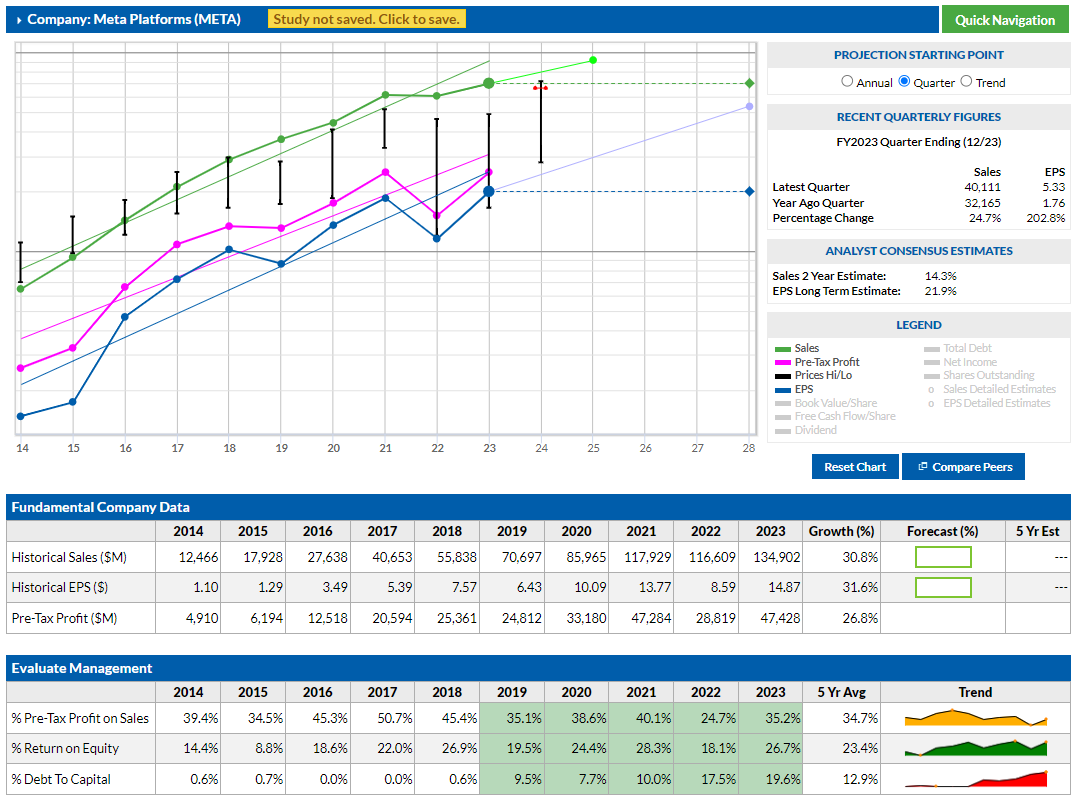
Over the past five years, Meta has delivered strong top‑line growth with revenue rising from $117.9 billion in 2021 to $200.9 billion in 2025, representing a compound annual growth rate of approximately 14%. After a slight revenue decline of 1.1% in 2022, growth re‑accelerated to 15.7% in 2023, 21.9% in 2024, and 22.2% in 2025, indicating a robust recovery driven by stronger advertising demand and improved monetization. Gross profit margin improved steadily from around 80% in 2021 to 82% in 2025, reflecting efficient cost of goods sold management. However, operating expenses – particularly research and development – grew dramatically; R&D spending more than doubled from $24.7 billion to $57.4 billion over the five years, as Meta invested heavily in artificial intelligence, data center infrastructure, and the metaverse. Selling, general and administrative expenses also increased but at a more moderate pace. Earnings before interest and taxes (EBIT) grew from $46.8 billion in 2021 to $83.3 billion in 2025, though 2022 was a weak year due to $4.6 billion in unusual expenses. Net income showed volatility: it fell to $23.2 billion in 2022, rebounded to $39.1 billion in 2023 and $62.4 billion in 2024, then declined slightly to $60.5 billion in 2025 – a 3% drop despite the 22% revenue increase. This anomaly is almost entirely explained by a surge in income tax expense to $25.5 billion in 2025 from $8.3 billion in 2024, driven by a large deferred domestic tax charge of $18.8 billion, which appears to be a non‑cash, one‑time item. Consequently, diluted earnings per share followed a similar pattern: $13.77 in 2021, $8.59 in 2022, $14.87 in 2023, $23.86 in 2024, and $23.49 in 2025. Depreciation and amortization expense more than doubled over the period, reaching $18.6 billion in 2025, consistent with Meta’s heavy capital expenditure on servers and facilities. Overall, the annual data show a company with powerful revenue momentum and stable gross margins, but with reported net income increasingly distorted by tax accounting and high investment spending.


### Latest Five Quarters (Q1 2025 – Q1 2026)


The quarterly data provide a more granular view of Meta’s recent performance and reveal significant volatility in net income driven almost entirely by tax items. Revenue grew sequentially from $42.3 billion in Q1 2025 to $59.9 billion in Q4 2025, a typical seasonal pattern with a strong holiday quarter, then declined 6% to $56.3 billion in Q1 2026 – though on a year‑over‑year basis Q1 2026 revenue was 33% higher than Q1 2025, indicating continued robust growth. Gross margin remained consistently around 82% throughout the five quarters. Operating earnings before interest, taxes, depreciation, and amortization (EBITDA) showed steady improvement, rising from $21.5 billion in Q1 2025 to $30.2 billion in Q4 2025, then easing slightly to $28.9 billion in Q1 2026 in line with the seasonal revenue dip. However, reported net income was highly erratic: Q1 2025 net income was $16.6 billion, Q2 2025 $18.3 billion, Q3 2025 plunged to just $2.7 billion, Q4 2025 rebounded to $22.8 billion, and Q1 2026 surged to $26.8 billion. The Q3 2025 collapse was not due to operational weakness – revenue was $51.2 billion and EBITDA was $25.5 billion – but rather an enormous income tax expense of $19.0 billion, likely a one‑time deferred tax charge or settlement. Conversely, Q1 2026 net income received a tax benefit of negative $5.0 billion, artificially boosting the bottom line. Interest expense grew from $240 million in Q1 2025 to $562 million in Q1 2026, reflecting higher debt or interest rates, and an unusual expense of $1.4 billion appeared in Q1 2026, possibly for restructuring or legal matters. In summary, the quarterly statements confirm that Meta’s core operations remain exceptionally healthy – revenue growth is accelerating, EBITDA is strong and stable, and gross margins are best‑in‑class – but reported net income has become a misleading metric due to large, non‑recurring tax adjustments. Investors and analysts are better served by focusing on revenue, EBITDA, and free cash flow to assess the underlying business momentum.

Thursday, 6 November 2025

The Magnificent 7 Stocks (10 years Revenues and Net Earnings records)

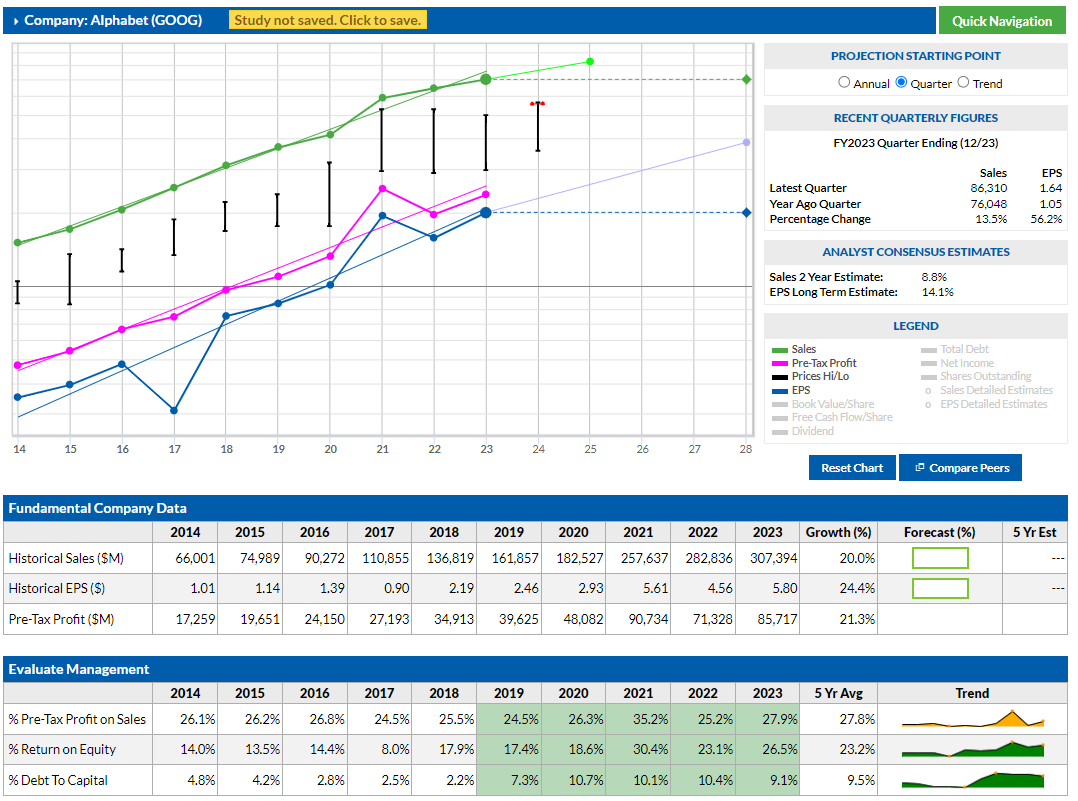
 The "Magnificent Seven" are the leading, prominent tech companies in the world: Apple, Alphabet, Amazon (NASDAQ: AMZN), Meta Platforms, Microsoft, Nvidia, and Tesla. How these stocks perform typically dictates how well the overall market does.

Meta's Revenue and Net Earnings (2015 - 2025)

Here is a detailed breakdown of Meta Platforms, Inc.'s revenues and net earnings for the calendar years 2015 to 2025, followed by a summary of the Compound Annual Growth Rate (CAGR).


**Important Note:** Meta's fiscal year aligns with the calendar year (ending December 31). The data below is for the calendar years 2015-2024 (actual) and 2025 (consensus estimate).


---


### **Meta's Revenue and Net Earnings (2015 - 2025)**


All figures are in USD millions. Data for 2015-2024 is sourced from Meta's official annual reports (10-K filings). **Data for 2025 is based on the current consensus analyst estimates.**


| Calendar Year | Revenue ($ millions) | Net Earnings ($ millions) |

| :------------ | :------------------- | :------------------------- |

| **2015**      | $17,928              | $3,688                     |

| **2016**      | $27,638              | $10,217                    |

| **2017**      | $40,653              | $15,934                    |

| **2018**      | $55,838              | $22,112                    |

| **2019**      | $70,697              | $18,485                    |

| **2020**      | $85,965              | $29,146                    |

| **2021**      | $117,929             | $39,370                    |

| **2022**      | $116,609             | $23,200                    |

| **2023**      | $134,902             | $39,098                    |

| **2024**      | $153,344             | $49,816                    |

| **2025 (Est.)**| ~$172,500            | ~$58,500                   |


**Key Context for the Data:**

*   **2015-2018: The Mobile Advertising Juggernaut.** This period represents the massive, uninterrupted scaling of Meta's core business as it perfected mobile news feed advertising on Facebook and Instagram. Revenue and profits grew at a staggering rate.

*   **2019: The Year of Investment.** A significant increase in costs related to safety, security, and building out new platforms (like Reality Labs) led to a dip in net earnings despite strong revenue growth.

*   **2020-2021: The Pandemic Acceleration.** The shift to online activity during lockdowns provided a huge tailwind for digital advertising, leading to record revenue and profits in 2021.

*   **2022: The Perfect Storm.** Meta experienced its first-ever annual revenue decline due to a combination of factors: Apple's iOS privacy changes (ATT), macroeconomic headwinds hurting ad budgets, and increased competition (notably TikTok). Soaring expenses, particularly in Reality Labs, caused profits to plummet. This was a pivotal "year of efficiency."

*   **2023-2025 (Est.): The Efficiency Era & AI Rebound.** Under Mark Zuckerberg's "Year of Efficiency," Meta conducted major layoffs and streamlined operations. This, combined with a recovering ad market and powerful new AI-driven advertising tools, led to a dramatic rebound in profitability. The focus is now on profitable growth, with the core Family of Apps subsidizing the long-term bet on the metaverse (Reality Labs).


---


### **Summary of CAGR (2015 to 2025)**


The Compound Annual Growth Rate (CAGR) measures the mean annual growth rate over a specified period.


**Period:** From the end of **2015** to the end of **estimated 2025** (a 10-year period).


*   **Revenue CAGR (2015 to 2025 Est.):**

    *   Starting Value (2015): $17,928 million

    *   Ending Value (2025 Est.): ~$172,500 million

    *   Number of Years: 10

    *   **CAGR = ~25.4%**


*   **Net Earnings CAGR (2015 to 2025 Est.):**

    *   Starting Value (2015): $3,688 million

    *   Ending Value (2025 Est.): ~$58,500 million

    *   Number of Years: 10

    *   **CAGR = ~32.0%**


### **Conclusion**


Over the ten-year period from 2015 to the projected 2025, Meta Platforms has delivered one of the most impressive financial performances in the history of the stock market, despite a significant mid-period reset.


*   The **Revenue CAGR of approximately 25.4%** demonstrates an extraordinary ability to scale its advertising business from a dominant position on desktop to an even more dominant one on mobile, continuously finding new ways to monetize its vast user base.

*   The even higher **Net Earnings CAGR of ~32.0%** highlights the immense operating leverage of its business model. After a period of heavy investment and external pressures in 2022, the company's sharp focus on cost discipline and efficiency has allowed profit growth to outpace revenue growth over the full decade. This underscores the incredibly high margins of its core social media advertising empire.


This journey showcases Meta's resilience and its capacity to navigate profound shifts—from mobile and privacy changes to the rise of AI—while maintaining a trajectory of exceptional wealth creation for shareholders.


***Disclaimer:*** *This information is for illustrative purposes only. Data for 2015-2024 is historical. Data for 2025 are analyst estimates and are not guaranteed. This is not financial advice. Investing in the stock market involves risk, including the possible loss of principal.*

Friday, 26 April 2024

The Magnificent Seven stocks: Apple, Microsoft, Google parent Alphabet, Amazon, Nvidia, Meta Platforms and Tesla

 Dubbed the Magnificent Seven stocks, Apple, Microsoft, Google parent Alphabet, Amazon, Nvidia, Meta Platforms and Tesla lived up to their name in 2023 with big gains. But the early part of the second quarter of 2024 showed a big divergence of returns.