
Wednesday, 24 August 2011


Strategies and finance for all stages of the business life cycle
 |
 |

The business life cycle theory is very much alive and kicking. Most of us are well aware of the failure rate of starts-ups. Around the world, the statistics tell the same story – 50 per cent of privately owned businesses fail in the first year and 95 per within the first five years.
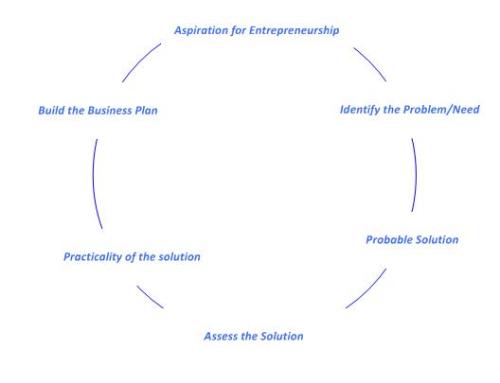
While a certain amount of attrition is inevitable, it is important to understand the life cycle of a business and where strategy and finance can have the greatest impact.
What life cycle are we talking about - business, industry or product? Well they all typically follow a pattern: start-up stage, growth, maturity and then decline. And all are important. The business life cycle tracks how a business starts, grows and eventually declines. Clearly, the start-up stage is a high-risk time and the causes for business failure can vary from a lack of capital, poor management or because it was just not a good business idea from the beginning.
What are less understood are the reasons why later on in its life a business plateaus out, and stagnation occurs, with the result that the rates of growth experienced earlier in the cycle become unsustainable. Most evidence around this problem points to an implicit change in the objectives of the shareholder/owner/manager as they become stale and lose focus. Rather than being the driving force behind the business, the owner/manager becomes a handbrake, forgetting or simply unaware that continuous value innovation, monitoring and improvement lead to growth and success.
Just like people, a business needs rejuvenation from time to time and this is typically achieved through a change of the CEO, a merger, a take-over or an insolvency event that can cut away the dead wood.


So how do strategy and finance change over the different stages of the business life cycle?

A moment’s reflection on the table above shows that it is important to understand where we are in the business life cycle, as it determines what strategy we should follow. In addition, our reaction to a particular KPI can differ greatly depending on the life cycle stage of the business.


The industry life cycle follows the way aggregated businesses within an industry trend over time. There are no rules for defining an industry, but it is typically classified through one of the stages of the overall value chain, or the nature of the products the business sells.
For example, a grape producer growing grapes for wine is simultaneously in the wine industry and the primary production industry. So the grape producer would need to observe what is happening with trends and issues in the manufacture, distribution, retailing and consumption of wine, in addition to the trends and issues impacting on primary producers.
While all industries do follow a life cycle, some move through it quicker than others. Agriculture as an industry is certainly changing. If one were to study the history of agriculture, human beings only started to trade when they had agricultural surpluses. Leap ahead to today and a return on investment is very difficult to achieve without the ability to mass produce. That’s the reason the ‘family farm’ is no longer a viable model and why agribusiness is now controlled by large corporate organizations. The change in the business model of a primary producer has shifted enormously as the industry has moved through its life cycle.

Further observation as described in the table above shows it is important to understand where we are in the industry life cycle as it determines what strategy we should follow. Also our reaction to a particular Return on Investment KPI differs greatly depending on our stage in the cycle.


The product life cycle is somewhat different – it is certainly shorter than the other two, and can take a terminal turn at very short notice (i.e. the product can drop out of favor with consumers very quickly).
The interesting thing about product life cycles is that typically there is a lot of activity that happens before the product is released to the market, i.e. research, concept development, design, testing, manufacture and launch. In many respects this is the invisible part of the product life cycle – the more visible part is the product launch, early penetration, early adoption, mature and then decline.

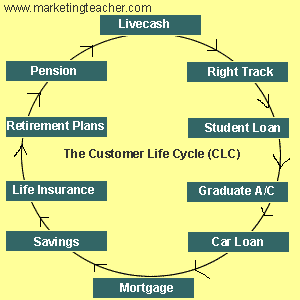
Importantly, all businesses, irrespective of whether they are smaller single businesses or business units within a large corporation, can learn a great deal from studying the life cycle theory. Having distinguished what stage your business is at, industry and product life cycles can help you to determine your strategic focus, and provide a greater understanding of some of the trends your financial KPIs reveal.


Tuesday, 23 August 2011
Economic Cycle versus Stock Market Cycle

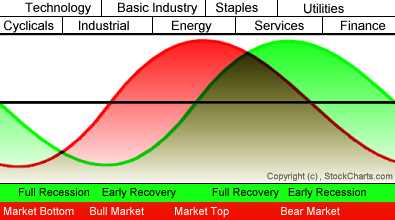
Sam Stovall's Sector Investing, 1996  states that different sectors are stronger at different points along the business cycle. The table below describes this theoretical model throughout the business cycle.
states that different sectors are stronger at different points along the business cycle. The table below describes this theoretical model throughout the business cycle.Stage: Consumer Expectations: Industrial Production: Interest Rates: Yield Curve: | Full Recession Reviving Bottoming Out Falling Normal | Early Recovery Rising Rising Bottoming Out Normal (Steep) | Full Recovery Declining Flat Rising Rapidly (Fed) Flattening Out | Early Recession Falling Sharply Falling Peaking Flat/Inverted |
The graph below, courtesy of StockCharts.com , shows these relationships and the order the key sectors respond to the economic cycle. The Stock Market Cycle precedes the Economic Cycle as investors try to anticipate how the market will react to the changes to the economy.




Life Cycle of a Growth Stock (BBB)
What's Beyond for Bed Bath and Beyond?
| ||||||


Turnaround and Restructuring
Turnaround and Restructuring
Zobrazit stránku: ČeskyCompanies often exhibit the symptoms of financial distress well before a crisis erupts. In many cases, a downward spiral is not inevitable. It can be arrested and reversed. Early detection and swift, decisive action are the keys to restoring performance and value. That is why timely and expert advice is critical.
Our turnaround and restructuring practice provides advisory and insolvency services to lenders, creditors, companies and individuals who are experiencing a wide range of difficulties, from weakening performance and reduced operating profit, to crisis marked by severe cash flow problems and the imminent threat of insolvency. 
We are able to rapidly identify problem areas, develop value-preserving and unique solutions, and then implement them swiftly and precisely. PwC is the world's largest provider of business recovery and insolvency services.
The Prague turnaround and restructuring team has many years of experience in major restructuring projects in the Czech Republic. We have provided our services to leading companies in the steel industry, the glass and porcelain industry, and the chemical industry. We focus on implementation with the aim of helping our client rather than on producing theoretical reports on different issues. This gives us depth and breadth that are unmatched in the market place.
Subscribe to:
Posts (Atom)