Sunday, 25 December 2011

What do you need to beat the market? Higher mathematical expectancy


What do you need to beat the market?  


You need to pick stocks of companies that have a higher mathematical expectancy than that of the market, example, the S&P 500. 

Of course, this could come in many forms, for example:
- a higher earnings yield (low PE), 
better growth prospects (high EPS growth rate), 
higher certainty in the company’s future prospects (good quality business and management), or 
- a cheaper stock price in relation to the business’s underlying assets (undervalued stock).  

There it is: simple math – no algebra, fancy spreadsheets, or Greek letters.

Do the math!

What do you need to beat the market?  


You need to pick stocks of companies that have a higher mathematical expectancy than that of the S&P 500. 

Of course, this could come in many forms, for example:
- a higher earnings yield, 
- better growth prospects, 
- higher certainty in the company’s future prospects, or 
- a cheaper stock price in relation to the business’s underlying assets.

To determine a stock’s mathematical expectancy, you need to do the math.  

For example, if you buy a stock that sells for a P/E of 30 and that you project to grow at 12% per year – something very few companies can do – for the next 10 years, what will your return be if it sells at a market-average multiple of 15 in year 10? It turns out that your return would only be about 4.5% – hardly mouthwatering! Moreover, you would have given yourself little or no margin of safety.


Buffett shared his SIMPLE MATHS on valuation..

When he spoke at Columbia in 2010, Tom Russo explained how Buffett thought about Internet valuations during the tech bubble of the late 90′s. At the shareholder meeting, a questioner pressed Buffet on why he was not buying tech stocks such as Cisco. At the time, Cisco was earning about $1 billion annually and had a market cap of approximately $500 billion. 


- Buffett started out by saying that the same $500 billion – Buffett often thinks in terms of buying the entire company – would earn $30 billion if invested in 10-year treasuries. 
- Moreover, Buffett had some doubts whether the $1 billion in earnings was solid, given such items as options. 
- So after year one, if you invested in Cisco, you would be in the hole for $29 billion in earnings
- Take the analysis out two years and the earnings deficit would become much bigger still. 
-  Buffett doubted a person investing on these terms would ever catch up with the earnings forfeited by not simply buying treasuries.

There it is: simple math – no algebra, fancy spreadsheets, or Greek letters.


Next time you are looking at an investment, do the math. 
-  In fact, do the math on all your current holdings, if you have not already done so. 
-  Use common sense
-  Make reasonable assumptions. 
-  Consider what would happen if things do not go well. 
-  Build in a margin of safety.

It is not complicated, yet many do not have the discipline to do the basic blocking and tackling that makes all the difference. Resolve today to always “do the math”.


Patience - a fundamental investment discipline to have a lot of.

What does it take to beat the market?
-   Be a focused value investor:
-  Concentrates your capital in stocks of good businesses with strong management. 
-  Be PATIENT enough to buy them at attractive prices and then hold on as they appreciate.


PRICE BEHAVIOUR in individual stocks:
-   10% of the time they’re cheap enough to buy, 
-  10% of the time they’re expensive enough to sell, and 
-  the rest of the time you should just hold them if you own them and avoid them if you don’t.”


PATIENCE is fundamental to that objective of beating the market.  
-  All the great investors agree on this point.   
-  However, most investors do not possess enough of it.

Buffett talks about investors inability to do nothing and just sit still. In distilling the essence of his investing discipline, he sings the praise of “lethargy, bordering on sloth.”

Why not double or triple your investment discipline?

(even if it cannot be measured with anything approaching precision) 
-  Resolve to wait for the S&P 500 to be off by at least 20% before making a purchase. 
-  Or insist that a stock be on the new low list before loading up. 
-  Or wait for those magical times when the yield on normalized current earnings exceeds 15%
-  Or wait until your relatives or friends are asking if it would not be prudent to get completely out of the stock market, or – notwithstanding your esteem for the wisdom of the Mr. Market parable – you cannot help feeling a little queasy about your own equity holdings.

However you get there, limit your buying to the 10% of the time when stocks are really cheap. 


Otherwise, just sit still and prepare.


Reference:
Google: Steve Leonard, Pacifica’s website.

'Operating Cash Flow Ratio' is sometimes a better indication of liquidity.


Definition of 'Operating Cash Flow Ratio'

A measure of how well current liabilities are covered by the cash flow generated from a company's operations.

Formula:
Operating Cash Flow Ratio
Investopedia Says

Investopedia explains 'Operating Cash Flow Ratio'

The operating cash flow ratio can gauge a company's liquidity in the short term. Using cash flow as opposed to income is sometimes a better indication of liquidity simply because, as we know, cash is how bills are normally paid off.


Read more: http://www.investopedia.com/terms/o/ocfratio.asp#ixzz1hW4WvJ9t

The Essentials Of Corporate Cash Flow (3)

Digging Deeper into Cash Flow
All companies provide cash flow statements as part of their financial statements, but cash flow (net change in cash and equivalents) can also be calculated as net income plus depreciation and other non-cash items.

Generally, a company's principal industry of operation determine what is considered proper cash flow levels; comparing a company's cash flow against its industry peers is a good way to gauge the health of its cash flow situation. A company not generating the same amount of cash as competitors is bound to lose out when times get rough.

Even a company that is shown to be profitable according to accounting standards can go under if there isn't enough cash on hand to pay bills. Comparing amount of cash generated to outstanding debt, known as the operating cash flow ratio, illustrates the company's ability to service its loans and interest payments. If a slight drop in a company's quarterly cash flow would jeopardize its loan payments, that company carries more risk than a company with stronger cash flow levels.


Unlike reported earnings, cash flow allows little room for manipulation. Every company filing reports with the Securities and Exchange Commission (SEC) is required to include a cash flow statement with its quarterly and annual reports. Unless tainted by outright fraud, this statement tells the whole story of cash flow: either the company has cash or it doesn't.


What Cash Flow Doesn't Tell Us
Cash is one of the major lubricants of business activity, but there are certain things that cash flow doesn't shed light on. For example, as we explained above, it doesn't tell us the profit earned or lost during a particular period: profitability is composed also of things that are not cash based. This is true even for numbers on the cash flow statement like "cash increase from sales minus expenses", which may sound like they are indication of profit but are not.

As it doesn't tell the whole profitability story, cash flow doesn't do a very good job of indicating the overall financial well-being of the company. Sure, the statement of cash flow indicates what the company is doing with its cash and where cash is being generated, but these do not reflect the company's entire financial condition. The cash flow statement does not account for liabilities and assets, which are recorded on the balance sheet. Furthermore accounts receivable and accounts payable, each of which can be very large for a company, are also not reflected in the cash flow statement.

In other words, the cash flow statement is a compressed version of the company's checkbook that includes a few other items that affect cash, like the financing section, which shows how much the company spent or collected from the repurchase or sale of stock, the amount of issuance or retirement of debt and the amount the company paid out in dividends.

The Bottom Line
Like so much in the world of finance, the cash flow statement is not straightforward. You must understand the extent to which a company relies on the capital markets and the extent to which it relies on the cash it has itself generated. No matter how profitable a company may be, if it doesn't have the cash to pay its bills, it will be in serious trouble.

At the same time, while investing in a company that shows positive cash flow is desirable, there are also opportunities in companies that aren't yet cash-flow positive. The cash flow statement is simply a piece of the puzzle. So, analyzing it together with the other statements can give you a more overall look at a company' financial health. Remain diligent in your analysis of a company's cash flow statement and you will be well on your way to removing the risk of one of your stocks falling victim to a cash flow crunch.

by Investopedia Staff
Investopedia.com believes that individuals can excel at managing their financial affairs. As such, we strive to provide free educational content and tools to empower individual investors, including thousands of original and objective articles and tutorials on a wide variety of financial topics.


Read more: http://www.investopedia.com/articles/01/110701.asp#ixzz1hW0PDzMV

The Essentials Of Corporate Cash Flow (2)

What Is the Cash Flow Statement?
There are three important parts of a company's financial statements: the balance sheet, the income statement and the cash flow statement. The balance sheet gives a one-time snapshot of a company's assets and liabilities (see Reading the Balance Sheet). And the income statement indicates the business's profitability during a certain period (see Understanding The Income Statement).

The cash flow statement differs from these other financial statements because it acts as a kind of corporate checkbook that reconciles the other two statements. Simply put, the cash flow statement records the company's cash transactions (the inflows and outflows) during the given period. It shows whether all those lovely revenues booked on the income statement have actually been collected. At the same time, however, remember that the cash flow does not necessarily show all the company's expenses: not all expenses the company accrues have to be paid right away. So even though the company may have incurred liabilities it must eventually pay, expenses are not recorded as a cash outflow until they are paid (see the section "What Cash Flow Doesn't Tell Us" below).

The following is a list of the various areas of the cash flow statement and what they mean:

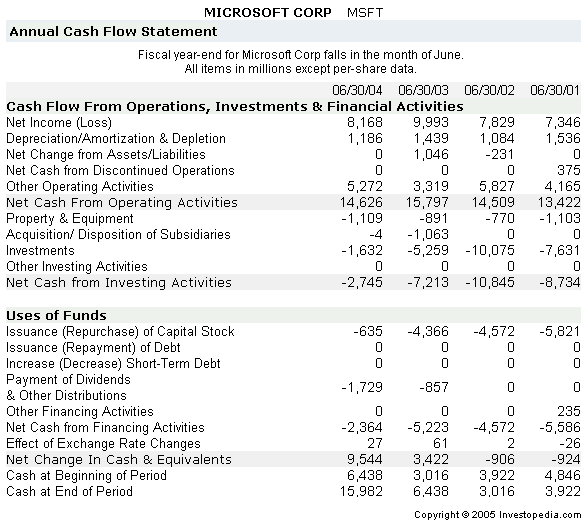
Cash flow from operating activities - This section measures the cash used or provided by a company's normal operations. It shows the company's ability to generate consistently positive cash flow from operations. Think of "normal operations" as the core business of the company. For example, Microsoft's normal operating activity is selling software.
Cash flows from investing activities - This area lists all the cash used or provided by the purchase and sale of income-producing assets. If Microsoft, again our example, bought or sold companies for a profit or loss, the resulting figures would be included in this section of the cash flow statement.
Cash flows from financing activities - This section measures the flow of cash between a firm and its owners and creditors. Negative numbers can mean the company is servicing debt but can also mean the company is making dividend payments and stock repurchases, which investors might be glad to see.

When you look at a cash flow statement, the first thing you should look at is the bottom line item that says something like "net increase/decrease in cash and cash equivalents", since this line reports the overall change in the company's cash and its equivalents (the assets that can be immediately converted into cash) over the last period. If you check under current assets on the balance sheet, you will find cash and cash equivalents (CCE or CC&E). If you take the difference between the current CCE and last year's or last quarter's, you'll get this same number found at the bottom of the statement of cash flows.

In the sample Microsoft annual cash flow statement (from June 2004) shown below, we can see that the company ended up with about $9.5 billion more cash at the end of its 2003/04 fiscal year than it had at the beginning of that fiscal year (see "Net Change in Cash and Equivalents"). Digging a little deeper, we see that the company had a negative cash outflow of $2.7 billion from investment activities during the year (see "Net Cash from Investing Activities"); this is likely from the purchase of long-term investments, which have the potential to generate a profit in the future.Generally, a negative cash flow from investing activities are difficult to judge as either good or bad - these cash outflows are investments in future operations of the company (or another company); the outcome plays out over the long term.


The "Net Cash from Operating Activities" reveals that Microsoft generated $14.6 billion in positive cash flow from its usual business operations - a good sign. Notice the company has had similar levels of positive operating cash flow for several years. If this number were to increase or decrease significantly in the upcoming year, it would be a signal of some underlying change in the company's ability to generate cash.


Read more: http://www.investopedia.com/articles/01/110701.asp#ixzz1hVxZy4dt

The Essentials Of Corporate Cash Flow (1)

The Essentials Of Corporate Cash Flow

Posted: Mar 14, 2011
Investopedia Staff


ARTICLE HIGHLIGHTS
To be positive, the company's long-term cash inflows need to exceed its outflows.
Just because a company is bringing in cash does not mean it is making a profit.


If a company reports earnings of $1 billion, does this mean it has this amount of cash in the bank? Not necessarily. Financial statements are based on accrual accounting, which takes into account non-cash items. It does this in an effort to best reflect the financial health of a company. However, accrual accounting may create accounting noise, which sometimes needs to be tuned out so that it's clear how much actual cash a company is generating. The statement of cash flow provides this information, and here we look at what cash flow is and how to read the cash flow statement.

What Is Cash Flow?
Business is all about trade, the exchange of value between two or more parties, and cash is the asset needed for participation in the economic system. For this reason - while some industries are more cash intensive than others - no business can survive in the long run without generating positive cash flow per share for its shareholders. To have a positive cash flow, the company's long-term cash inflows need to exceed its long-term cash outflows. (For more, see What Is Money?)

An outflow of cash occurs when a company transfers funds to another party (either physically or electronically). Such a transfer could be made to pay for employees, suppliers and creditors, or to purchase long-term assets and investments, or even pay for legal expenses and lawsuit settlements. It is important to note that legal transfers of value through debt - a purchase made on credit - is not recorded as a cash outflow until the money actually leaves the company's hands.

A cash inflow is of course the exact opposite; it is any transfer of money that comes into the company's possession. Typically, the majority of a company's cash inflows are from customers, lenders (such as banks or bondholders) and investors who purchase company equity from the company. Occasionally cash flows come from sources like legal settlements or the sale of company real estate or equipment.


Cash Flow vs Income
It is important to note the distinction between being profitable and having positive cash flow transactions: just because a company is bringing in cash does not mean it is making a profit (and vice versa).

For example, say a manufacturing company is experiencing low product demand and therefore decides to sell off half its factory equipment at liquidation prices. It will receive cash from the buyer for the used equipment, but the manufacturing company is definitely losing money on the sale: it would prefer to use the equipment to manufacture products and earn an operating profit. But since it cannot, the next best option is to sell off the equipment at prices much lower than the company paid for it. In the year that it sold the equipment, the company would end up with a strong positive cash flow, but its current and future earnings potential would be fairly bleak. Because cash flow can be positive while profitability is negative, investors should analyze income statements as well as cash flow statements, not just one or the other.

Read more: http://www.investopedia.com/articles/01/110701.asp#ixzz1hVwE5gVi

'Channel Stuffing' is usually done fraudulently to raise the value of the stock.

A deceptive business practice used by a company to inflate its sales and earnings figures by deliberately sending retailers along its distribution channel more products than they are able to sell to the public.

By channel stuffing, distributors temporarily beef up their accounts receivables. However, unable to sell the excess products, retailers will send the excess items instead of cash back to the distributor, who must readjust its accounts receivable and ultimately its bottom line. In other words, stuffing always catches up with the company, because it cannot maintain sales at the rate it is stuffing.

This is usually done fraudulently to raise the value of the stock. Channel stuffing is illegal.


Read more: http://www.investopedia.com/terms/c/channelstuffing.asp#ixzz1hVql8RCY

Operating Cash Flow: Better Than Net Income?

Operating Cash Flow: Better Than Net Income?

Posted: Oct 4, 2010
Rick Wayman


Operating cash flow is the lifeblood of a company and the most important barometer that investors have. Although many investors gravitate toward net income, operating cash flow is a better metric of a company's financial health for two main reasons. First, cash flow is harder to manipulate under GAAP than net income (although it can be done to a certain degree). Second, "cash is king" and a company that does not generate cash over the long term is on its deathbed.

But operating cash flow doesn't mean EBITDA (earnings before interest taxes depreciation and amortization). While EBITDA is sometimes called "cash flow", it is really earnings before the effects of financing and capital investment decisions. It does not capture the changes in working capital (inventories, receivables, etc.). The real operating cash flow is the number derived in the statement of cash flows.

Overview of the Statement of Cash Flows
The statement of cash flows for non-financial companies consists of three main parts:
Operating flows - The net cash generated from operations (net income and changes in working capital).
Investing flows - The net result of capital expenditures, investments, acquisitions, etc.
Financing flows - The net result of raising cash to fund the other flows or repaying debt.
By taking net income and making adjustments to reflect changes in the working capital accounts on the balance sheet (receivables, payables, inventories) and other current accounts, the operating cash flow section shows how cash was generated during the period. It is this translation process from accrual accounting to cash accounting that makes the operating cash flow statement so important.

Accrual Accounting vs. Cash Flows
The key differences between accrual accounting and real cash flow are demonstrated by the concept of the cash cycle. A company's cash cycle is the process that converts sales (based upon accrual accounting) into cash as follows:
Cash is used to make inventory.
Inventory is sold and converted into accounts receivables (because customers are given 30 days to pay).
Cash is received when the customer pays (which also reduces receivables).
There are many ways that cash from legitimate sales can get trapped on the balance sheet. The two most common are for customers to delay payment (resulting in a build up of receivables) and for inventory levels to rise because the product is not selling or is being returned.

For example, a company may legitimately record a $1 million sale but, because that sale allowed the customer to pay within 30 days, the $1 million in sales does not mean the company made $1 million cash. If the payment date occurs after the close of the end of the quarter, accrued earnings will be greater than operating cash flow because the $1 million is still in accounts receivable.

Harder to Fudge Operating Cash Flows
Not only can accrual accounting give a rather provisional report of a company's profitability, but under GAAP it allows management a range of choices to record transactions. While this flexibility is necessary, it also allows for earnings manipulation. Because managers will generally book business in a way that will help them earn their bonus, it is usually safe to assume that the income statement will overstate profits.

An example of income manipulation is called "stuffing the channel" To increase their sales, a company can provide retailers with incentives such as extended terms or a promise to take back the inventory if it is not sold. Inventories will then move into the distribution channel and sales will be booked. Accrued earnings will increase, but cash may actually never be received, because the inventory may be returned by the customer. While this may increase sales in one quarter, it is a short-term exaggeration and ultimately "steals" sales from the following periods (as inventories are sent back). (Note: While liberal return policies, such as consignment sales, are not allowed to be recorded as sales, companies have been known to do so quite frequently during a market bubble.)

The operating cash flow statement will catch these gimmicks. When operating cash flow is less than net income, there is something wrong with the cash cycle. In extreme cases, a company could have consecutive quarters of negative operating cash flow and, in accordance with GAAP, legitimately report positive EPS. In this situation, investors should determine the source of the cash hemorrhage (inventories, receivables, etc.) and whether this situation is a short-term issue or long-term problem. (For more on cash flow manipulation, see Cash Flow On Steroids: Why Companies Cheat.)


Cash Exaggerations
While the operating cash flow statement is more difficult to manipulate, there are ways for companies to temporarily boost cash flows. Some of the more common techniques include: delaying payment to suppliers (extending payables); selling securities; and reversing charges made in prior quarters (such as restructuring reserves).

Some view the selling of receivables for cash - usually at a discount - as a way for companies to manipulate cash flows. In some cases, this action may be a cash flow manipulation; but I think it is also a legitimate financing strategy. The challenge is being able to determine management's intent.

Cash Is King
A company can only live by EPS alone for a limited time. Eventually, it will need cash to pay the piper, suppliers and, most importantly, the bankers. There are many examples of once-respected companies who went bankrupt because they could not generate enough cash. Strangely, despite all this evidence, investors are consistently hypnotized by EPS and market momentum and ignore the warning signs.


The Bottom Line
Investors can avoid a lot of bad investments if they analyze a company's operating cash flow. It's not hard to do, but you'll need to do it, because the talking heads and analysts are all too often focused on EPS.
by Rick Wayman


Read more: http://www.investopedia.com/articles/analyst/03/122203.asp#ixzz1hVjope5c

The difference between Earnings and Cash - Analyze Cash Flow The Easy Way


Summary


Once you understand the importance of how cash flow is generated and reported, you can use these simple indicators to conduct an analysis on your own portfolio. 

The point is to stay away from "looking only at a firm's income statement and not the cash flow statement." 

This approach will allow you to discover how a company is managing to pay its obligations and make money for its investors.


Difference Between Earnings and Cash

At least as important as a company's profitability is its liquidity - whether or not it's taking in enough money to meet its obligations. 

Companies, after all, go bankrupt because they cannot pay their bills, not because they are unprofitable. 


The Statement of Cash Flows


Cash flow statements have three distinct sections, each of which relates to a particular component - operations, investing and financing - of a company's business activities.

1.  Cash Flow from Operations: 
-  This is the key source of a company's cash generation
-  It is the cash that the company produces internally as opposed to funds coming from outside investing and financing activities. 
-  In this section of the cash flow statement, net income (income statement) is adjusted for non-cash charges and the increases and decreases to working capital items - operating assets and liabilities in the balance sheet's current position.

2.  Cash Flow from Investing: 
-  For the most part, investing transactions generate cash outflows, such as capital expenditures for plant, property and equipment, business acquisitions and the purchase of investment securities. 
-  Inflows come from the sale of assets, businesses and investment securities.
-  For investors, the most important item in this category is capital expenditures. 
-  It's generally assumed that this use of cash is a prime necessity for ensuring the proper maintenance of, and additions to, a company's physical assets to support its efficient operation and competitiveness.

3.  Cash Flow from Financing: 
-  Debt and equity transactions dominate this category. 
-  Companies continuously borrow and repay debt. 
-  The issuance of stock is much less frequent. 
-  Here again, for investors, particularly income investors, the most important item is cash dividends paid. It's cash, not profits, that is used to pay dividends to shareholders.


A Simplified Approach to Cash Flow Analysis


-  A company's cash flow can be defined as the number that appears in the cash flow statement as net cash provided by operating activities, or "net operating cash flow".

-  Many financial professionals consider a company's cash flow to be the sum of its net income and depreciation (a non-cash charge in the income statement). While often coming close to net operating cash flow, this professional's short-cut can be way off the mark and investors should stick with the net operating cash flow number.


Indicators to measure investment quality of company's cash flow 


The following indicators provide a starting point for an investor to measure the investment quality of a company's cash flow:

1.  Operating Cash Flow / Net Sales: 
-  This ratio, which is expressed as a percentage of a company's net operating cash flow to its net sales, or revenue (from the income statement), tells us how many dollars of cash we get for every dollar of sales.
-  There is no exact percentage to look for but obviously, the higher the percentage the better. 
-  It should also be noted that industry and company ratios will vary widely. Investors should track this indicator's performance historically to detect significant variances from the company's average cash flow/sales relationship along with how the company's ratio compares to its peers. 
-  Also, keep an eye on how cash flow increases as sales increase; it is important that they move at a similar rate over time.

2.  (a)  Free Cash Flow: 
-  Free cash flow is often defined as net operating cash flow minus capital expenditures, which, as mentioned previously, are considered obligatory. 
- A steady, consistent generation of free cash flow is a highly favorable investment quality – so make sure to look for a company that shows steady and growing free cash flow numbers.


FCF = 
Net Operating Cash Flow - Capital Expenditures

2 (b).  Comprehensive Free Cash Flow:
-  For the sake of conservatism, you can go one step further by expanding what is included in the free cash flow number. 
-  For example, in addition to capital expenditures, you could also include dividends for the amount to be subtracted from net operating cash flow to get to get a more comprehensive sense of free cash flow. 

Comprehensive FCF 
= Net Operating Cash Flow - Capital expenditure - dividends.

-  This could then be compared to sales as was shown above.


FCF / Net Sales
Comprehensive FCF / Net Sales


-  As a practical matter, if a company has a history of dividend payments, it cannot easily suspend or eliminate them without causing shareholders some real pain. 
-  Even dividend payout reductions, while less injurious, are problematic for many shareholders. 
-  In general, the market considers dividend payments to be in the same category as capital expenditures - as necessary cash outlays.
-  But the important thing here is looking for stable levels. This shows not only the company's ability to generate cash flow but it also signals that the company should be able to continue funding its operations. 

3..  Comprehensive Free Cash Flow Coverage: 
-You can calculate a comprehensive free cash flow ratio by dividing the comprehensive free cash flow by net operating cash flow to get a percentage ratio - the higher the percentage the better.


Comprehensive FCF Coverage 
=  Comprehensive FCF / Net operating cash flow


Importance of free cash flow.


Free cash flow is an important evaluative indicator for investors. 
- It captures all the positive qualities of internally produced cash from a company's operations and subjects it to a critical use of cash - capital expenditures. 
-  If a company's cash generation passes this test in a positive way, it is in a strong position to avoid excessive borrowing, expand its business, pay dividends and to weather hard times.
-  The term "cash cow," which is applied to companies with ample free cash flow, is not a very elegant term, but it is certainly one of the more appealing investment qualities you can apply to a company with this characteristic. 


Read more:http://www.investopedia.com/articles/stocks/07/easycashflow.asp#ixzz1hPqfkDZZ