Saturday, 9 August 2014

Success Will Come and Go, But Integrity is Forever


If I could teach only one value to live by, it would be this: Successwill come and go, but integrity is forever. Integrity means doing the right thing at all times and in all circumstances, whether or not anyone is watching. It takes having the courage to do the right thing, no matter what the consequences will be. Building a reputation of integrity takes years, but it takes only a second to lose, so never allow yourself to ever do anything that would damage your integrity.
We live in a world where integrity isn’t talked about nearly enough. We live in a world where “the end justifies the means” has become an acceptable school of thought for far too many. Sales people overpromise and under deliver, all in the name of making their quota for the month. Applicants exaggerate in job interviews because they desperately need a job. CEOs overstate their projected earnings because they don’t want the board of directors to replace them. Entrepreneurs overstate their pro formas because they want the highest valuation possible from an investor. Investors understate a company’s value in order to negotiate a lower valuation in a deal. Customer service representatives cover up a mistake they made because they are afraid the client will leave them. Employees call in “sick” because they don’t have any more paid time off when they actually just need to get their Christmas shopping done. The list could go on and on, and in each case the person committing the act of dishonesty told themselves they had a perfectly valid reason why the end result justified their lack of integrity.

It may seem like people can gain power quickly and easily if they are willing to cut corners and act without the constraints of morality. Dishonesty may provide instant gratification in the moment but it will never last. I can think of several examples of people without integrity who are successful and who win without ever getting caught, which creates a false perception of the path to success that one should follow. After all, each person in the examples above could have gained the result they wanted in the moment, but unfortunately, that momentary result comes at an incredibly high price with far reaching consequences.  That person has lost their ability to be trusted as a person of integrity, which is the most valuable quality anyone can have in their life. Profit in dollars or power is temporary, but profit in a network of people who trust you as a person of integrity is forever.
Every one person who trusts you will spread the word of that trust to at least a few of their associates, and word of your character will spread like wildfire. The value of the trust others have in you is far beyond anything that can be measured.  For entrepreneurs it means investors that are willing to trust them with their money. For employees it means a manager or a boss that is willing to trust them with additional responsibility and growth opportunities. For companies it means customers that trust giving them more and more business. For you it means having an army of people that are willing to go the extra mile to help you because they know that recommending you to others will never bring damage to their own reputation of integrity. Yes, the value of the trust others have in you goes beyond anything that can be measured because it brings along with it limitless opportunities and endless possibilities.
Contrast that with the person who cannot be trusted as a person of integrity.  Warren Buffet, Chairman and CEO of Berkshire Hathaway said it best:, “In looking for people to hire, look for three qualities: integrity, intelligence, and energy.  And if they don’t have the first one, the other two will kill you.”  A person’s dishonesty will eventually catch up to them. It may not be today, and it may not be for many years, but you can rest assured that at some point there will always be a reckoning.
A word of advice to those who are striving for a reputation of integrity: Avoid those who are not trustworthy. Do not do business with them. Do not associate with them. Do not make excuses for them.  Do not allow yourself to get enticed into believing that “while they may be dishonest with others, they would never be dishonest with me.” If someone is dishonest in any aspect of his life you can be guaranteed that he will be dishonest in many aspects of his life. You cannot dismiss even those little acts of dishonesty, such as the person who takes two newspapers from the stand when they paid for only one. After all, if a person cannot be trusted in the simplest matters of honesty then how can they possibly be trusted to uphold lengthy and complex business contracts?
It is important to realize that others pay attention to those you have chosen to associate with, and they will inevitably judge your character by the character of your friends. Why is that?  It is best explained by a quote my father often says when he is reminding me to be careful of the company I am keeping:  “When you lie down with dogs you get fleas.” Inevitably we become more and more like the people we surround ourselves with day to day. If we surround ourselves with people who are dishonest and willing to cut corners to get ahead, then we’ll surely find ourselves following a pattern of first enduring their behavior, then accepting their behavior, and finally adopting their behavior. If you want to build a reputation as a person of integrity then surround yourself with people of integrity.
There is a plaque on the wall of my office which reads: “Do what is right, let the consequence follow.” It serves as a daily reminder that success will indeed come and go, but integrity is forever.
~Amy (for my daily blogs go to www.amyreesanderson.com/blog)
Related on Forbes:


http://www.forbes.com/sites/amyanderson/2012/11/28/success-will-come-and-go-but-integrity-is-forever/

Thursday, 7 August 2014

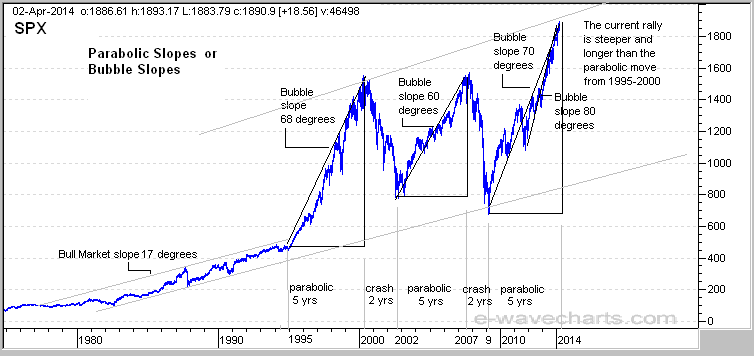
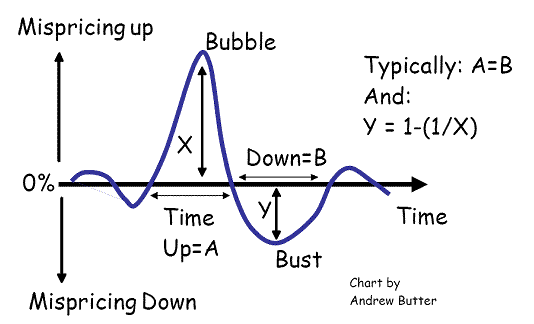
Stock market bubble: Sound advice

"We do not specifically look to profit from a bubble in the stock market.  We just make sure we are not impoverished by it."


Wednesday, 6 August 2014

Keys to Successful Investing

Keys to Successful Investing

Know Yourself 
Know your investing objectives
Know your time horizon
Know your risk tolerance
Know your financial capacity and reserves

Know your investing philosophy and strategy
Keep it simple and safe (relevant, powerful and focussed)
Never lose money (Rule No 1 and Rule No 2 of Warren Buffett )
Develop and stay with your investing philosophy and strategy (value investing, long term)
Know the difference between investing and speculation/gambling (avoid speculation and gambling)
Avoid market timing (a most dangerous game to play, best avoided)
Selective stock picking (earning power, economic moat, durable competitive advantage, franchise value)
Know your rules for buying (circle of competence, margin of safety, buy quality, great companies at wonderful price)
Know your rules for selling (sell the losers- fundamentals deteriorated permanently or underperformers)
Know your rules for portfolio management (concentrated, defensive and offensive strategies)
Keep good records to guide your investing (an essential to your success in your investing journey)
Reinvest your dividends and dollar cost averaging (take advantage of compounding)

Ongoing activities to invest for the future
Continue to learn and explore.
Continue to master the understanding of all types of businesses
Continue to master valuation of business  Thumbs Up
Continue to master the understanding of market behaviour and Mr. Market
Continue to master behavioural finance to understand herd and individual behaviour.
Continue to learn, develop, refine and explore investing knowledge, concepts and applications.
Continue to research companies and businesses.
Continue to seek opportunities in good and bad markets.


A guide to property valuations


WHETHER you’re a potential homebuyer or a greenhorn property investor, your impending venture into the property market will very much revolve around valuations. You might have heard the term being thrown about by experienced property market players, but how much do you know about valuations and how the process would influence your purchase? Here’s what you need to know.
What is valuation?
Officially, “market value” is the estimated amount for which a property should exchange on the date of valuation between a willing buyer and a willing seller in an arm’s length transaction after proper marketing wherein the parties have each acted knowledgeably, prudently and without compulsion. Valuation calculations take into account recent transacted prices from the Government’s Valuations and Property Services Department (JPPH). Additionally, launch prices of new and upcoming projects in the area play a factor. Once a valuation is done, a bank would usually extend a loan of 90% based on the figure.
How valuation affects you
Say you’ve got your eye on an apartment unit, and after negotiating with the seller, the two of you agree on a price of RM500,000. A 90% loan means that you would need to fork out a down payment of RM50,000, aside from other entry costs. Now, here’s where the valuation comes into play – for a housing loan, a report by a real estate valuation firm recognised by the bank you’re dealing with is needed. If a valuation firm only prices the said property at RM450,000, you would only be eligible for a loan of 90% from RM450,000. Basically, this means that if you were to go ahead and purchase it, you would need to bear the price difference and come up with RM95,000; and not the RM50,000 you were initially expecting.
Why the disparity?
If you observed the Malaysian property market, you would know that prices in certain areas have surged upwards quite quickly. Herein
lies the issue – as it takes up to six months for JPPH to collect and analyse transaction data, which valuation firms rely on for their calculations. Basically, this means that valuations would be centred on outdated prices from up to six months earlier, and are likely to be lower than current prices.

Although many firms take the trouble to ensure an accurate and fair valuation by taking into account as many relevant factors as possible, many others only do as much as they need to, resulting in common cases of disparities between valuations and negotiated prices.
What can you do?
Here’s the bit where you have control over. It’s a well-known fact among veteran property players that different banks can provide different valuations on a single piece of property. Some bank sales agents may aggressively push up their valuations of your property, just so they can obtain more transactions. You could take advantage of this and go “shopping” for valuation rates. Remember to mention what the other branches are offering as you might just end up with the valuation that you want.
> Loanstreet.com.my is a website where visitors can compare and apply for loans online.


http://www.starproperty.my/index.php/articles/investment/a-guide-to-property-valuations/?utm_source=TSOL&utm_medium=widget&utm_campaign=a-guide-to-property-valuations

Tuesday, 5 August 2014

Lessons learned from Sir John Templeton


Lessons from Sir John Templeton


“A MAJOR CAUSE OF HIGHER PRICES is higher prices; but when the trend is reversed, then lower prices lead to still lower prices. To buy when others are despondently selling and to sell when others are avidly buying requires the greatest fortitude and pays the greatest ultimate rewards.”
Sir John Templeton


“Bull markets are born on pessimism, grow on skepticism, mature on optimism and die on euphoria. The time of maximum pessimism is the best time to buy and the time of maximum optimism is the best time to sell.”
Sir John Templeton


15 Personal Attributes
Self Reliance
Reasonable Risk Taking
Sense of Stewardship
A Drive towards Diversity
Bargain Hunting Mentality
Broad Social and Political Awareness
Flexibility
Devote Large Amounts of Time to Study
  •   An Ability to Retreat from Daily Pressures
  •   Develop an Extensive Friendship Network
  •   Patience
  •   Thought Control
  •   Positive Thinking
  •   Simplicity
  •   Great Intuitive Powers


    “If you want to have a better performance than the crowd, you must do things differently from the crowd.”
    Sir John Templeton

    Where were the buyers on March 9, 2009?
    The truth is that it is very hard to buy at the point of maximum pessimism.
    Humans are not wired to do so.


    Stock Prices are 14x More Volatile than Actual Fundamentals This Creates Opportunities for those who are Prepared


    Methods Sir John Used to Take Advantage of these Events
    Preparation, Preparation, Preparation
    Always stored some funds in reserves, one basis for his thrift...sought out crises
    Maintained a wish list, had already researched and prepared a list of companies he wanted to own at a bargain price
    •   Maintained good-to-cancel limit orders in the market 20% below the current price
    •   An optimist, held a fundamental belief in the continued innovation, ambitions and ingenuity of others


Intelligent Finance

http://www.mgmt.uestc.edu.cn/prc/papers/IWIF-II%20PAN%20Heping-Intelligent%20Finance%20C4%20-%20FSA.ppt

Strategies of the Great Masters (ppt)

http://hum14.files.wordpress.com/2009/01/chapter-22-strategies-of-the-great-masters.ppt


The Value of Cumulative Research 
A Competitive Advantage. Lessons of the Masters

Time to Invest? There have always been reasons not to invest.

https://www.franklintempleton.com/retail/ppt/sales_tools/2020_PPT_FA.ppt

Invest Yourself! (Ppt)

http://econ.org/investyourself/Invest%20Yourself%20PowerPoint.ppt

What is happiness to you?

Common Stocks and the Investment Banking Process (ppt)

http://people.hofstra.edu/Ivan_D_Orlic/chapter16.ppt