RM149 billion KLSE losses in 5 days
Keep INVESTING Simple and Safe (KISS)***** Investment Philosophy, Strategy and various Valuation Methods***** Warren Buffett: Rule No. 1 - Never lose money. Rule No. 2 - Never forget Rule No. 1.
Wednesday, 28 October 2009
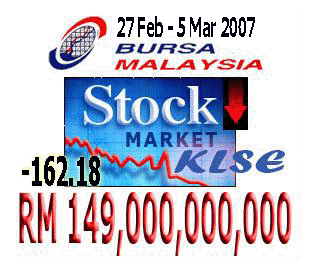
RM149 billion KLSE losses in 5 days
What is a stock market index?
A stock market index is a measure of the average price level of the shares traded in the market. Its use is analogous to the use of degree of celcius to measure the temperature. It is constructed by comparing the current price of a sample of shares with their prices at some earlier date.
The organization which is setting up the index (e.g. KLSE) has to make two decisions regarding the design of the index.
First, what are the companies to be included in the index?
Second, what is to be the starting point of the index?
Both decisions would involve a certain degree of compromise.
In general, 30 companies is a good compromise to represent the actual situation at the stock market. KLSE Indices have the starting date of 1st January 1970. The KLSE Indices are given the base value of 100 as at 1st January 1970.
There are various ways of computing an index but the easiest way to understand is probably the one using the market value of the companies included in the index.
The KLSE Industrial Index has a based value of 100 at 1st of January 1970. It stood at 700 at the end of August 1988. This means that the market value of the companies chosen for the index had increased their total value by 600 per cent since 1970 (an average annual increase of 11.5 per cent).
It is worthwhile to remember how indices are calculated and remind ourselves how much the market has gone up in the bull run. When the market is next in a manic phase, we have to ask ourselves if it is feasible for the market to continue its performance in the future.
Click:
http://finance.yahoo.com/echarts?s=%5EKLSE#symbol=%5EKLSE;range=my
FTSE Bursa Malaysia KLCI Index (^KLSE)
http://blog.limkitsiang.com/2007/03/06/rm149-billion-klse-losses-in-5-days-pmministers-not-stock-market-consultants/
RM149 billion KLSE losses in 5 days
The organization which is setting up the index (e.g. KLSE) has to make two decisions regarding the design of the index.
First, what are the companies to be included in the index?
Second, what is to be the starting point of the index?
Both decisions would involve a certain degree of compromise.
In general, 30 companies is a good compromise to represent the actual situation at the stock market. KLSE Indices have the starting date of 1st January 1970. The KLSE Indices are given the base value of 100 as at 1st January 1970.
There are various ways of computing an index but the easiest way to understand is probably the one using the market value of the companies included in the index.
The KLSE Industrial Index has a based value of 100 at 1st of January 1970. It stood at 700 at the end of August 1988. This means that the market value of the companies chosen for the index had increased their total value by 600 per cent since 1970 (an average annual increase of 11.5 per cent).
It is worthwhile to remember how indices are calculated and remind ourselves how much the market has gone up in the bull run. When the market is next in a manic phase, we have to ask ourselves if it is feasible for the market to continue its performance in the future.
Click:
http://finance.yahoo.com/echarts?s=%5EKLSE#symbol=%5EKLSE;range=my
FTSE Bursa Malaysia KLCI Index (^KLSE)
http://blog.limkitsiang.com/2007/03/06/rm149-billion-klse-losses-in-5-days-pmministers-not-stock-market-consultants/
RM149 billion KLSE losses in 5 days
Market Timing
The fundamental approach to investment requires one to work out the intrinsic value of a share before its purchase.
"Why don't we just wait until the whole market is low enough and then go in and buy a wide selection of shares?"
This question suggests that one invests by means of "market timing". If practical, it will surely save us a lot of time and effort.
"Why don't we just wait until the whole market is low enough and then go in and buy a wide selection of shares?"
This question suggests that one invests by means of "market timing". If practical, it will surely save us a lot of time and effort.
- Is it possible to carry out consistently correct market timing?
- How easy or difficult is the art of of market timing?
KLSE 1994 to 2009
http://finance.yahoo.com/echarts?s=%5EKLSE#symbol=%5EKLSE;range=my
Is there a correct time to buy and sell?
Tuesday, 27 October 2009
Insiders' actions in 3-A Resources
The share price of 3A rose rapidly to a high level recently. What actions did the "smarter" insiders in 3A take?
Click here:
http://www.klse.com.my/website/bm/listed_companies/company_announcements/changes_in_s_holding/index.jsp
Type of transaction Date of change No of securities Price Transacted ($$)
Disposed 15/10/2009 2,448,002
Disposed 16/10/2009 2,300,000
Click here:
http://www.klse.com.my/website/bm/listed_companies/company_announcements/changes_in_s_holding/index.jsp
Type of transaction Date of change No of securities Price Transacted ($$)
Disposed 15/10/2009 2,448,002
Disposed 16/10/2009 2,300,000
The recent budget introduces a mandatory basic insurance coverage
Insurance
A basic insurance and takaful scheme will be offered to provide mandatory basic insurance coverage for third party bodily injuries and death. The scheme is expected to be introduced by mid-2010.
Positive for insurance companies (Kurnia (NR), LPI (NR)) and banks with major insurance subsidiaries such AMMB (AmAssurance)
http://malaysiainfoedgezone.blogspot.com/2009/10/market-strategy-after-budget-2010-full.html
http://www.box.net/shared/uj9jmp9h63
A basic insurance and takaful scheme will be offered to provide mandatory basic insurance coverage for third party bodily injuries and death. The scheme is expected to be introduced by mid-2010.
Positive for insurance companies (Kurnia (NR), LPI (NR)) and banks with major insurance subsidiaries such AMMB (AmAssurance)
http://malaysiainfoedgezone.blogspot.com/2009/10/market-strategy-after-budget-2010-full.html
http://www.box.net/shared/uj9jmp9h63
Nestle 27.10.2009
Valuation
http://spreadsheets.google.com/pub?key=tdjqbDNEEF54lSn6z6yORcw&output=html
Comment: Recent price has climbed faster than earnings.
http://spreadsheets.google.com/pub?key=tdjqbDNEEF54lSn6z6yORcw&output=html
Comment: Recent price has climbed faster than earnings.
Monday, 26 October 2009
Business model of Parkson Retail Group
PRG operates the Lion group's department store business in China.
The Hong Kong-listed PRG is sitting on cash reserves of RMB 3 billion (RM 1.49 billion). The retailer is a 51.6% owned subsidiary of Parkson Holdings Bhd, in which Lion group boss Tan Sri William Cheng holds a 21.9% direct equity stake and 32.5% indirect stake.
After stripping out debts of RMB 2.3 billion, PRG is in a net cash position of RMB 667.5 million.
The retail giant is in a cash-generating business and its department stores are ringing up good sales.
Business model of Parkson Retail Group
PRG's growing cash pile is also due to its asset-light strategy. It does not own many properties while its business model of letting out space to branded names does not tie up its cash with unsold inventories.
For instance, if John Master or Bonia has an outlet in Parkson, the inventory is held by the manufacturers themselves. Parkson lets out the space and gets a commission from sales. This way, it keeps its balance sheet light.
Lingering Concerns
Local fund managers do buy into PRG's growth story. It certainly does not take rocket science to figure out that China's robust growth augurs well for retailers such as PRG. However, there is always a lingering concern because of the state of other companies within the Lion group.
The concerns of investors are not entirely unjustified, going by the track record of other companies within the Lion group stable. For instance, Lion Corp Bhd and Lion Industries are in net debt positions. Further, Amsteel Corp Bhd, once the flagship of the Lion group, and Silverstone Corp Bhd were removed from Bursa Malaysia for failing to regularise their financial positions due to debt problems.
That explains why Parkson Holdings' share price on Bursa Malaysia has been lagging that of PRG's in Hong Kong. The stock does not command the premium it deserves despite its exposure to the sizeable consumer market in China plus Vietnam - another booming emerging economy.
PRG does not have a dividend policy
According to its managing director Alfred Cheng, PRG doesn't have a dividend policy. However, the group has been paying out almost half of its earnings as dividends since it was listed in November 2005. In the last financial year ended Dec 31, 2008, PRG paid out total dividends of RMB 405 million versus RMB 332.5 million in FY2207.
Paying regular dividends isn't a norm among the companies in the Lion group; PRG is probably the first to do so. And PRG needs to keep it up to maintain its status as the group's cash-generating jewel.
Ref: The Edge
The Hong Kong-listed PRG is sitting on cash reserves of RMB 3 billion (RM 1.49 billion). The retailer is a 51.6% owned subsidiary of Parkson Holdings Bhd, in which Lion group boss Tan Sri William Cheng holds a 21.9% direct equity stake and 32.5% indirect stake.
After stripping out debts of RMB 2.3 billion, PRG is in a net cash position of RMB 667.5 million.
The retail giant is in a cash-generating business and its department stores are ringing up good sales.
Business model of Parkson Retail Group
PRG's growing cash pile is also due to its asset-light strategy. It does not own many properties while its business model of letting out space to branded names does not tie up its cash with unsold inventories.
For instance, if John Master or Bonia has an outlet in Parkson, the inventory is held by the manufacturers themselves. Parkson lets out the space and gets a commission from sales. This way, it keeps its balance sheet light.
Lingering Concerns
Local fund managers do buy into PRG's growth story. It certainly does not take rocket science to figure out that China's robust growth augurs well for retailers such as PRG. However, there is always a lingering concern because of the state of other companies within the Lion group.
The concerns of investors are not entirely unjustified, going by the track record of other companies within the Lion group stable. For instance, Lion Corp Bhd and Lion Industries are in net debt positions. Further, Amsteel Corp Bhd, once the flagship of the Lion group, and Silverstone Corp Bhd were removed from Bursa Malaysia for failing to regularise their financial positions due to debt problems.
That explains why Parkson Holdings' share price on Bursa Malaysia has been lagging that of PRG's in Hong Kong. The stock does not command the premium it deserves despite its exposure to the sizeable consumer market in China plus Vietnam - another booming emerging economy.
PRG does not have a dividend policy
According to its managing director Alfred Cheng, PRG doesn't have a dividend policy. However, the group has been paying out almost half of its earnings as dividends since it was listed in November 2005. In the last financial year ended Dec 31, 2008, PRG paid out total dividends of RMB 405 million versus RMB 332.5 million in FY2207.
Paying regular dividends isn't a norm among the companies in the Lion group; PRG is probably the first to do so. And PRG needs to keep it up to maintain its status as the group's cash-generating jewel.
Ref: The Edge
Parkson's venture into Vietnam and Indochina
Revenues of Parkson at present are generated as shown:
75% from China
20% from Malaysia
6% from Vietnam
Parkson Holdings' total revenue for FY 2008 ended June 30 was RM 2.35 billion.
RM 1.55 billion from China
RM 718.9 million from Malaysia
RM 80 million from Vietnam
The growth in China is impressive.
It is equally exciting in Vietnam too. While small compared with the operations in China and Malaysia, Vietnam's contribution has nearly doubled from RM 41.9 million in FY 2007.
Vietnam is the stepping stone for Parkson Holdings to capture the market in Indochina, consisting of Vietnam, Cambodia and Laos. Parkson plans to open its first store in Phnom Penh in 1H2011.
Whether Parkson's success in China can be repeated in Vietnam and greater Indochina will depend to a large extent on how it utilises its first-mover advantage to fend off competitors.
Vietnam: Total retail sales in the first 8 months of this year rose 18.4% y-o-y to US$41.67 billion (RM 141 billion), according to the country's General Statistics Office. The growth was recorded in a year that the global economy was in turmoil and the dong (the Vietnamese currency) devalued.
Ref: The Edge
75% from China
20% from Malaysia
6% from Vietnam
Parkson Holdings' total revenue for FY 2008 ended June 30 was RM 2.35 billion.
RM 1.55 billion from China
RM 718.9 million from Malaysia
RM 80 million from Vietnam
The growth in China is impressive.
It is equally exciting in Vietnam too. While small compared with the operations in China and Malaysia, Vietnam's contribution has nearly doubled from RM 41.9 million in FY 2007.
Vietnam is the stepping stone for Parkson Holdings to capture the market in Indochina, consisting of Vietnam, Cambodia and Laos. Parkson plans to open its first store in Phnom Penh in 1H2011.
Whether Parkson's success in China can be repeated in Vietnam and greater Indochina will depend to a large extent on how it utilises its first-mover advantage to fend off competitors.
Vietnam: Total retail sales in the first 8 months of this year rose 18.4% y-o-y to US$41.67 billion (RM 141 billion), according to the country's General Statistics Office. The growth was recorded in a year that the global economy was in turmoil and the dong (the Vietnamese currency) devalued.
Ref: The Edge
Sunday, 25 October 2009
New KLCI 30 counter (July 2009)
1066 "RHB Capital" FBM30
3786 "Malaysia Airline System" FBM30
4162 "British American Tobacco (Malaysia)" FBM30
6888 "Axiata Group Bhd" FBM30
3182 "Genting" FBM30
2445 "Kuala Lumpur Kepong" FBM30
1155 "Malayan Banking" FBM30
2194 "MMC" FBM30
4065 "PPB Group" FBM30
4197 "Sime Darby Bhd" FBM30
1961 "IOI" FBM30
4715 "Resorts World" FBM30
4863 "Telekom Malaysia" FBM30
5347 "Tenaga Nasional" FBM30
1015 "AMMB Holdings" FBM30
1562 "Berjaya Sports Toto" FBM30
1023 "Bumiputra-Commerce Holdings" FBM30
5819 "Hong Leong Bank" FBM30
2267 "Tanjong" FBM30
4588 "UMW Holdings" FBM30
4677 "YTL Corp" FBM30
6033 "Petronas Gas" FBM30
6742 "YTL Power International" FBM30
6947 "Digi.com" FBM30
5657 "Parkson Holdings" FBM30
5681 "Petronas Dagangan Bhd" FBM30
5052 "Plus Expressways" FBM30
3816 "MISC" FBM30
1295 "Public Bank BHD" FBM30
5076 "Astro All Asia Networks" FBM30
1066 "RHB Capital" FBM30
3786 "Malaysia Airline System" FBM30
4162 "British American Tobacco (Malaysia)" FBM30
6888 "Axiata Group Bhd" FBM30
3182 "Genting" FBM30
2445 "Kuala Lumpur Kepong" FBM30
1155 "Malayan Banking" FBM30
2194 "MMC" FBM30
4065 "PPB Group" FBM30
4197 "Sime Darby Bhd" FBM30
1961 "IOI" FBM30
4715 "Resorts World" FBM30
4863 "Telekom Malaysia" FBM30
5347 "Tenaga Nasional" FBM30
1015 "AMMB Holdings" FBM30
1562 "Berjaya Sports Toto" FBM30
1023 "Bumiputra-Commerce Holdings" FBM30
5819 "Hong Leong Bank" FBM30
2267 "Tanjong" FBM30
4588 "UMW Holdings" FBM30
4677 "YTL Corp" FBM30
6033 "Petronas Gas" FBM30
6742 "YTL Power International" FBM30
6947 "Digi.com" FBM30
5657 "Parkson Holdings" FBM30
5681 "Petronas Dagangan Bhd" FBM30
5052 "Plus Expressways" FBM30
3816 "MISC" FBM30
1295 "Public Bank BHD" FBM30
5076 "Astro All Asia Networks" FBM30
Differences between investment and speculation
1. Investment: Investment is rationally based on the knowledge of past share price behaviour. From such knowledge, it is possible to compute the probability of future return.
2. Investment: Investment requires an investor to do some work before hand and decisions are made based on known facts and figure.
3. Investment: Investment is made for the long term (i.e. two years or more) based on the idea that one is much more certain when one is trying to predict the cumulative results of many daily movement. Once invests with the knowledge that over the long run, the real investors will always make a gain.
Speculation: Speculation is usually for the short run (i.e three months or less unless one is caught whence a speculator is then forced to become an investor), based on the idea that certain events may result in a rise in price (bonus, rights, takeovers, and others).
4. Investment: Over a long period of time, true investment tends to produce a positive result. Based on many years of research in the US and Europe, Long Term Investment consistently produced much higher return than fixed deposit or the inflation rate. The Malaysian experience has mirrored the Western experience.
Speculation: Since speculation is not based on anything concrete, its result is not at all predictable. Speculation can occasionally produce very high gains just as it can produce very high losses. Over a long period of time, speculation is most unlikely to produce better return than true investment.
5. Investment: True investors can sleep soundly at night since they have a fairly good idea of the possible extent of their loss and gain before hand. Besides, since they are investing for the long term, they can forget about short term movements and ignore the market most of the time.
Speculation: Speculation is likely to lead to many sleepless nights and anxious days since its result is so uncertain. The speculator will have to be always on the alert to take the necessary quick action to catch the right moment.
1. Investment: Investment is rationally based on the knowledge of past share price behaviour. From such knowledge, it is possible to compute the probability of future return.
- A common method of investment analysis is to study the past range of PER or DY of a particular share or a class of shares.
- From this study of its past price range, we can predict the likelihood of its price being out of this range in the future.
- By comparing its current price with the expected future price range (future price = future PER x future earnings) we know whether the current price is too high or too low and take the necessary action accordingly.
2. Investment: Investment requires an investor to do some work before hand and decisions are made based on known facts and figure.
- Such work typically may consist of estimating future level of Earnings Per Share and computing the past range of the PER.
- By multiplying the future EPS with the likely PER, we have an estimate of the future level of price.
- If the present price is very low compared with the future price, we buy and vice versa.
3. Investment: Investment is made for the long term (i.e. two years or more) based on the idea that one is much more certain when one is trying to predict the cumulative results of many daily movement. Once invests with the knowledge that over the long run, the real investors will always make a gain.
Speculation: Speculation is usually for the short run (i.e three months or less unless one is caught whence a speculator is then forced to become an investor), based on the idea that certain events may result in a rise in price (bonus, rights, takeovers, and others).
4. Investment: Over a long period of time, true investment tends to produce a positive result. Based on many years of research in the US and Europe, Long Term Investment consistently produced much higher return than fixed deposit or the inflation rate. The Malaysian experience has mirrored the Western experience.
Speculation: Since speculation is not based on anything concrete, its result is not at all predictable. Speculation can occasionally produce very high gains just as it can produce very high losses. Over a long period of time, speculation is most unlikely to produce better return than true investment.
5. Investment: True investors can sleep soundly at night since they have a fairly good idea of the possible extent of their loss and gain before hand. Besides, since they are investing for the long term, they can forget about short term movements and ignore the market most of the time.
Speculation: Speculation is likely to lead to many sleepless nights and anxious days since its result is so uncertain. The speculator will have to be always on the alert to take the necessary quick action to catch the right moment.
"Sure lose (gambling)" situations in investment
There is only one real difference between investment and gambling. In investment, one can expect to make a profit over the long run but gambling will always result in a loss over the long run although the gambler may not know it.
There are certain situations in the world of investment which resemble gambling and investors are well advised to keep clear of them.
1. To buy shares when the market is at its "hottest" is definitely gambling because like all bull markets, once everyone interested has been sucked in, there are no more lambs left and the market can only go down.
2. To sell shares which have been held through a long period of decline is also a gamble because the market is cyclical; it will recover after a long period of decline.
These are among the many examples of the "sure lose" situations in investment similar to gambling.
There are certain situations in the world of investment which resemble gambling and investors are well advised to keep clear of them.
1. To buy shares when the market is at its "hottest" is definitely gambling because like all bull markets, once everyone interested has been sucked in, there are no more lambs left and the market can only go down.
2. To sell shares which have been held through a long period of decline is also a gamble because the market is cyclical; it will recover after a long period of decline.
These are among the many examples of the "sure lose" situations in investment similar to gambling.
Probability of Return in Investment, Speculation and Gambling
The main difference between investment, speculation and gambling is the "ex ante probability of obtaining a reasonable return which is known at the time when each of these three activities is carried out".
Ex-Ante Probability of Return
Investment - Good
Speculation - Uncertain
Gambling - Negative
What this means is that we are fairly confident that we can make a reasonable amount of money by making a true investment; we are uncertain as to whether we can make money from speculation but we are sure that we will lose money by gambling.
The sidetracking of investors into speculation and even gambling is the worst enemy of good investment.
We must be ultraconservative and maximise the odds in our favour. If a stock analyst warns you that there is only a 10 percent chance that prices would rise above this level, you should avoid buying shares at that level. On the other hand, if he says that there is a 90 percent chance that share prices would not fall further, we should certainly grasp the opportunity and buy.
Ex-Ante Probability of Return
Investment - Good
Speculation - Uncertain
Gambling - Negative
What this means is that we are fairly confident that we can make a reasonable amount of money by making a true investment; we are uncertain as to whether we can make money from speculation but we are sure that we will lose money by gambling.
The sidetracking of investors into speculation and even gambling is the worst enemy of good investment.
We must be ultraconservative and maximise the odds in our favour. If a stock analyst warns you that there is only a 10 percent chance that prices would rise above this level, you should avoid buying shares at that level. On the other hand, if he says that there is a 90 percent chance that share prices would not fall further, we should certainly grasp the opportunity and buy.
Subscribe to:
Posts (Atom)