Wednesday, 28 October 2009

Past Market Movements: Prices Can Be Very Volatile

Examination of Past Market Movements of Malaysia KLSE
What can we learn from the history of overall market movements in the Malaysia KLSE?

1. Generally Upward Trend
2. Trends Not Consistent
3. Irregular Price Patterns
4. Prices Can Be Very Volatile
5. Prices Move Volatile Upward
6. Big Booms Are Irregular

-----

4. Prices Can Be Very Volatile

The price movements even within a year can be considerable - the average is 38%.


The minimum movement within a year is still 19% from the highest to the lowest which is about six times greater than the average dividend yield.

This means that price changes can very quickly wipe out any return provided by dividend.

This means that the value of one's investment can vary considerably from year to year.

One must be able to sustain such losses if one wishes to invest in shares.

Past Market Movements: Irregular Price Patterns

Examination of Past Market Movements of Malaysia KLSE

What can we learn from the history of overall market movements in the Malaysia KLSE?

1. Generally Upward Trend
2. Trends Not Consistent
3. Irregular Price Patterns
4. Prices Can Be Very Volatile
5. Prices Move Volatile Upward
6. Big Booms Are Irregular

----

4. Irregular Price Patterns.

Although the price movements appear to be centered around the trend lines, they do not appear to be regular. Small troughs can be followed by big peaks and vice versa.

The period in which the market prices stay above or below the trend line is not regular either.

The market can stay under or overvalued for some years.

This means that it is probably very difficult to predict accurately the direction of market movements over the short run.

Past Market Movements: Trends Not Consistent

Examination of Past Market Movements of Malaysia KLSE
What can we learn from the history of overall market movements in the Malaysia KLSE?

1.  Generally Upward Trend
2.  Trends Not Consistent
3.  Irregular Price Patterns
4.  Prices Can Be Very Volatile
5.  Prices Move Volatile Upward
6.  Big Booms Are Irregular

----

2.  Trends Not Consistent
It is very difficult to draw trends to fit stock market movements. 

The main problem is determining the starting point of the trend. 

While it is true that statistical programmes can be used for trend determination, one still has to rely on subjective judgement to determine the beginning and ending point of a trend.  The trend lines shown in charts are drawn based on the best available projected knowledge.

Past Market Movements: Generally Upward Trend

Examination of Past Market Movements of Malaysia KLSE
What can we learn from the history of overall market movements in the Malaysia KLSE?

1. Generally Upward Trend

2. Trends Not Consistent
3. Irregular Price Patterns
4. Prices Can Be Very Volatile
5. Prices Move Volatile Upward
6. Big Booms Are Irregular

-----


1.  Generally Upward Trend

We can see that although there are peaks and troughs, the overall tendency is for the market to be moving upwards.  From 1970 to 1981, the Malaysian market was growing at an annual rate of about 12% (Singapore market 15%).  From 1981 to 1987, the trend appears to be much less, around 4% per annum for the Malaysian market (6% for Singapore market).  The reason for the slowdown in the growth trend from 1981 to 1987 was deflation and the negative growth experienced during the first half of the Eighties. 

These trend lines may be regarded as equivalent to the intrinsic value of an individual share for they mark the inherent value of the market as a whole.  The market seems to fluctuate around these trend lines. 

In the future, the upward tendency of the market is most likely to continue although we are not sure what will be the actual growth rate. 

However, by projecting a trend which is conservatively drawn we can have some idea where the market is heading.  If we buy our shares when the market is at a reasonable level (that is when the index is around the trend line or below), we can rely on the long term rising trend to obtain our gain from the market. 

Unless we buy shares near the top of the peaks, we should be able to profit from buying shares after a few years.  It is therefore important to go for the long run.

Past Market Movements: Malaysia KLSE

By using an index, we can very quickly have an idea of how much the market has moved within a noted period. 

For example, if the index stood at 800 and it is now standing at 1200, we can say that the market as a whole has moved up 50%  [(1200-800) divided by 800)].

Click: http://finance.yahoo.com/echarts?s=%5EKLSE#symbol=%5EKLSE;range=my
This figure shows graphically the movements of the KLSE for the years 1999 to 2009. 

What can we learn from the history of the overall market movements in the Malaysia stock market?

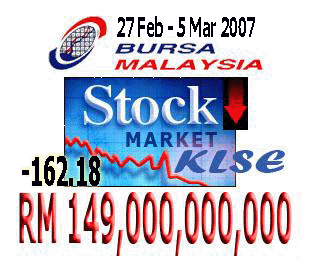
RM149 billion KLSE losses in 5 days


RM149 billion KLSE losses in 5 days

http://blog.limkitsiang.com/2007/03/06/rm149-billion-klse-losses-in-5-days-pmministers-not-stock-market-consultants/

What is a stock market index?

A stock market index is a measure of the average price level of the shares traded in the market.  Its use is analogous to the use of degree of celcius to measure the temperature.  It is constructed by comparing the current price of a sample of shares with their prices at some earlier date. 

The organization which is setting up the index (e.g. KLSE) has to make two decisions regarding the design of the index. 

First, what are the companies to be included in the index?

Second, what is to be the starting point of the index?

Both decisions would involve a certain degree of compromise.

In general, 30 companies is a good compromise to represent the actual situation at the stock market.  KLSE Indices have the starting date of 1st January 1970.  The KLSE Indices are given the base value of 100 as at 1st January 1970. 

There are various ways of computing an index but the easiest way to understand is probably the one using the market value of the companies included in the index. 

The KLSE Industrial Index has a based value of 100 at 1st of January 1970.  It stood at 700 at the end of August 1988.  This means that the market value of the companies chosen for the index had increased their total value by 600 per cent since 1970 (an average annual increase of 11.5 per cent). 

It is worthwhile to remember how indices are calculated and remind ourselves how much the market has gone up in the bull run.  When the market is next in a manic phase, we have to ask ourselves if it is feasible for the market to continue its performance in the future.

Click:
http://finance.yahoo.com/echarts?s=%5EKLSE#symbol=%5EKLSE;range=my
FTSE Bursa Malaysia KLCI Index (^KLSE)


http://blog.limkitsiang.com/2007/03/06/rm149-billion-klse-losses-in-5-days-pmministers-not-stock-market-consultants/
RM149 billion KLSE losses in 5 days

Market Timing

The fundamental approach to investment requires one to work out the intrinsic value of a share before its purchase. 

"Why don't we just wait until the whole market is low enough and then go in and buy a wide selection of shares?" 

This question suggests that one invests by means of "market timing". If practical, it will surely save us a lot of time and effort. 

  • Is it possible to carry out consistently correct market timing? 
  • How easy or difficult is the art of of market timing?

KLSE 1994 to 2009

http://finance.yahoo.com/echarts?s=%5EKLSE#symbol=%5EKLSE;range=my

Is there a correct time to buy and sell?

Tuesday, 27 October 2009

Insiders' actions in 3-A Resources


The share price of 3A rose rapidly to a high level recently.  What actions did the "smarter" insiders in 3A take?

Click here:
http://www.klse.com.my/website/bm/listed_companies/company_announcements/changes_in_s_holding/index.jsp

Type of transaction Date of change No of securities Price Transacted ($$)
Disposed 15/10/2009 2,448,002
Disposed 16/10/2009 2,300,000

Always INVESTigate before you INVEST


The recent budget introduces a mandatory basic insurance coverage

Insurance

A basic insurance and takaful scheme will be offered to provide mandatory basic insurance coverage for third party bodily injuries and death. The scheme is expected to be introduced by mid-2010.

Positive for insurance companies (Kurnia (NR), LPI (NR)) and banks with major insurance subsidiaries such AMMB (AmAssurance)

http://malaysiainfoedgezone.blogspot.com/2009/10/market-strategy-after-budget-2010-full.html

http://www.box.net/shared/uj9jmp9h63

Nestle 27.10.2009


Valuation
http://spreadsheets.google.com/pub?key=tdjqbDNEEF54lSn6z6yORcw&output=html


Comment:  Recent price has climbed faster than earnings.

Monday, 26 October 2009

Business model of Parkson Retail Group

PRG operates the Lion group's department store business in China.

The Hong Kong-listed PRG is sitting on cash reserves of RMB 3 billion (RM 1.49 billion).  The retailer is a 51.6% owned subsidiary of Parkson Holdings Bhd, in which Lion group boss Tan Sri William Cheng holds a 21.9% direct equity stake and 32.5% indirect stake.

After stripping out debts of RMB 2.3 billion, PRG is in a net cash position of RMB 667.5 million.

The retail giant is in a cash-generating business and its department stores are ringing up good sales.

Business model of Parkson Retail Group

PRG's growing cash pile is also due to its asset-light strategy.  It does not own many properties while its business model of letting out space to branded names does not tie up its cash with unsold inventories.

For instance, if John Master or Bonia has an outlet in Parkson, the inventory is held by the manufacturers themselves.  Parkson lets out the space and gets a commission from sales.  This way, it keeps its balance sheet light. 

Lingering Concerns

Local fund managers do buy into PRG's growth story.  It certainly does not take rocket science to figure out that China's robust growth augurs well for retailers such as PRG.  However, there is always a lingering concern because of the state of other companies within the Lion group. 

The concerns of investors are not entirely unjustified, going by the track record of other companies within the Lion group stable.  For instance, Lion Corp Bhd and Lion Industries are in net debt positions.  Further, Amsteel Corp Bhd, once the flagship of the Lion group, and Silverstone Corp Bhd were removed from Bursa Malaysia for failing to regularise their financial positions due to debt problems.

That explains why Parkson Holdings' share price on Bursa Malaysia has been lagging that of PRG's in Hong Kong.  The stock does not command the premium it deserves despite its exposure to the sizeable consumer market in China plus Vietnam - another booming emerging economy. 

PRG does not have a dividend policy

According to its managing director Alfred Cheng, PRG doesn't have a dividend policy.  However, the group has been paying out almost half of its earnings as dividends since it was listed in November 2005.  In the last financial year ended Dec 31, 2008, PRG paid out total dividends of RMB 405 million versus RMB 332.5 million in FY2207.

Paying regular dividends isn't a norm among the companies in the Lion group; PRG is probably the first to do so.  And PRG needs to keep it up to maintain its status as the group's cash-generating jewel.

Ref:  The Edge

Parkson's venture into Vietnam and Indochina

Revenues of Parkson at present are generated as shown:
75% from China
20% from Malaysia
6% from Vietnam

Parkson Holdings' total revenue for FY 2008 ended June 30 was RM 2.35 billion.
RM 1.55 billion from China
RM 718.9 million from Malaysia
RM 80 million from Vietnam

The growth in China is impressive. 

It is equally exciting in Vietnam too.  While small compared with the operations in China and Malaysia, Vietnam's contribution has nearly doubled from RM 41.9 million in FY 2007.

Vietnam is the stepping stone for Parkson Holdings to capture the market in Indochina, consisting of Vietnam, Cambodia and Laos.  Parkson plans to open its first store in Phnom Penh in 1H2011.

Whether Parkson's success in China can be repeated in Vietnam and greater Indochina will depend to a large extent on how it utilises its first-mover advantage to fend off competitors.

Vietnam:  Total retail sales in the first 8 months of this year rose 18.4% y-o-y to US$41.67 billion (RM 141 billion), according to the country's General Statistics Office.  The growth was recorded in a year that the global economy was in turmoil and the dong (the Vietnamese currency) devalued.

Ref:  The Edge