FREQUENTLY ASKED QUESTIONS
1. What is Expectations Investing about?
Stock prices are the clearest and most reliable signal of the market's expectations about a company's future performance. The key to successful investing is to estimate the level of expected performance embedded in the current stock price and then to assess the likelihood of a revision in expectations. Investors who properly read the market expectations and anticipate revisions increase their odds of achieving superior investment results. The expectations investing process allows you to identify the right expectations and effectively anticipate revisions in a company’s prospects. Expectations investing comprises the following three-step process:
Estimate Price-Implied Expectations. The expectations investor “reads” the expectations for cash flow embedded in a company's current stock price.
Identify Expectations Opportunities. The expectations investor then assesses those expectations, evaluates the company's competitive position, and considers the likelihood of upward or downward revisions in those expectations.
Buy, Sell, or Hold? The Expectations Investor makes a buy, sell, or hold decision, making sure that all investments have a clear-cut after-tax "margin of safety" between the stock's price today and the expected price tomorrow.
2. Do I need to be a financial guru to understand and apply the Expectations Investing approach?
If you feel comfortable reading The Wall Street Journal and other leading business and investment periodicals, you should easily grasp the basic concepts presented in the book.
To apply the expectations investing approach to selecting stocks, it helps to be familiar with spreadsheet software such as Microsoft Excel. We have made the spreadsheets presented in the book available for download at this web site, so don't worry; you won't need to create complex spreadsheets yourself!
3. Who should read this book?
This book brings the power of expectations investing to:
Institutional investors, security analysts, and investment advisors. Professional money managers who make investment decisions day-in and day-out, analysts who make stock recommendations, and investment advisors who often make buy and sell decisions for their clients will find that the Expectations Investing approach represents a fundamental shift from the way they evaluate stocks today.
Individual investors. Investment tools presented to the mass market are typically over-simplified so they can be easily understood, but as a consequence lack economic substance. Expectations investing is constructed on top of a solid economic foundation. Implementing expectations investing successfully, however, does require familiarity with the company and its competitive environment, finely honed insight, and dedication.
Corporate managers. We expect Expectations Investing to generate substantial interest in the corporate community. After all, both investors and managers accept stock prices as the "scorecard" for corporate performance. Companies seeking to outperform the Standard & Poor's 500 Index or an index of their peers can use expectations investing to establish the reasonableness of the goal.
Business students. All business schools offer finance courses that cover valuation and courses on competitive strategy. However, there are few courses that bridge competitive strategy and valuation. If you are eager to cross this chasm, Expectations Investing may be the book for you.
4. Can't I "read " market expectations using earnings per share (EPS) or price-to-earnings (P/E) multiples?
The answer is an emphatic "No"!
Investors who use EPS and P/E multiples may have their hearts in the right place, but their money on the wrong idea. Granted, the investment community undeniably fixates on EPS. Business publications amply cover quarterly earnings, EPS growth, and price-earnings multiples. This broad dissemination and the frequent market reactions to earnings announcements might lead some to believe that reported earnings strongly influence, if not totally determine stock prices.
Extensive empirical research finds that the market sets the prices of stocks just as it does any other financial asset. Specifically, the studies show two relationships. First, market prices respond to changes in a company’s cash-flow prospects. Second, market prices reflect long-term cash–flow prospects. Static measures such as reported EPS or estimates of next year’s EPS do not capture future performance, and ultimately they let investors down—especially in a global economy marked by spirited competition and disruptive technologies. Without assessing a company’s future cash-flow prospects, investors cannot reasonably conclude that a stock is undervalued or overvalued.
The investment community’s favorite valuation metric is the price-earnings (P/E) multiple. Presumably a stock’s value is the product of EPS and an “appropriate” P/E multiple. But since we know the EPS denominator of the P/E multiple, the only unknown is the appropriate share price, or P. We therefore are left with a useless tautology: To estimate value, we require an estimate of value.
This flawed logic underscores the fundamental point: The price-earnings multiple does not determine value; rather, it derives from value. Price-earnings analysis is not an analytic shortcut. It is an economic cul-de-sac.
5. Does Expectations Investing fall into the "growth" or "value" investing style?
Please don't associate us with either camp!
Most professional money managers classify their investing style as either “growth” or “value.” Growth managers seek companies that rapidly increase sales and profits and generally trade at high-price earnings multiples. Value managers seek stocks that trade at substantial discounts to their expected value and often have low price-earnings multiples. Significantly, fund industry consultants discourage money managers from drifting from their stated style, thus limiting their universe of acceptable stocks.
Expectations investing doesn’t distinguish between growth and value; managers simply pursue maximum long-term returns within a specified investment policy. As Warren Buffett convincingly argues, “Market commentators and investment managers who glibly refer to ‘growth’ and ‘value’ styles as contrasting approaches to investment are displaying their ignorance, not their sophistication. Growth is simply a component—usually a plus, sometime a minus—in the value equation.”
6. Does Expectations Investing work for technology stocks?
Unquestionably!
Fundamental economic principles endure, and they are sufficiently robust to capture the dynamics of value creation across all types of companies and business models. The principles of value creation—which are central to the expectations investing process—are the ties that bind all companies.
While fundamental economic tenets apply to all companies, when analyzing technology stocks, we have to take into account their source of competitive advantage.
Most technology companies are essentially knowledge businesses that develop a competitive advantage by having their people develop an initial product that is then reproduced over and over again. This contrasts with physical businesses that leverage tangible assets to create a competitive advantage, and service businesses that rely on people as the main source of advantage and generally deliver their service on a one-to-one basis. We need to incorporate the primary characteristics of knowledge businesses into our analyses of technology companies:the importance of product obsolescence, high scalability, the production of "non-rival" goods such as software that can be used by many people at once, the difficulty of protecting intellectual capital, and the existence of demand-side economies of scale.
http://www.expectationsinvesting.com/faq.shtml
Friday, 13 November 2009

Do profits matter? It's a fine line to walk between generating profits and growing.
April 21, 2000 8:15 AM PDT
Patience-to-Earnings ratio wears thin for dot-coms
By Tiffany Kary
Staff Writer, CNET News
.With the Nasdaq well below its March 10 high of 5,048, investors are finally asking what the 'E' in the P/E, or price-to-earnings ratio, means.
Although profits suddenly mean something to dot-com investors, some analysts and executives maintain Net companies still need leeway to build out their businesses.
Do profits matter?
The profit tug-of-war will determine the direction of Net stocks for the foreseeable future, said investment experts. The tug-of-war is already underway -- shares of Excite@Home (Nasdaq: ATHM) fell Thursday after the company said it was foregoing near-term profits for long-term market share. The usually optimistic Merrill Lynch analyst Henry Blodget said he didn't 'see any positive catalysts for the stock.'
And in recent weeks, companies with no roadmap to earnings suffered the most (see chart). Shares of companies like CDNow (Nasdaq: CDNW), DrKoop.com (Nasdaq: KOOP) and Webvan (Nasdaq: WBVN) have been decimated.
As investors shun promising ideas for real results, dot-coms will have to generate cash instead of running back to the market for a quick-fix stock offering. To determine the long-term winners, investors will have to scrutinize business models and look for balance between growth and profitability.
Growth vs. profit
It's a fine line to walk between generating profits and growing. Excite@Home was panned by some analysts because it chose international expansion over immediate profits. The problem? Excite@Home has been profitable and has a track record. The market is more forgiving with promising newcomers.
'Companies that have been around for a while should have profits, but newcomers should be allowed time to build market share,' said Abhishek Gami, analyst for William Blair & Co.
Gami said he would allow business-to-consumer e-commerce companies about 12 to 18 months to become profitable. In the business-to-business space, a company should have as much as two to three years to turn a profit. In B2B, there are only a handful of competitors and a lot of market share to grab. With a portal, he wouldn't look at anything that didn't plan on earnings within 12 to 18 months.
About.com (Nasdaq: BOUT), which is far below its 52-week high of 105 13/16, is caught in the middle.
'Investors are looking at the total market, not individual companies,' said About.com CEO Scott Kurnit. 'They are looking at stock charts, and bringing the company down to at least 50 percent below its 52-week high, without regard for when the company reached its peak, or why.'
Kurnit is hoping a path to profits and strong third and fourth quarters will give About.com a boost. But his company is still in danger: Kurnit said About.com won’t be profitable for another 20 months.
The profit club
About.com is on the outside looking into a club that includes Yahoo! Inc. (Nasdaq: YHOO), eBay (Nasdaq: EBAY), America Online (NYSE: AOL), RealNetworks (Nasdaq: RNWK), Lycos (Nasdaq: LCOS) and Go2Net (Nasdaq: GNET). Inktomi (Nasdaq: INKT) and CNet (Nasdaq: CNET) are the latest members to the profitable dot-com club.
'The end game is, everyone will ask about profitability for every Net stock,' said Go2Net president John Keister. 'In 1997, people were talking about investing in earnings multiples for 2000, and now its 2002. People keep pushing it out.
'Smart investors, and institutional investors may not be satisfied with this anymore. Everyone has to trade on a multiple of earnings and revenue growth,' said Keister.
Leadership counts too
Leadership also counts for a lot. Chuck Hill, director of research at earnings tracking firm First Call, noted that profitable companies such as Yahoo, Go2Net, RealNetworks, AOL and Lycos have held up better than others, but said it doesn't have much to do with earnings. Hill said those companies are seen as industry leaders, which will survive. 'Even these companies are selling at multiples that are questionable,' he added.
'When a new company comes along, it's valued as a concept. Then there's a correction, and those that survive go on to be a good growth stock,' Hill said.
http://news.cnet.com/Patience-to-Earnings-ratio-wears-thin-for-dot-coms/2100-12_3-262272.html
Patience-to-Earnings ratio wears thin for dot-coms
By Tiffany Kary
Staff Writer, CNET News
.With the Nasdaq well below its March 10 high of 5,048, investors are finally asking what the 'E' in the P/E, or price-to-earnings ratio, means.
Although profits suddenly mean something to dot-com investors, some analysts and executives maintain Net companies still need leeway to build out their businesses.
Do profits matter?
The profit tug-of-war will determine the direction of Net stocks for the foreseeable future, said investment experts. The tug-of-war is already underway -- shares of Excite@Home (Nasdaq: ATHM) fell Thursday after the company said it was foregoing near-term profits for long-term market share. The usually optimistic Merrill Lynch analyst Henry Blodget said he didn't 'see any positive catalysts for the stock.'
And in recent weeks, companies with no roadmap to earnings suffered the most (see chart). Shares of companies like CDNow (Nasdaq: CDNW), DrKoop.com (Nasdaq: KOOP) and Webvan (Nasdaq: WBVN) have been decimated.
As investors shun promising ideas for real results, dot-coms will have to generate cash instead of running back to the market for a quick-fix stock offering. To determine the long-term winners, investors will have to scrutinize business models and look for balance between growth and profitability.
Growth vs. profit
It's a fine line to walk between generating profits and growing. Excite@Home was panned by some analysts because it chose international expansion over immediate profits. The problem? Excite@Home has been profitable and has a track record. The market is more forgiving with promising newcomers.
'Companies that have been around for a while should have profits, but newcomers should be allowed time to build market share,' said Abhishek Gami, analyst for William Blair & Co.
Gami said he would allow business-to-consumer e-commerce companies about 12 to 18 months to become profitable. In the business-to-business space, a company should have as much as two to three years to turn a profit. In B2B, there are only a handful of competitors and a lot of market share to grab. With a portal, he wouldn't look at anything that didn't plan on earnings within 12 to 18 months.
About.com (Nasdaq: BOUT), which is far below its 52-week high of 105 13/16, is caught in the middle.
'Investors are looking at the total market, not individual companies,' said About.com CEO Scott Kurnit. 'They are looking at stock charts, and bringing the company down to at least 50 percent below its 52-week high, without regard for when the company reached its peak, or why.'
Kurnit is hoping a path to profits and strong third and fourth quarters will give About.com a boost. But his company is still in danger: Kurnit said About.com won’t be profitable for another 20 months.
The profit club
About.com is on the outside looking into a club that includes Yahoo! Inc. (Nasdaq: YHOO), eBay (Nasdaq: EBAY), America Online (NYSE: AOL), RealNetworks (Nasdaq: RNWK), Lycos (Nasdaq: LCOS) and Go2Net (Nasdaq: GNET). Inktomi (Nasdaq: INKT) and CNet (Nasdaq: CNET) are the latest members to the profitable dot-com club.
'The end game is, everyone will ask about profitability for every Net stock,' said Go2Net president John Keister. 'In 1997, people were talking about investing in earnings multiples for 2000, and now its 2002. People keep pushing it out.
'Smart investors, and institutional investors may not be satisfied with this anymore. Everyone has to trade on a multiple of earnings and revenue growth,' said Keister.
Leadership counts too
Leadership also counts for a lot. Chuck Hill, director of research at earnings tracking firm First Call, noted that profitable companies such as Yahoo, Go2Net, RealNetworks, AOL and Lycos have held up better than others, but said it doesn't have much to do with earnings. Hill said those companies are seen as industry leaders, which will survive. 'Even these companies are selling at multiples that are questionable,' he added.
'When a new company comes along, it's valued as a concept. Then there's a correction, and those that survive go on to be a good growth stock,' Hill said.
http://news.cnet.com/Patience-to-Earnings-ratio-wears-thin-for-dot-coms/2100-12_3-262272.html
Valuation Methodologies
Despite their widespread usage, only limited theory is available to guide the application of multiples. With a few exceptions, the finance and accounting literature contain inadequate support on how or why certain multiples or comparable firms should be chosen in specific contexts. Compared to the DCF and RIV approach, standard textbooks on valuation devote little space to discussing the multiples valuation method.
Valuation Methodologies
This note provides an overview of the wide range of methodologies employed by Davy analysts when valuing shares.
One approach used is to apply average valuation multiples derived over multi-year periods, primarily with a view to smoothing cyclical effects.
Share-based multiples include:
Historic and forward price/earnings (P/E) ratios, based on normalised earnings before goodwill amortisation
Historic and forward price/cash-earnings (pre-depreciation) ratios
Price to net asset value per share
Dividend yields
Enterprise-based valuation multiples include:
Historic and forward earnings before depreciation, interest, tax, depreciation or amortisation (EBITDA) ratios; EBITDAR ratios are used where rental/lease charges (R) are material
Historic and forward EBITA ratios
Historic and forward operating cash-flow ratios
Enterprise value (EV)/sales ratios
EV/invested capital ratios
As enterprise values include net financial liabilities and minority interests, these are then deducted to arrive at the residual equity value.
Cyclical considerations
In the case of average earnings multiples, cognisance is given to the stage of the relevant industry cycle, as it may not be appropriate to apply average multiples towards the peak or trough of a cycle. In such cases, earnings multiples prevailing at the corresponding stages of previous cycles may be used.
Asset-based valuations
In the case of asset-based valuations, reported net assets generally provide a floor to a company's valuation. In many cases, however, company accounts can understate the underlying economic value of a company's assets, and a ratio such as return on invested capital to weighted average cost of capital (ROIC/WACC) may provide a more appropriate indicator of the book value multiple.
Company comparisons
The ratings of similar companies may be taken into account in valuing shares, as indeed may average ratings for particular industry sectors. Such ratings are commonly used in analysts' sum-of-the-parts (SOTP) valuations.
Cash-flow based valuation
In discounted cash-flow (DCF) models a company's forecast future free cash-flows are discounted by its weighted WACC. Due to the uncertainties involved in forecasting long-term cash-flows, analysts use a number of different DCF models.
Other valuation techniques
In some instances, other valuation metrics may be used. For instance, enterprise value per tonne of installed capacity may be used in capital-intensive sectors or in the earlier stages of a company's development.
http://www.davy.ie/Generic?page=valuationmethodologies
Valuation Methodologies
This note provides an overview of the wide range of methodologies employed by Davy analysts when valuing shares.
One approach used is to apply average valuation multiples derived over multi-year periods, primarily with a view to smoothing cyclical effects.
Share-based multiples include:
Historic and forward price/earnings (P/E) ratios, based on normalised earnings before goodwill amortisation
Historic and forward price/cash-earnings (pre-depreciation) ratios
Price to net asset value per share
Dividend yields
Enterprise-based valuation multiples include:
Historic and forward earnings before depreciation, interest, tax, depreciation or amortisation (EBITDA) ratios; EBITDAR ratios are used where rental/lease charges (R) are material
Historic and forward EBITA ratios
Historic and forward operating cash-flow ratios
Enterprise value (EV)/sales ratios
EV/invested capital ratios
As enterprise values include net financial liabilities and minority interests, these are then deducted to arrive at the residual equity value.
Cyclical considerations
In the case of average earnings multiples, cognisance is given to the stage of the relevant industry cycle, as it may not be appropriate to apply average multiples towards the peak or trough of a cycle. In such cases, earnings multiples prevailing at the corresponding stages of previous cycles may be used.
Asset-based valuations
In the case of asset-based valuations, reported net assets generally provide a floor to a company's valuation. In many cases, however, company accounts can understate the underlying economic value of a company's assets, and a ratio such as return on invested capital to weighted average cost of capital (ROIC/WACC) may provide a more appropriate indicator of the book value multiple.
Company comparisons
The ratings of similar companies may be taken into account in valuing shares, as indeed may average ratings for particular industry sectors. Such ratings are commonly used in analysts' sum-of-the-parts (SOTP) valuations.
Cash-flow based valuation
In discounted cash-flow (DCF) models a company's forecast future free cash-flows are discounted by its weighted WACC. Due to the uncertainties involved in forecasting long-term cash-flows, analysts use a number of different DCF models.
Other valuation techniques
In some instances, other valuation metrics may be used. For instance, enterprise value per tonne of installed capacity may be used in capital-intensive sectors or in the earlier stages of a company's development.
http://www.davy.ie/Generic?page=valuationmethodologies
Fair market valuation of a business
Fair market valuation of a business
Table of earnings multiples for groups of industries
(choose the earnings multiple for the industry closest to the one you are valuing)
Very narrow profit variation - 10 times average earnings
Cosmetics; Food; Tobacco; Utilities
Moderately narrow profit variation - 9 times average earnings
Amusement; Beverages; Chemical; Container; Drug; Meat Packing; Oil; Paper / Paper Products; Retail Trade; Sugar; Textile
Moderately wide profit variation - 7 times average earnings
Advertising; Agricultural Impt.; Aviation; Boots and Shoes; Coal; Electrical Equipment; Household Products; Financial; Leather; Office Equipment; Printing; Publishing; Radio; Railroad; Rubber; Shipping; Ship Building
Very wide profit variation - 6 times average earnings
Automobiles; Automobile Accessories; Construction; Machinery; Non-Ferrous Met.; R.R. Equipment; Steel
http://www.investordesktop.com/calcs/calcs/busins_fmvb_tbl.htm
Table of earnings multiples for groups of industries
(choose the earnings multiple for the industry closest to the one you are valuing)
Very narrow profit variation - 10 times average earnings
Cosmetics; Food; Tobacco; Utilities
Moderately narrow profit variation - 9 times average earnings
Amusement; Beverages; Chemical; Container; Drug; Meat Packing; Oil; Paper / Paper Products; Retail Trade; Sugar; Textile
Moderately wide profit variation - 7 times average earnings
Advertising; Agricultural Impt.; Aviation; Boots and Shoes; Coal; Electrical Equipment; Household Products; Financial; Leather; Office Equipment; Printing; Publishing; Radio; Railroad; Rubber; Shipping; Ship Building
Very wide profit variation - 6 times average earnings
Automobiles; Automobile Accessories; Construction; Machinery; Non-Ferrous Met.; R.R. Equipment; Steel
http://www.investordesktop.com/calcs/calcs/busins_fmvb_tbl.htm
Price to earnings ratio (P/E ratio) explained
Price to earnings ratio (P/E ratio) explained
by Kenneth W. McCarty
Price to earnings ratio (P/E ratio sometimes referred to as the multiple) is the current price per share divided by a years worth of earnings per share (EPS) for a particular stock. It is an important indicator of perceived value for a stock. Often it is used to compare two different stocks in the same sector (or two sectors in a given market) in an effort to find the better "deal". It sounds simple enough, but in practice it is a bit more complicated.
Not all publicly traded companies have earnings (they can have losses instead), yet these stocks clearly have value. P/E in such circumstance cannot be relied upon when it is negative or undefined. Much more important for estimating the current value of this type of equity are such things as cash on hand and other tangible assets. Some investors may anticipate that the stock will eventually have real earnings and add perceived value to the stock based on this assumption.
A backwards or "trailing" P/E takes into account only the earnings for the past year. In a "Bull Market", this form of P/E can be considered an indicator for the floor of a stock's share price. Instead of estimates, the earnings stated in the last 4 quarterly reports are publicly known and are generally not subject to change at a whim (except when future reports become current or the company is forced to make restatements by the SEC or an unfavorable audit).
Many investors prefer to use a forward P/E instead. This speculative potential of the stock's perceived worth that may or may not be added into the price anticipates and uses earnings over the next 12 months. Market forces determine how reliable such calculated predictions are and adjust prices accordingly. Company track records and economic influences are used by traders to judge the reliability of those numbers.
The difference between the two values that forward and backward P/E represent helps create volatility in the price of the stock as traders try to forecast earnings. Different stocks trade over different ranges of multiples for a variety of reasons. Many stocks in mature industries historically tend to trade between multiples of 10 and 20. Technology stocks that have real earnings often trade between multiples of 20 and 40. A company that has significant revenue growth may deserve a much higher multiple than this because the implication is that notable future earnings growth will continue to occur. When track records for 10Q quarterly reports are consistently positive, investors tend to follow the idea that solid companies under good management will continue to notify the market of future earnings growth. Investors like to trade on trends because "the trend is your friend".
When traders and investors on the market either become extremely pessimistic or optimistic, historical range standards for P/Es generally do not hold true over the short-term. During the height of the stock bubble of 1999 and 2000, too many stocks traded with ratios over 500! Such imbalances are eventually corrected and that is what happened. Knowing the historical standards gives us insight into why those stock prices eventually crashed so abruptly and steeply. The trend could no longer continue.
In contrast, currently there is a dramatic pessimism depressing prices in the stock market (since November of 2007). I've seen a number of technology stocks trade with a backward P/E of 10 or lower. Certainly in this financial environment a P/E of around 15 seems common for even a technology stock! Some might even consider the trend justified because of the implications inherent from a failing sub-prime loan market. Yet these P/E ratios are far below the historic average even in the worst of times.
Even more unusual is that some of those same stocks are experiencing record breaking increased earnings with projected significant earnings growth - despite the continued horrendous condition of the financial sector. Some of these stock's earnings performance over the last 6 to 9 months have even been better than the most optimistic expectations. Yet a few of these top performers have had their price cut nearly in half with little to no recovery! Clearly there are forces other than just P/E ratios and growth potential at work when the market determines the worth of a given stock at any given time. Part of my job as a trader is to ask why this is happening at this particular time and respond appropriately. Keep in mind that history tells us a significant correction to the upside is inevitable once investors recognize the "good deals" available.
http://www.helium.com/items/1082973-what-is-pe-ratio
by Kenneth W. McCarty
Price to earnings ratio (P/E ratio sometimes referred to as the multiple) is the current price per share divided by a years worth of earnings per share (EPS) for a particular stock. It is an important indicator of perceived value for a stock. Often it is used to compare two different stocks in the same sector (or two sectors in a given market) in an effort to find the better "deal". It sounds simple enough, but in practice it is a bit more complicated.
Not all publicly traded companies have earnings (they can have losses instead), yet these stocks clearly have value. P/E in such circumstance cannot be relied upon when it is negative or undefined. Much more important for estimating the current value of this type of equity are such things as cash on hand and other tangible assets. Some investors may anticipate that the stock will eventually have real earnings and add perceived value to the stock based on this assumption.
A backwards or "trailing" P/E takes into account only the earnings for the past year. In a "Bull Market", this form of P/E can be considered an indicator for the floor of a stock's share price. Instead of estimates, the earnings stated in the last 4 quarterly reports are publicly known and are generally not subject to change at a whim (except when future reports become current or the company is forced to make restatements by the SEC or an unfavorable audit).
Many investors prefer to use a forward P/E instead. This speculative potential of the stock's perceived worth that may or may not be added into the price anticipates and uses earnings over the next 12 months. Market forces determine how reliable such calculated predictions are and adjust prices accordingly. Company track records and economic influences are used by traders to judge the reliability of those numbers.
The difference between the two values that forward and backward P/E represent helps create volatility in the price of the stock as traders try to forecast earnings. Different stocks trade over different ranges of multiples for a variety of reasons. Many stocks in mature industries historically tend to trade between multiples of 10 and 20. Technology stocks that have real earnings often trade between multiples of 20 and 40. A company that has significant revenue growth may deserve a much higher multiple than this because the implication is that notable future earnings growth will continue to occur. When track records for 10Q quarterly reports are consistently positive, investors tend to follow the idea that solid companies under good management will continue to notify the market of future earnings growth. Investors like to trade on trends because "the trend is your friend".
When traders and investors on the market either become extremely pessimistic or optimistic, historical range standards for P/Es generally do not hold true over the short-term. During the height of the stock bubble of 1999 and 2000, too many stocks traded with ratios over 500! Such imbalances are eventually corrected and that is what happened. Knowing the historical standards gives us insight into why those stock prices eventually crashed so abruptly and steeply. The trend could no longer continue.
In contrast, currently there is a dramatic pessimism depressing prices in the stock market (since November of 2007). I've seen a number of technology stocks trade with a backward P/E of 10 or lower. Certainly in this financial environment a P/E of around 15 seems common for even a technology stock! Some might even consider the trend justified because of the implications inherent from a failing sub-prime loan market. Yet these P/E ratios are far below the historic average even in the worst of times.
Even more unusual is that some of those same stocks are experiencing record breaking increased earnings with projected significant earnings growth - despite the continued horrendous condition of the financial sector. Some of these stock's earnings performance over the last 6 to 9 months have even been better than the most optimistic expectations. Yet a few of these top performers have had their price cut nearly in half with little to no recovery! Clearly there are forces other than just P/E ratios and growth potential at work when the market determines the worth of a given stock at any given time. Part of my job as a trader is to ask why this is happening at this particular time and respond appropriately. Keep in mind that history tells us a significant correction to the upside is inevitable once investors recognize the "good deals" available.
http://www.helium.com/items/1082973-what-is-pe-ratio
When to start investing for retirement
When to start investing for retirement
by Janet Grischy
The best time to prepare for your retirement is when it seems much too far off to worry about. People in their twenties and early thirties know they have years before retirement, but they may not know how quickly those years will pass. Money put into a retirement vehicle in your youth is worth ten times or more what the same amount will be worth if socked away at age 59. That's because of compounding.
Compounding is the magic ingredient in retirement investing. It can turn a pile of small investments into millions, given time. The longer an investment has to grow, the more likely you'll retire as a billionaire. This is because as the years pass you get a return on your investment, and then a return on the return, and then a return on the return on the return, and so on.
Many people start investing for retirement when they get their first "real" job, when their company or union makes a payroll deduction plan available to them. That way, money is taken out of their pay before they ever see it, and preparing for the future is easy, because it's automated. Americans who are self-employed, or who change jobs often, need to start their own investment plan, making it a habit to consistently put money in an IRA or Keogh each pay period.
Money in an IRA or Keogh avoids taxes, either when it's put in or when it is taken out, and it's all quite legal! Without the drag of taxes to slow you down, you can invest more, faster. It will grow much faster too. Your investing also helps your country, by adding to the stock of capital available to business and industry.
Another good time to invest is in your thirties and forties. Now you are mature, and acquainted with the financial realities of life. You have a clear idea of the kind of retirement you want, and can make a plan to go after it. You'll have to save a bit more than you would have if you'd started sooner, but you may be making more than you did then, too.
Even the fifties and sixties are a good time to start investing for retirement. The government knows that you have to make up for the investments you neglected to make earlier, so it permits larger contributions to your IRA at this age. The sense of urgency you feel will also help guide you when you make decisions that will affect your finances.
When is the best time to prepare for your future by investing for retirement? There's a simple answer to that question. Now.
http://www.helium.com/items/1248480-when-to-start-investing-for-retirement
by Janet Grischy
The best time to prepare for your retirement is when it seems much too far off to worry about. People in their twenties and early thirties know they have years before retirement, but they may not know how quickly those years will pass. Money put into a retirement vehicle in your youth is worth ten times or more what the same amount will be worth if socked away at age 59. That's because of compounding.
Compounding is the magic ingredient in retirement investing. It can turn a pile of small investments into millions, given time. The longer an investment has to grow, the more likely you'll retire as a billionaire. This is because as the years pass you get a return on your investment, and then a return on the return, and then a return on the return on the return, and so on.
Many people start investing for retirement when they get their first "real" job, when their company or union makes a payroll deduction plan available to them. That way, money is taken out of their pay before they ever see it, and preparing for the future is easy, because it's automated. Americans who are self-employed, or who change jobs often, need to start their own investment plan, making it a habit to consistently put money in an IRA or Keogh each pay period.
Money in an IRA or Keogh avoids taxes, either when it's put in or when it is taken out, and it's all quite legal! Without the drag of taxes to slow you down, you can invest more, faster. It will grow much faster too. Your investing also helps your country, by adding to the stock of capital available to business and industry.
Another good time to invest is in your thirties and forties. Now you are mature, and acquainted with the financial realities of life. You have a clear idea of the kind of retirement you want, and can make a plan to go after it. You'll have to save a bit more than you would have if you'd started sooner, but you may be making more than you did then, too.
Even the fifties and sixties are a good time to start investing for retirement. The government knows that you have to make up for the investments you neglected to make earlier, so it permits larger contributions to your IRA at this age. The sense of urgency you feel will also help guide you when you make decisions that will affect your finances.
When is the best time to prepare for your future by investing for retirement? There's a simple answer to that question. Now.
http://www.helium.com/items/1248480-when-to-start-investing-for-retirement
WHAT DOES PE RATIO TELL YOU?
WHAT DOES IT TELL YOU?
The P/E ratio gives us an idea of how much the investors are willing to pay for the company's earnings. The higher the P/E, more the chances of good earnings in the future and the higher premium investors are ready to pay for that anticipated growth. A lower ratio on the other hand means just the opposite; that the market has ruled out the company.
But just because the ratio is very high or very low cannot help investors to make a decision. A high P/E can also be an overpriced stock. Also if one stock has double the P/E of another stock in the same industry, but with the same rate of earnings growth, it is not seen to be a wise investment as more money has to be shelled out. A low P/E ratio may be a market that was overlooked. The investors who discover the true worth of such stocks make big fortunes overnight.
There are various interpretations for the P/E value and this is just one of them:
*N/A: A company with no earnings has an undefined P/E ratio. Companies with losses or negative earnings also fall under this category.
*0-10: This means that the company's earnings are declining. It could also mean an overlooked stock.
*10-17: This is the average healthy value
*17-25: This means that the stock is either overvalued or its earnings are increasing.
*25+: Such companies are expected to have high future growth in earnings.
It is important that investors note avoid basing a decision on this measure alone. The ratio is dependent on share price which can fluctuate according to changes in the market.
http://www.helium.com/items/1059698-price-to-earnings-ratio-pe-ratio-explained
The P/E ratio gives us an idea of how much the investors are willing to pay for the company's earnings. The higher the P/E, more the chances of good earnings in the future and the higher premium investors are ready to pay for that anticipated growth. A lower ratio on the other hand means just the opposite; that the market has ruled out the company.
But just because the ratio is very high or very low cannot help investors to make a decision. A high P/E can also be an overpriced stock. Also if one stock has double the P/E of another stock in the same industry, but with the same rate of earnings growth, it is not seen to be a wise investment as more money has to be shelled out. A low P/E ratio may be a market that was overlooked. The investors who discover the true worth of such stocks make big fortunes overnight.
There are various interpretations for the P/E value and this is just one of them:
*N/A: A company with no earnings has an undefined P/E ratio. Companies with losses or negative earnings also fall under this category.
*0-10: This means that the company's earnings are declining. It could also mean an overlooked stock.
*10-17: This is the average healthy value
*17-25: This means that the stock is either overvalued or its earnings are increasing.
*25+: Such companies are expected to have high future growth in earnings.
It is important that investors note avoid basing a decision on this measure alone. The ratio is dependent on share price which can fluctuate according to changes in the market.
http://www.helium.com/items/1059698-price-to-earnings-ratio-pe-ratio-explained
Demystifying Small Business Valuation
Demystifying Small Business Valuation
Valuing a business is based on return on your investment (ROI). The value of a Business for Sale does not need to be subjective and can be based on several attributes and industry best practices.
Approach to Business Valuation
Valuing businesses is of paramount importance to a small business. It is one of the several metrics used to ensure the business is growing and creating value for the owners. There are several approaches to valuing a business including:
• Revenue Multiples
Earnings Multiples (including EBITA and operating income)
• Multiple of Book Value
Multiple of a measured unit (Like Restaurant tables, hospital beds, subscribers and more)
Rules of thumb are used by business brokers to ascertain the price of a business and simplify the valuation process. However, one must be mindful that the values determined using “Rule of thumb” are simplifications and only an estimate of the true value of the business. The “Rule of thumb” approach is used as a staring point before conducting detailed due-diligence to ascertain the correct value. Some examples of “Rules of thumb” used in the industry are listed in Table 1 below:
Table 1: Rules of Thumb Valuation
Type of Business “Rule of Thumb” valuation
Book Stores 15% of annual sales + inventory
Coffee Shops 40% - 45% of annual sales + inventory
Food/Gourmet Shops 20% of annual sales + inventory
Gas Stations 15% - 25% of annual sales + equip/inventory
Restaurants (non-franchised) 30% - 45% of annual sales
Dry Cleaners 70% - 100% of annual sales
A common approach to valuing a business is to use earnings or sales multiples. In this case since the price it is derived from annual earnings or sales and it directly addresses a buyer’s motive of estimating the return on investment (ROI) on deals.
When using earnings multipliers, it is inappropriate to get the multiples from Real Estate or Stock Markets. Real Estate is historically priced at 8 to 10 times its net operating income (EBITA). Stock markets are typically priced at 12 to 20 times earnings. These multiples do not apply to small businesses as the risk premium associated with a small business is much higher than managing a building or a stock portfolio.
Therefore, the first step in using the earnings multiplier approach is to determine which earnings multiplier is to be used. For example, one could use the current earnings, next year’s earnings or last 5 years earnings averaged. Other factors to consider include determining the composition of earnings. Do we need to calculate earnings after owner’s pay and perks, interest expenses, depreciation and taxes? The preferred earnings to use are 'Earnings before Interest and Taxes’ (EBIT).
Normalized earnings are adjusted for cyclical ups and downs in the economy. They are also adjusted for unusual or one-time influences. For small businesses normalized earnings projections are quite useful.
Finally we need to determine the multiplier. The number picked for multiplier is based on risk and there usually are “Rules of Thumb” multiplier numbers depending on the industry.
Using a multiplier with annual sales is also a common approach. For example, the “Rule of thumb” for a coffee shop is 40% - 45% of annual sales + inventory.
Tangible and Intangible assets
A tangible asset is an asset that has a physical form such as land, buildings and machinery. Intangible assets are the opposite of tangible assets. Intangible assets include patents, trademarks, brand value etc. Tangible and intangible assets raise interesting questions when valuing a business.
Typically once the value of the business itself has been ascertained, we need to factor in a value for Tangible and Intangible assets. These assets usually have a value separate from the business. One way to determine if an asset should be included as a tangible/intangible asset or included in the price for the business is to determine if the asset was used to generate the projected earnings. If the asset was used to generate earnings it should be included as a part of the multiple derived price of the business.
Factoring in tangible assets separately is especially true for businesses that own land and buildings, as these assets can be sold in the market even if the business failed. Therefore the best way to treat tangible/intangible asset is to separate them from the business and then add them back to the multiple derived value of the business. Obviously during the valuation period, asserts should not be counted twice. For example if the building has been factored out as a tangible and intangible asset, then rent for the premises must be subtracted from the business earnings. Similarly inventory impacts the business value. Typically inventory is valued at cost and treated as a tangible asset.
Earnings Multiples
After the value of tangible and intangible assets is determined we need to determine the value of the business using the correct multiples. Multiples used are very specific to a business and location of the business but broadly speaking it can be between 2 to 5 times normalized EBIT (Earnings before Interest and Taxes). The business can be worth more if it is has distinctive attributes that make it very attractive. To the buyer, 2 to 5 times earnings represent getting back their investment in the business in 2 to 5 years from profits a projected annual return of 20% to 50%.
Eventually the right multiple is the amount the buyer is willing to pay for the business. A business can demand higher multiples by clearly defining a case to increase earnings over time.
Disadvantages and caveats
Based on the content covered earlier, you may wonder how one can be certain the business valuation is perfect for the business buyer and seller. In reality there is no perfect price and techniques described in the earlier sections are just guidelines to derive an acceptable price.
The multiplier approach discussed does not provide sufficient information to assess the uniqueness of the business, such as management depth, customer relationships, industry trends, reputation, location, competition, capital structure and other information unique to the business. Further, two businesses of the same type and same revenue can have different cash flows.
The rules for evaluating a business are more of guidance then a hard and fast rule. They should be thought of as a starting point which can be further refined by factors specifically impacting the business. Proper evaluation will go beyond calculations based on multiples and tangible/intangible asset values. It requires complete business, marketing and financial due-diligence. However the approach describes in this article can play a key role in determining a starting value of your business.
Sites such as http://www.buysellbusiness.org allow entrepreneurs to do deals by buying and selling businesses and partnering. When researching businesses for deals, these guidelines can play an important role in quickly calculating the intrinsic value of a business.
http://www.buysellbusiness.org/BusinessTools/BizValuations.aspx
Valuing a business is based on return on your investment (ROI). The value of a Business for Sale does not need to be subjective and can be based on several attributes and industry best practices.
Approach to Business Valuation
Valuing businesses is of paramount importance to a small business. It is one of the several metrics used to ensure the business is growing and creating value for the owners. There are several approaches to valuing a business including:
• Revenue Multiples
Earnings Multiples (including EBITA and operating income)
• Multiple of Book Value
Multiple of a measured unit (Like Restaurant tables, hospital beds, subscribers and more)
Rules of thumb are used by business brokers to ascertain the price of a business and simplify the valuation process. However, one must be mindful that the values determined using “Rule of thumb” are simplifications and only an estimate of the true value of the business. The “Rule of thumb” approach is used as a staring point before conducting detailed due-diligence to ascertain the correct value. Some examples of “Rules of thumb” used in the industry are listed in Table 1 below:
Table 1: Rules of Thumb Valuation
Type of Business “Rule of Thumb” valuation
Book Stores 15% of annual sales + inventory
Coffee Shops 40% - 45% of annual sales + inventory
Food/Gourmet Shops 20% of annual sales + inventory
Gas Stations 15% - 25% of annual sales + equip/inventory
Restaurants (non-franchised) 30% - 45% of annual sales
Dry Cleaners 70% - 100% of annual sales
A common approach to valuing a business is to use earnings or sales multiples. In this case since the price it is derived from annual earnings or sales and it directly addresses a buyer’s motive of estimating the return on investment (ROI) on deals.
When using earnings multipliers, it is inappropriate to get the multiples from Real Estate or Stock Markets. Real Estate is historically priced at 8 to 10 times its net operating income (EBITA). Stock markets are typically priced at 12 to 20 times earnings. These multiples do not apply to small businesses as the risk premium associated with a small business is much higher than managing a building or a stock portfolio.
Therefore, the first step in using the earnings multiplier approach is to determine which earnings multiplier is to be used. For example, one could use the current earnings, next year’s earnings or last 5 years earnings averaged. Other factors to consider include determining the composition of earnings. Do we need to calculate earnings after owner’s pay and perks, interest expenses, depreciation and taxes? The preferred earnings to use are 'Earnings before Interest and Taxes’ (EBIT).
Normalized earnings are adjusted for cyclical ups and downs in the economy. They are also adjusted for unusual or one-time influences. For small businesses normalized earnings projections are quite useful.
Finally we need to determine the multiplier. The number picked for multiplier is based on risk and there usually are “Rules of Thumb” multiplier numbers depending on the industry.
Using a multiplier with annual sales is also a common approach. For example, the “Rule of thumb” for a coffee shop is 40% - 45% of annual sales + inventory.
Tangible and Intangible assets
A tangible asset is an asset that has a physical form such as land, buildings and machinery. Intangible assets are the opposite of tangible assets. Intangible assets include patents, trademarks, brand value etc. Tangible and intangible assets raise interesting questions when valuing a business.
Typically once the value of the business itself has been ascertained, we need to factor in a value for Tangible and Intangible assets. These assets usually have a value separate from the business. One way to determine if an asset should be included as a tangible/intangible asset or included in the price for the business is to determine if the asset was used to generate the projected earnings. If the asset was used to generate earnings it should be included as a part of the multiple derived price of the business.
Factoring in tangible assets separately is especially true for businesses that own land and buildings, as these assets can be sold in the market even if the business failed. Therefore the best way to treat tangible/intangible asset is to separate them from the business and then add them back to the multiple derived value of the business. Obviously during the valuation period, asserts should not be counted twice. For example if the building has been factored out as a tangible and intangible asset, then rent for the premises must be subtracted from the business earnings. Similarly inventory impacts the business value. Typically inventory is valued at cost and treated as a tangible asset.
Earnings Multiples
After the value of tangible and intangible assets is determined we need to determine the value of the business using the correct multiples. Multiples used are very specific to a business and location of the business but broadly speaking it can be between 2 to 5 times normalized EBIT (Earnings before Interest and Taxes). The business can be worth more if it is has distinctive attributes that make it very attractive. To the buyer, 2 to 5 times earnings represent getting back their investment in the business in 2 to 5 years from profits a projected annual return of 20% to 50%.
Eventually the right multiple is the amount the buyer is willing to pay for the business. A business can demand higher multiples by clearly defining a case to increase earnings over time.
Disadvantages and caveats
Based on the content covered earlier, you may wonder how one can be certain the business valuation is perfect for the business buyer and seller. In reality there is no perfect price and techniques described in the earlier sections are just guidelines to derive an acceptable price.
The multiplier approach discussed does not provide sufficient information to assess the uniqueness of the business, such as management depth, customer relationships, industry trends, reputation, location, competition, capital structure and other information unique to the business. Further, two businesses of the same type and same revenue can have different cash flows.
The rules for evaluating a business are more of guidance then a hard and fast rule. They should be thought of as a starting point which can be further refined by factors specifically impacting the business. Proper evaluation will go beyond calculations based on multiples and tangible/intangible asset values. It requires complete business, marketing and financial due-diligence. However the approach describes in this article can play a key role in determining a starting value of your business.
Sites such as http://www.buysellbusiness.org allow entrepreneurs to do deals by buying and selling businesses and partnering. When researching businesses for deals, these guidelines can play an important role in quickly calculating the intrinsic value of a business.
http://www.buysellbusiness.org/BusinessTools/BizValuations.aspx
Your special industry number: Every industry has at least one.
Your special industry number
Every industry has at least one. Here are some examples:
Restaurants: covers per night, wastage.
Services: staff utilisation rates.
Hotels: occupancy rates.
Builders: work in progress, progress payments due.
Retail: sales per metre of floor space.
Knowing the benchmark indicators for your industry can help you compare yourself with your peers, measure your business’s success, and identify any problems.
http://www.commbank.com.au/business/betterbusiness/growing-a-business/five-numbers/default.aspx
Every industry has at least one. Here are some examples:
Restaurants: covers per night, wastage.
Services: staff utilisation rates.
Hotels: occupancy rates.
Builders: work in progress, progress payments due.
Retail: sales per metre of floor space.
Knowing the benchmark indicators for your industry can help you compare yourself with your peers, measure your business’s success, and identify any problems.
http://www.commbank.com.au/business/betterbusiness/growing-a-business/five-numbers/default.aspx
****A P/E ratio is a much better indicator of a stock's value than its market price alone.
Everything You Must Know About The P/E Ratio
And as a bonus, the PEG ration as well.
By Mark Vergenes
--------------------------------------------------------------------------------
Question: What is a P/E and PEG Ratio?
The usefulness of the price-to-earnings (P/E) and price-to-earnings growth (PEG) ratios depends on how they are calculated, what kind of market you're in, and how well you grasp their limitations. This overview can help you understand the mechanics underlying these common valuation measures and better finesse stock and market evaluations.
It's so simple, it often seems sublime. The term "P/E" or "price/earnings ratio" gets bandied about so freely, it's easy to assume that everyone knows what it is and how it's used. The ratio is one of the oldest and most frequently used metrics for valuing stocks. Though simple to construct, a P/E ratio is actually difficult to interpret. It can be extremely informative in some situations, yet virtually meaningless in other contexts.
P/E ratio explained
As the name implies, the ratio expresses the relationship of a company's per-share earnings to its stock price. To calculate the P/E, simply divide a stock's current market price (CMP) by its issuer's earnings per share (EPS):
P/E = CMP ÷ EPS
Typically, P/E ratios are historic in nature. These "trailing" P/Es are calculated using EPS from the preceding four quarters. A "leading" or "projected" P/E, alternatively, is derived from earnings expected over the coming four quarters. This P/E, of course, is an estimate. Hybrid P/Es can also be created using the EPS of the past two quarters and estimates for the next two quarters. The P/E ratio is also often called the "multiple" because it shows how much investors are willing to pay for each $1 of a company's earnings. Not all companies, of course, produce profits. And it's these operations that create problems for analysts cranking out P/Es. When the divisor is negative (losses, after all, are manifested as negative EPS), some analysts report a negative P/E, while others bestow a P/E of zero on the company. Most analysts, however, just say the P/E doesn't exist.
The market P/E--at least, the market represented by the S&P 500 Index--has historically ranged between 15 and 25. A market P/E of over 18 is usually considered expensive, while a market P/E under 10 is considered inexpensive or undervalued. P/Es can also vary widely among different market segments. The P/E for the technology sector as of March 2005, for example, is around 28, while the overall multiple for financial companies is not quite 16.
Interpreting a P/E ratio
On the surface, a stock's P/E indicates the price the public is willing to pay for a company's earnings. A P/E ratio of 25, for example, suggests that investors are ready to fork over $25 for every $1 of company profits. Since a stock's price not only reflects a firm's worth now but also what investors think it will be worth in the future, this simplistic interpretation of P/E ignores growth prospects. Using forward EPS projections compensates in some measure for this.
P/Es are one of the metrics used to classify stocks as "growth" or "value" plays. As a rule of thumb, most stocks trade with P/Es 50 percent higher than their forecasted annual earnings growth. For example, a P/E of 30 would be considered reasonable for a company expected to grow earnings around 20 percent annually. That company's stock might be classified as a "growth" issue (ignoring all other factors) if it were priced above a 30 P/E, while a ratio under 30 might tip it into the "value" category.
A high P/E--that is, one above a company's "reasonable" earnings multiple or higher than the market or industry average--typically indicates very optimistic earnings prospects. A company brandishing a high P/E ratio eventually has to live up to these expectations, of course, or see its stock price drop as a consequence. A stock with a high P/E can still be a good buy for the long term, but further research may be needed to justify the price. Extreme ratios--multiples in the thousands, for instance--are typical of startups with little or no revenues.
What is "cheap"?
A P/E ratio is a much better indicator of a stock's value than its market price alone. All things being equal, a $10 stock with a P/E of 50 is much more "expensive" than a $100 stock with a P/E of 20. There are limits to this form of analysis, of course. A particular P/E can only be considered high or low by taking into account other factors, namely:
• Growth rates. How fast has the company been growing in the past, and is that rate expected to increase or at least continue into the future? A stratospheric P/E sported by a company that's growing earnings at a measly 5 percent annual clip might very well be overpriced.
• Industry. Apples, of course, should only be compared to other apples. Financial companies like banks typically have low multiples, while technology stocks' P/Es tend to be high. Using P/E to compare a tech company to a bank offers little actionable information. It's better to compare companies to others in the same industry or to the industry average.
Problems with P/E
While P/E ratios can point out overvalued or undervalued companies, P/E analysis is valid only in certain circumstances. For one thing, accounting rules change over time and vary from one country to the next, complicating cross-border analysis or historic comparisons. The inclusion of non-cash items, such as depreciation, into earnings further clouds the picture. Worse still, EPS can be presented in a variety of ways depending on how a company or an analyst chooses to do the math. EPS can be based upon either outstanding or fully diluted shares, for example. "Pro forma" EPS presentations can be especially vexing in comparisons, making it difficult to discern if apples are actually put up against apples.
Most importantly, P/E ratios are strongly influenced by inflation. P/Es, as a rule, head south during times of high inflation because of the resulting understatement of inventory and depreciation costs. The flip-side of this coin is that P/E ratios often seem lofty in periods of low inflation. When inflation moderates, central bank rate hikes become less likely, creating expansive expectations for earnings. Additionally, earnings quality rises, meaning that companies' improved financial results are more likely to be attributed to actual growth rather than the inflation of asset prices.
Trading on P/E information
Keeping the foregoing in mind, traders tread the P/E waters carefully. A low P/E ratio doesn't automatically mean that a company is undervalued--it could actually spell trouble for the company in the near future. A company that has warned of lower-than-expected earnings, for example, might look undervalued if a trailing P/E is used as the basis for analysis. Conversely, a high P/E ratio might mean that a stock is overvalued, but that's hardly a guarantee that its price will fall anytime soon. A P/E ratio is only one part of the jigsaw puzzle that is security analysis.
Factoring in growth
While P/Es can be useful in comparing one company to another in the same industry, to the market in general, or to a company's own historical ratios, their utility is still limited. Some analysts complain that P/Es, even when based upon projected EPS, don't accurately measure a company's performance in relation to its growth potential. Factors affecting a company's growth rate--the value of its brand value, its human capital, and the like--aren't reflected in a P/E alone, they say.
Enter the "PEG" or "price/earnings growth ratio" which expresses the relationship between a company's price/earnings ratio and its earnings growth. PEGs, say some pundits, help investors see whether a company is reasonably priced given future expectations. PEGs, too, permit direct comparison of companies across industries.
A PEG is formulated as:
PEG = P/E ratio ÷ annual EPS growth
As with P/Es, the number used for the annual growth rate can vary; rates can be trailing or forward looking and cover a one- to five-year time span. Most analysts argue that longer periods make for better analyses, since their use is less likely to produce outcomes skewed by short-term anomalies.
Simplistically, a PEG ratio equal to one means that the market is pricing the stock to fully reflect the stock's EPS growth. A PEG greater than one indicates a stock that is either overvalued or one that the market expects to outdo analysts' future EPS growth estimates. Growth stocks typically have PEG ratios greater than one, reflecting investors' willingness to pay more for growth at any price. Keep in mind, though, that a high PEG could also stem from recently lowered earnings forecasts.
Undervalued stocks can be signaled by a PEG ratio below one. Alternatively, the market may not expect the company to achieve the earnings growth reflected in Wall Street estimates. Value stocks reside in this territory, but a low PEG could also indicate that earnings expectations have fallen ahead of analysts' new forecasts.
PEGs, unlike P/Es, can be used to compare stocks across industries. Consider two candidates for inclusion in a portfolio. The first, a technology company growing its earnings at a 40 percent annual clip and bearing a P/E ratio of 90; and the second, a financial firm with net income growth at 25 percent, but with a P/E ratio of only 15.
Does the higher growth rate of the technology company justify its price? Or is the financial firm a better value play?
Technology Company
Financial Company
P/E Ratio
90
15
EPS Growth (%)
40
25
PEG Ratio
2.25
0.60
The financial company has a PEG ratio of 0.60 (15 ÷ 25), relatively low for its growth rate. The technology company, with its PEG ratio of 2.25 (90 ÷ 40), is quite pricey. Compared to its industry PEG, this stock may, in fact, be overpriced. Even though the technology company seemingly has higher growth prospects, this alone may not be worth the money that investors are forking out to own the stock. Because the purchase price is so high, an investor might not get a very good return on the stock if it does grow.
Conclusion
P/Es and PEGs can be useful tools for the evaluation of portfolio prospects, but they shouldn't be used in isolation. Like all financial ratios, investors need additional information to get a clear perspective on a company. To accurately determine if a company's stock is overvalued or undervalued, the company's P/E and PEG ratios should be regarded in relation to its peer group and the overall market.
--------------------------------------------------------------------------------
Mark A. Vergenes, CSA (mavergenes@ehd-ins.com) with EHD Advisory Services.
http://www.business2businessonline.com/pastissues/2005/june05/vergenes_june05.htm
And as a bonus, the PEG ration as well.
By Mark Vergenes
--------------------------------------------------------------------------------
Question: What is a P/E and PEG Ratio?
The usefulness of the price-to-earnings (P/E) and price-to-earnings growth (PEG) ratios depends on how they are calculated, what kind of market you're in, and how well you grasp their limitations. This overview can help you understand the mechanics underlying these common valuation measures and better finesse stock and market evaluations.
It's so simple, it often seems sublime. The term "P/E" or "price/earnings ratio" gets bandied about so freely, it's easy to assume that everyone knows what it is and how it's used. The ratio is one of the oldest and most frequently used metrics for valuing stocks. Though simple to construct, a P/E ratio is actually difficult to interpret. It can be extremely informative in some situations, yet virtually meaningless in other contexts.
P/E ratio explained
As the name implies, the ratio expresses the relationship of a company's per-share earnings to its stock price. To calculate the P/E, simply divide a stock's current market price (CMP) by its issuer's earnings per share (EPS):
P/E = CMP ÷ EPS
Typically, P/E ratios are historic in nature. These "trailing" P/Es are calculated using EPS from the preceding four quarters. A "leading" or "projected" P/E, alternatively, is derived from earnings expected over the coming four quarters. This P/E, of course, is an estimate. Hybrid P/Es can also be created using the EPS of the past two quarters and estimates for the next two quarters. The P/E ratio is also often called the "multiple" because it shows how much investors are willing to pay for each $1 of a company's earnings. Not all companies, of course, produce profits. And it's these operations that create problems for analysts cranking out P/Es. When the divisor is negative (losses, after all, are manifested as negative EPS), some analysts report a negative P/E, while others bestow a P/E of zero on the company. Most analysts, however, just say the P/E doesn't exist.
The market P/E--at least, the market represented by the S&P 500 Index--has historically ranged between 15 and 25. A market P/E of over 18 is usually considered expensive, while a market P/E under 10 is considered inexpensive or undervalued. P/Es can also vary widely among different market segments. The P/E for the technology sector as of March 2005, for example, is around 28, while the overall multiple for financial companies is not quite 16.
Interpreting a P/E ratio
On the surface, a stock's P/E indicates the price the public is willing to pay for a company's earnings. A P/E ratio of 25, for example, suggests that investors are ready to fork over $25 for every $1 of company profits. Since a stock's price not only reflects a firm's worth now but also what investors think it will be worth in the future, this simplistic interpretation of P/E ignores growth prospects. Using forward EPS projections compensates in some measure for this.
P/Es are one of the metrics used to classify stocks as "growth" or "value" plays. As a rule of thumb, most stocks trade with P/Es 50 percent higher than their forecasted annual earnings growth. For example, a P/E of 30 would be considered reasonable for a company expected to grow earnings around 20 percent annually. That company's stock might be classified as a "growth" issue (ignoring all other factors) if it were priced above a 30 P/E, while a ratio under 30 might tip it into the "value" category.
A high P/E--that is, one above a company's "reasonable" earnings multiple or higher than the market or industry average--typically indicates very optimistic earnings prospects. A company brandishing a high P/E ratio eventually has to live up to these expectations, of course, or see its stock price drop as a consequence. A stock with a high P/E can still be a good buy for the long term, but further research may be needed to justify the price. Extreme ratios--multiples in the thousands, for instance--are typical of startups with little or no revenues.
What is "cheap"?
A P/E ratio is a much better indicator of a stock's value than its market price alone. All things being equal, a $10 stock with a P/E of 50 is much more "expensive" than a $100 stock with a P/E of 20. There are limits to this form of analysis, of course. A particular P/E can only be considered high or low by taking into account other factors, namely:
• Growth rates. How fast has the company been growing in the past, and is that rate expected to increase or at least continue into the future? A stratospheric P/E sported by a company that's growing earnings at a measly 5 percent annual clip might very well be overpriced.
• Industry. Apples, of course, should only be compared to other apples. Financial companies like banks typically have low multiples, while technology stocks' P/Es tend to be high. Using P/E to compare a tech company to a bank offers little actionable information. It's better to compare companies to others in the same industry or to the industry average.
Problems with P/E
While P/E ratios can point out overvalued or undervalued companies, P/E analysis is valid only in certain circumstances. For one thing, accounting rules change over time and vary from one country to the next, complicating cross-border analysis or historic comparisons. The inclusion of non-cash items, such as depreciation, into earnings further clouds the picture. Worse still, EPS can be presented in a variety of ways depending on how a company or an analyst chooses to do the math. EPS can be based upon either outstanding or fully diluted shares, for example. "Pro forma" EPS presentations can be especially vexing in comparisons, making it difficult to discern if apples are actually put up against apples.
Most importantly, P/E ratios are strongly influenced by inflation. P/Es, as a rule, head south during times of high inflation because of the resulting understatement of inventory and depreciation costs. The flip-side of this coin is that P/E ratios often seem lofty in periods of low inflation. When inflation moderates, central bank rate hikes become less likely, creating expansive expectations for earnings. Additionally, earnings quality rises, meaning that companies' improved financial results are more likely to be attributed to actual growth rather than the inflation of asset prices.
Trading on P/E information
Keeping the foregoing in mind, traders tread the P/E waters carefully. A low P/E ratio doesn't automatically mean that a company is undervalued--it could actually spell trouble for the company in the near future. A company that has warned of lower-than-expected earnings, for example, might look undervalued if a trailing P/E is used as the basis for analysis. Conversely, a high P/E ratio might mean that a stock is overvalued, but that's hardly a guarantee that its price will fall anytime soon. A P/E ratio is only one part of the jigsaw puzzle that is security analysis.
Factoring in growth
While P/Es can be useful in comparing one company to another in the same industry, to the market in general, or to a company's own historical ratios, their utility is still limited. Some analysts complain that P/Es, even when based upon projected EPS, don't accurately measure a company's performance in relation to its growth potential. Factors affecting a company's growth rate--the value of its brand value, its human capital, and the like--aren't reflected in a P/E alone, they say.
Enter the "PEG" or "price/earnings growth ratio" which expresses the relationship between a company's price/earnings ratio and its earnings growth. PEGs, say some pundits, help investors see whether a company is reasonably priced given future expectations. PEGs, too, permit direct comparison of companies across industries.
A PEG is formulated as:
PEG = P/E ratio ÷ annual EPS growth
As with P/Es, the number used for the annual growth rate can vary; rates can be trailing or forward looking and cover a one- to five-year time span. Most analysts argue that longer periods make for better analyses, since their use is less likely to produce outcomes skewed by short-term anomalies.
Simplistically, a PEG ratio equal to one means that the market is pricing the stock to fully reflect the stock's EPS growth. A PEG greater than one indicates a stock that is either overvalued or one that the market expects to outdo analysts' future EPS growth estimates. Growth stocks typically have PEG ratios greater than one, reflecting investors' willingness to pay more for growth at any price. Keep in mind, though, that a high PEG could also stem from recently lowered earnings forecasts.
Undervalued stocks can be signaled by a PEG ratio below one. Alternatively, the market may not expect the company to achieve the earnings growth reflected in Wall Street estimates. Value stocks reside in this territory, but a low PEG could also indicate that earnings expectations have fallen ahead of analysts' new forecasts.
PEGs, unlike P/Es, can be used to compare stocks across industries. Consider two candidates for inclusion in a portfolio. The first, a technology company growing its earnings at a 40 percent annual clip and bearing a P/E ratio of 90; and the second, a financial firm with net income growth at 25 percent, but with a P/E ratio of only 15.
Does the higher growth rate of the technology company justify its price? Or is the financial firm a better value play?
Technology Company
Financial Company
P/E Ratio
90
15
EPS Growth (%)
40
25
PEG Ratio
2.25
0.60
The financial company has a PEG ratio of 0.60 (15 ÷ 25), relatively low for its growth rate. The technology company, with its PEG ratio of 2.25 (90 ÷ 40), is quite pricey. Compared to its industry PEG, this stock may, in fact, be overpriced. Even though the technology company seemingly has higher growth prospects, this alone may not be worth the money that investors are forking out to own the stock. Because the purchase price is so high, an investor might not get a very good return on the stock if it does grow.
Conclusion
P/Es and PEGs can be useful tools for the evaluation of portfolio prospects, but they shouldn't be used in isolation. Like all financial ratios, investors need additional information to get a clear perspective on a company. To accurately determine if a company's stock is overvalued or undervalued, the company's P/E and PEG ratios should be regarded in relation to its peer group and the overall market.
--------------------------------------------------------------------------------
Mark A. Vergenes, CSA (mavergenes@ehd-ins.com) with EHD Advisory Services.
http://www.business2businessonline.com/pastissues/2005/june05/vergenes_june05.htm
Valuation: What's it worth?
What's it worth?
Although there are several formulas you can use, there are no black-and-white answers on valuation techniques.
It’s important to conduct your own research, then get independent advice from a business valuer or broker. Here are four of the most commonly used valuation methods.
Method 1: Asset valuation
Method 2: Capitalised future earnings
Method 3: Earnings multiple
Method 4: Comparable sales
Method 1: Asset valuation
This approach determines the value of a business by adding up the value of its assets and subtracting liabilities. It tells you what the business would be worth if it were closed down today and its assets sold off, but it doesn’t take into account the ability of those assets to generate revenue in the future. For that reason, it may understate the true value of the business.
How it works
1.Add up the value of all the assets such as cash, stock, plant and equipment and receivables.
2.Add up liabilities, such as any bank debts and payments due.
3.Subtract the business’ liabilities from its assets to get the net asset value.
Example
Richard wants to buy a manufacturing business. Here’s an extract from the business’ balance sheet.

With assets of $300,000 and liabilities of $200,000, the net asset value of the business is $100,000.
What about goodwill?
This method doesn’t include a value for goodwill or the right to earn future profits, so it may understate the true value of a business. Goodwill is the difference between the true value of a business and the value of its net assets. It can be crucial to the value of retail and service-based businesses.
For example, when you are valuing a business such as a hairdressing salon, where the standard of service, location and reputation are important, the value of any goodwill would have to be added to net assets to get a valuation.
You need to consider whether goodwill can be transferred when you buy the business. While goodwill can come from physical features such as location, it can also arise from personal factors, such as the owner’s reputation or their relationships with customers or suppliers, which may not be transferable.
And if the business is underperforming and there is no goodwill attached to it, then using the net assets valuation method could be an accurate way of determining its value.
Method 2: Capitalised future earnings
When you buy a business, you’re not only buying its assets. You’re also buying the right to all of the profits that business might generate. Different valuation methods try to capture that.
Capitalising future earnings is the most common method used to value small businesses. The method looks at the rate of return on investment (ROI) that you can expect to get from the business.
How it works
1.Work out the average net profit of the business over the last three years using its profit-and-loss statements. You’ll need to adjust the profit for any one-off expenses or other irregular items each year.
2.Decide the annual rate of return that you’re looking for as a business owner (for example, 20%). There are no hard and fast rules about what number you should choose, except that the higher the risk, the higher your return should be. A good starting point is to compare the business with other investment opportunities — everything from safe havens like term deposits, to riskier investments like shares. You can also look at the rate of return that similar businesses in the same industry achieve.
3.Divide net profits by the rate of return to determine the value of the business, then multiply by 100.
Example
David is looking at buying a bakery business with average net profits of $100,000 per annum after adjustments. David wants an annual rate of return of 20%. The capitalised earnings valuation is:

Method 3: Earnings multiple
If you invest in shares, you might already be familiar with this method, since it’s often used to assess the value of companies whose shares are traded on a stock exchange and therefore reflect market expectations. But it can be used to value unlisted businesses.
Its big advantage is its simplicity. The difficulty lies in deciding which multiple to use.
How it works
Simply multiply the business’ earnings before interest and tax (EBIT) by your selected multiple. For example, you might value the business at twice its annual earnings — so a business with an EBIT of $200,000 might be valued at $400,000.
The multiple you choose will depend on the industry and the growth potential of the business. A service-based business might be valued at as little as one year’s earnings, while an established business with sustainable profits might sell for as much as six times earnings. (Listed companies trade at much higher multiples, because their size and liquidity makes them less risky investments.)
This method can be useful for valuing a business where there are regular sales of similar businesses to help you determine an objective earnings multiple. A business broker should be able to tell you this.
Method 4: Comparable sales
Whatever other valuation method you use, you should also look at prices for recent sales of similar businesses. Like buying a house, it makes sense to know what is happening in the market in which you’re interested.
Speak to a few business brokers and gauge their feeling about the business’ value. They might know what similar operations are selling for and how the market is placed at that particular time. Check business-for-sale listings in relevant industry magazines, newspapers or websites.
Tools and templates
Buying a business checklist
Important information
As this advice has been prepared without considering your objectives, financial situation or needs, you should, before acting on the advice, consider its appropriateness to your circumstances. All products mentioned on this web page are issued by the Commonwealth Bank of Australia; view our Financial Services Guide (PDF 59kb).
http://www.commbank.com.au/business/betterbusiness/buying-a-business/whats-it-worth/
Although there are several formulas you can use, there are no black-and-white answers on valuation techniques.
It’s important to conduct your own research, then get independent advice from a business valuer or broker. Here are four of the most commonly used valuation methods.
Method 1: Asset valuation
Method 2: Capitalised future earnings
Method 3: Earnings multiple
Method 4: Comparable sales
Method 1: Asset valuation
This approach determines the value of a business by adding up the value of its assets and subtracting liabilities. It tells you what the business would be worth if it were closed down today and its assets sold off, but it doesn’t take into account the ability of those assets to generate revenue in the future. For that reason, it may understate the true value of the business.
How it works
1.Add up the value of all the assets such as cash, stock, plant and equipment and receivables.
2.Add up liabilities, such as any bank debts and payments due.
3.Subtract the business’ liabilities from its assets to get the net asset value.
Example
Richard wants to buy a manufacturing business. Here’s an extract from the business’ balance sheet.
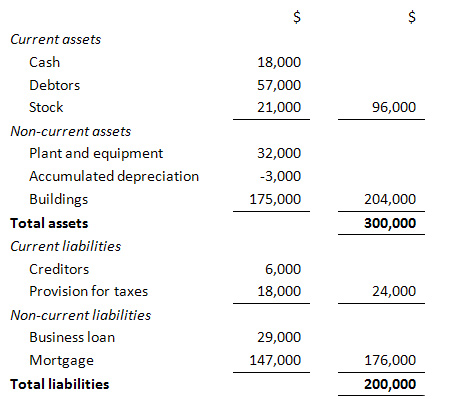
With assets of $300,000 and liabilities of $200,000, the net asset value of the business is $100,000.
What about goodwill?
This method doesn’t include a value for goodwill or the right to earn future profits, so it may understate the true value of a business. Goodwill is the difference between the true value of a business and the value of its net assets. It can be crucial to the value of retail and service-based businesses.
For example, when you are valuing a business such as a hairdressing salon, where the standard of service, location and reputation are important, the value of any goodwill would have to be added to net assets to get a valuation.
You need to consider whether goodwill can be transferred when you buy the business. While goodwill can come from physical features such as location, it can also arise from personal factors, such as the owner’s reputation or their relationships with customers or suppliers, which may not be transferable.
And if the business is underperforming and there is no goodwill attached to it, then using the net assets valuation method could be an accurate way of determining its value.
Method 2: Capitalised future earnings
When you buy a business, you’re not only buying its assets. You’re also buying the right to all of the profits that business might generate. Different valuation methods try to capture that.
Capitalising future earnings is the most common method used to value small businesses. The method looks at the rate of return on investment (ROI) that you can expect to get from the business.
How it works
1.Work out the average net profit of the business over the last three years using its profit-and-loss statements. You’ll need to adjust the profit for any one-off expenses or other irregular items each year.
2.Decide the annual rate of return that you’re looking for as a business owner (for example, 20%). There are no hard and fast rules about what number you should choose, except that the higher the risk, the higher your return should be. A good starting point is to compare the business with other investment opportunities — everything from safe havens like term deposits, to riskier investments like shares. You can also look at the rate of return that similar businesses in the same industry achieve.
3.Divide net profits by the rate of return to determine the value of the business, then multiply by 100.
Example
David is looking at buying a bakery business with average net profits of $100,000 per annum after adjustments. David wants an annual rate of return of 20%. The capitalised earnings valuation is:
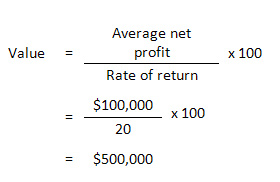
Method 3: Earnings multiple
If you invest in shares, you might already be familiar with this method, since it’s often used to assess the value of companies whose shares are traded on a stock exchange and therefore reflect market expectations. But it can be used to value unlisted businesses.
Its big advantage is its simplicity. The difficulty lies in deciding which multiple to use.
How it works
Simply multiply the business’ earnings before interest and tax (EBIT) by your selected multiple. For example, you might value the business at twice its annual earnings — so a business with an EBIT of $200,000 might be valued at $400,000.
The multiple you choose will depend on the industry and the growth potential of the business. A service-based business might be valued at as little as one year’s earnings, while an established business with sustainable profits might sell for as much as six times earnings. (Listed companies trade at much higher multiples, because their size and liquidity makes them less risky investments.)
This method can be useful for valuing a business where there are regular sales of similar businesses to help you determine an objective earnings multiple. A business broker should be able to tell you this.
Method 4: Comparable sales
Whatever other valuation method you use, you should also look at prices for recent sales of similar businesses. Like buying a house, it makes sense to know what is happening in the market in which you’re interested.
Speak to a few business brokers and gauge their feeling about the business’ value. They might know what similar operations are selling for and how the market is placed at that particular time. Check business-for-sale listings in relevant industry magazines, newspapers or websites.
Tools and templates
Buying a business checklist
Important information
As this advice has been prepared without considering your objectives, financial situation or needs, you should, before acting on the advice, consider its appropriateness to your circumstances. All products mentioned on this web page are issued by the Commonwealth Bank of Australia; view our Financial Services Guide (PDF 59kb).
http://www.commbank.com.au/business/betterbusiness/buying-a-business/whats-it-worth/
Summary:
Low Multiples
Another interesting way to assess PE of individual stocks, relative to their respective industry and country multiples
Low Multiples
04.08.09, 06:00 PM EDT
Forbes Magazine dated April 27, 2009
These stocks have estimated 2009 price-to-earnings multiples below their respective industry and country multiples. One example: Bombardier of Canada, which makes jets and railroad locomotives and coaches, trades at an estimated 2009 P/E of 6, versus 15 for all aerospace stocks and 13 for Canadian stocks.
http://www.forbes.com/forbes/2009/0427/152-global-2000-companies-cheap-and-cash-rich.html
Low Multiples
04.08.09, 06:00 PM EDT
Forbes Magazine dated April 27, 2009
These stocks have estimated 2009 price-to-earnings multiples below their respective industry and country multiples. One example: Bombardier of Canada, which makes jets and railroad locomotives and coaches, trades at an estimated 2009 P/E of 6, versus 15 for all aerospace stocks and 13 for Canadian stocks.
http://www.forbes.com/forbes/2009/0427/152-global-2000-companies-cheap-and-cash-rich.html
The world's richest men say go buy stocks, global economic panic is over
Updated: Friday November 13, 2009 MYT 7:48:41 AM
The world's richest men say go buy stocks, global economic panic is over
Buy attractive stocks, they say
NEW YORK: Capitalism is still alive and well, say the world's two richest men, despite lingering shocks from the longest, deepest recession since the Great Depression.
"The financial panic is behind us," said famed investor Warren Buffett, who recently made what he called an "all-in wager" on the U.S. economy by acquiring railroad Burlington Northern Santa Fe.
"The bottom has come in stocks. Don't pass on something that's attractive today."
Sitting facing each other in an auditorium filled with nearly 1,000 cheering people at Columbia University in New York, the CEO of Berkshire Hathaway Inc. and Microsoft founder Bill Gates fielded questions from Columbia Business School students on the recession, investing and what's the next Microsoft.
There were at first reassurances that the U.S. economy had not collapsed since the last time the two sat in front of a student audience, in Nebraska in 2005.
"We proved that we can make mistakes," said Gates.
"But the fundamentals of the system, a marketplace-driven system where we invest in education and a great infrastructure for the long-term, that's continued."
Even in the country's "darkest hour," he said, American businesses were still innovating.
"Last fall was really blindsiding," Buffett said later.
Still, "I did not worry about the overall survival of our economy."
The worst recession since the 1930s may be over, but the recovery isn't expected to be strong enough to stem job losses and get businesses hiring again.
Employers shed a net total of 190,000 jobs in October, a government survey showed Thursday.
It was the 22nd straight month of losses.
And the unemployment rate jumped last month to 10.2 percent, a 26-year high.
Buffett also commended the Bush administration's actions last September, saying "only the government could have saved things" after the collapse of Lehman Brothers triggered a freeze-up in credit markets and panic on Wall Street.
In the future, however, Buffett said "there should be more downside to the head of any institution that has to go to the federal government to be saved for reasons of the greater society. And so far, we have been better at carrots and sticks in rewarding CEOs at the top. But I think some more sticks are called for."
The two endeared themselves to the audience with tips.
Buffett exhorted students to "marry the right person" and said, "The worst investment you can have is cash."
Gates, meanwhile, said he sees big opportunities in environmentally friendly energy and medicine.
"Capitalism is great," he said.
Gates wore a suit and tie, flashing the inner red lining of his jacket as he walked to his chair. Buffett, who earned a master's degree from Columbia in 1951, wore a sweater with the Columbia insignia.
Students in the audience said they were glad the two were so confident about the economy.
"That probably weighs a lot to a lot of people to hear Buffett say we're out of the crisis," said Andrea Basche, an Earth Institute student at Columbia. - AP
The world's richest men say go buy stocks, global economic panic is over
Buy attractive stocks, they say
NEW YORK: Capitalism is still alive and well, say the world's two richest men, despite lingering shocks from the longest, deepest recession since the Great Depression.
"The financial panic is behind us," said famed investor Warren Buffett, who recently made what he called an "all-in wager" on the U.S. economy by acquiring railroad Burlington Northern Santa Fe.
"The bottom has come in stocks. Don't pass on something that's attractive today."
Sitting facing each other in an auditorium filled with nearly 1,000 cheering people at Columbia University in New York, the CEO of Berkshire Hathaway Inc. and Microsoft founder Bill Gates fielded questions from Columbia Business School students on the recession, investing and what's the next Microsoft.
There were at first reassurances that the U.S. economy had not collapsed since the last time the two sat in front of a student audience, in Nebraska in 2005.
"We proved that we can make mistakes," said Gates.
"But the fundamentals of the system, a marketplace-driven system where we invest in education and a great infrastructure for the long-term, that's continued."
Even in the country's "darkest hour," he said, American businesses were still innovating.
"Last fall was really blindsiding," Buffett said later.
Still, "I did not worry about the overall survival of our economy."
The worst recession since the 1930s may be over, but the recovery isn't expected to be strong enough to stem job losses and get businesses hiring again.
Employers shed a net total of 190,000 jobs in October, a government survey showed Thursday.
It was the 22nd straight month of losses.
And the unemployment rate jumped last month to 10.2 percent, a 26-year high.
Buffett also commended the Bush administration's actions last September, saying "only the government could have saved things" after the collapse of Lehman Brothers triggered a freeze-up in credit markets and panic on Wall Street.
In the future, however, Buffett said "there should be more downside to the head of any institution that has to go to the federal government to be saved for reasons of the greater society. And so far, we have been better at carrots and sticks in rewarding CEOs at the top. But I think some more sticks are called for."
The two endeared themselves to the audience with tips.
Buffett exhorted students to "marry the right person" and said, "The worst investment you can have is cash."
Gates, meanwhile, said he sees big opportunities in environmentally friendly energy and medicine.
"Capitalism is great," he said.
Gates wore a suit and tie, flashing the inner red lining of his jacket as he walked to his chair. Buffett, who earned a master's degree from Columbia in 1951, wore a sweater with the Columbia insignia.
Students in the audience said they were glad the two were so confident about the economy.
"That probably weighs a lot to a lot of people to hear Buffett say we're out of the crisis," said Andrea Basche, an Earth Institute student at Columbia. - AP
PLANTATION sector

Pile in as stocks pile up
Tags: Astra Agro | Brokers Call | CIMB Research | CPO | Golden Agri | Indofood Agri | Plantation | Sampoerna Agro | Sime Darby | Wilmar
Written by Financial Daily
Thursday, 12 November 2009 10:46
PLANTATION []s sector
Neutral: Malaysia’s palm oil stock figures for end-October 2009 were above both our and market estimates, which is slightly negative for the sector. However, we are keeping our 2009 crude palm oil (CPO) price forecast of RM2,240 per tonne, which is only a tad higher than the RM2,221 average achieved in 9M09. If this news of a rising stockpile triggers a correction of CPO price and planters’ share prices, investors should snap up the opportunity to accumulate selected plantation stocks ahead of a likely recovery of CPO price, potentially in 1Q10.
We remain neutral on the Malaysian plantation sector and continue to prefer the Singapore planters for their more appealing valuations. Our picks in the region remain Wilmar, Sime Darby, Indofood Agri, Golden Agri, Astra Agro and Sampoerna Agro.
Higher imports and output pushed Malaysia’s palm oil stocks to a 10-month high of 1.97 million tonnes at end-Oct, above market expectations of 1.82 million tonnes and our forecast of 1.72 million tonnes. The discrepancy came largely from a 27.5% month-on-month (m-o-m) uptick in production. We believe the key variances were higher production and imports. These statistics are negative as the rise in inventories will limit CPO price upside in the medium term.
Palm oil stocks are projected to rise further and potentially peak in November. We now estimate that Malaysia’s CPO stock level could increase 3% m-o-m to around 2.03 million tonnes in November, which we think could be the peak instead of our initial expectation of a peak of 1.9 million tonnes. This stems from the unexpected surge in production in October which may not be sustainable as we suspect some harvesting was carried over from the previous month.
Assuming steady crude oil prices, we continue to expect CPO prices to trade within a range of RM2,100 to RM2,300 per tonne in the short term. Despite the higher-than-expected palm oil stockpile, we are sticking to our view that CPO price could rally in 1Q 2010 as demand is expected to pick up, driven by the Chinese New Year festivities, the global economic recovery, lower domestic oilseed crops for India and higher biofuel mandates.
Although stocks appear to be closing in on last year’s record level, the outlook for demand is brighter than a year ago as global economies are on the mend and some governments have set or increased their biodiesel mandates. Also, the higher crude oil price of US$79 (RM267.02) per barrel compared to the year-ago level of US$60 may boost conversion to biodiesel. — CIMB Research, Nov 11
This article appeared in The Edge Financial Daily, November 12, 2009.
http://www.theedgemalaysia.com/business-news/153471-pile-in-as-stocks-pile-up.html

Subscribe to:
Posts (Atom)