Tuesday, September 26, 2006
Quick Comment: Contrarian Investment
I came across an article on contrarian investment recently and thought it is a nice article to share. According to Investopedia, the contrarian approach is an investment style that goes against prevailing market trends by buying assets that are performing poorly and selling when they perform well. A contrarian investor believes that the people who say the market is going up do so only when they are fully invested and have no further purchasing power. At this point the market is at a peak. On the other hand, when people predict a downturn, they have already sold out, at which point the market can only go up. Contrarian investing also emphasizes out-of-favor securities with low P/E ratios.
According to the article,
· It is a long-term strategy.
· It is not about timing the market, it is about value. For instance, "If your neighbour offers you his $500,000 house for $250,000 you don't wait for it to be offered at $200,000".
· One of the biggest errors is selling too early.
· You have to be prepared to look dumb for significant periods of time sometimes.
· Never expect to buy a stock right at the bottom.
· Staying out of companies that lose you money will save more than being in the ones that make you money. Preservation of capital and management of risk are paramount.
· Emotion is a contrarian's friend. When the market is going down the average man is looking at all the negatives and forgets the positive; that's when the opportunities arise.
The companies that contrarians look for are those that:
· Have solid brands.
· Have good cash flows.
· May be suffering a temporary economic setback.
· Would benefit from recapitalisation.
· Need management change.
· Would be capable of being changed.
· Opportunities seem to be where the market isn't, in sectors out of favour.
· Booms like the tech boom and the resources boom are good for contrarian investors because they take people away from value areas and make investors give up on long-term proven methods of investment and value assessment. They present opportunities that would never have been there otherwise.
· The contrarian is looking for market overreaction and the opportunity that overreaction presents.
· Don't be a mindless contrarian. Being contrarian is not about buying a share when it has fallen 10 per cent in a day just because everyone else is selling it. Only one in 20 major falls is an opportunity.
· Being contrarian means doing hard work to identify a situation the market hasn't while a stock is still at a price below what you calculate it to be worth.
· Contrarian investment does not rely on timing markets. You have to take a long-term view.
Sounds very much like TANJONG doesnt it? It has strong cash flow and is out of favour for fear of the negative effects of the PPA negotiations. However, the government has made it clear that it should be a win-win situation. Even if it ends up losing out a bit due to the new PPAs, downside would be rather limited since the bad news have already been priced in. Long term wise, it is still a very solid company.
Disclaimer: This report is brought to you by Investssmart, an unlicensed investment adviser. Please exercise your own judgment or seek professional advice from your remisiers. By law, they are the experts. I am not responsible for your investment decisions.
http://investssmart.blogspot.com/2006_09_01_archive.html
Thursday, 14 January 2010

Speculative stocks
Thursday, July 20, 2006
Market Talk: Speculative stocks
DJ MARKET TALK: Speculative Stks Hammered; May Fall Further - 2006-07-20 07:29:00.0
1529 [Dow Jones] Speculative issues and stocks usually associated with syndicates sharply lower; Iris (0010.KU) down 29% at 71 sen with 108.7 million shares traded, Poly Tower (7175.KU) down 16.8% at 86.5 sen, Sugar Bun (7036.KU) down 8.6% at 96 sen. "It looks like the syndicates used this morning's knee-jerk reaction to distribute their holdings to retail players. There currently does not seem to be much buying support for these stocks," dealer says; adds stocks may fall further.(VGB)
Investssmart: I am not surprised by the hammering at all. It was just a matter of time and the manipulators chose the best time. Dow Jones Industrial Index rose 212 points of 2% overnight and punters would have expected a sharp rise today on Bursa Malaysia. Of course, many rushed into speculative stocks like IRIS early in the morning hoping to get in at a lower price. It should be noted that IRIS rose by 8% to $1.08 this morning before succumbing to strong selling and reached a low of 67c.
The manipulators are not stupid. They cash in when market sentiment is strong and the naive retail investors purchase the shares hoping for a small gain. Has anyone wondered how much IRIS was worth at its peak? There are 914m IRIS shares, 368 IRIS-PA and 55m IRIS-WA on issue. At their peaks of $1.39, $1.28 and $1.17 respectively, the total value of IRIS works out to be $1806m. Was IRIS really ever worth $1.8 billion? It only made a profit of $1.8m in the latest quarter.
Every investor knows that IRIS is a manipulated counter but that did not stop them from purchasing its shares. Bursa Malaysia designated it. Brokers demand cash up front for purchases. News articles comment on it all the time but yet, some people choose to buy the shares, hoping to make some money from it. Who can you blame when they lose money? If someone throws a gold bar into the river and tell you that the river is infested with crocodiles but yet you jump in for the gold bar, who is to blame if you are eaten by the crocs?
The point I am trying to say is "dont try your luck in manipulated stocks". You may earn a little money each time but you could lose it all in just one day. This is an extract from an Australian financial journalist's comments on the share market:
"You need patience. If you try to rush your financial transformation you will fail. Patience is about having realistic expectations. You won't get anywhere trying to make money every day. I've seen people in the market who spend most of the time doing nothing. Just sitting watching things going by. On the lookout. They don't try to generate opportunities out of nothing, they just wait for them."
In conclusion, there is no need to try and earn a little bit of money every day. Even with IRIS at 82.5c, IRIS-PA at 43.5c and IRIS-WA at 38c, it is still way overvalued with a total value of the company at close to $1b. Everyone knows IRIS rose because of the manipulation of its shares. If you are still trying to beat the manipulators to make a profit, please give up because it is almost impossible. In this game, you are the player, the manipulators are the bankers and I don't remember GENTING ever reporting an annual loss. You may beat them once, you may beat them twice or even 10 times but at the end, there is only one winner. And unfortunately, it won't to be the player.
Disclaimer: This report is brought to you by Investssmart, an unlicensed investment adviser. Please exercise your own judgment or seek professional advice from your remisiers. By law, they are the experts. I am not responsible for your investment decisions.
http://investssmart.blogspot.com/2006_07_01_archive.html
Market Talk: Speculative stocks
DJ MARKET TALK: Speculative Stks Hammered; May Fall Further - 2006-07-20 07:29:00.0
1529 [Dow Jones] Speculative issues and stocks usually associated with syndicates sharply lower; Iris (0010.KU) down 29% at 71 sen with 108.7 million shares traded, Poly Tower (7175.KU) down 16.8% at 86.5 sen, Sugar Bun (7036.KU) down 8.6% at 96 sen. "It looks like the syndicates used this morning's knee-jerk reaction to distribute their holdings to retail players. There currently does not seem to be much buying support for these stocks," dealer says; adds stocks may fall further.(VGB)
Investssmart: I am not surprised by the hammering at all. It was just a matter of time and the manipulators chose the best time. Dow Jones Industrial Index rose 212 points of 2% overnight and punters would have expected a sharp rise today on Bursa Malaysia. Of course, many rushed into speculative stocks like IRIS early in the morning hoping to get in at a lower price. It should be noted that IRIS rose by 8% to $1.08 this morning before succumbing to strong selling and reached a low of 67c.
The manipulators are not stupid. They cash in when market sentiment is strong and the naive retail investors purchase the shares hoping for a small gain. Has anyone wondered how much IRIS was worth at its peak? There are 914m IRIS shares, 368 IRIS-PA and 55m IRIS-WA on issue. At their peaks of $1.39, $1.28 and $1.17 respectively, the total value of IRIS works out to be $1806m. Was IRIS really ever worth $1.8 billion? It only made a profit of $1.8m in the latest quarter.
Every investor knows that IRIS is a manipulated counter but that did not stop them from purchasing its shares. Bursa Malaysia designated it. Brokers demand cash up front for purchases. News articles comment on it all the time but yet, some people choose to buy the shares, hoping to make some money from it. Who can you blame when they lose money? If someone throws a gold bar into the river and tell you that the river is infested with crocodiles but yet you jump in for the gold bar, who is to blame if you are eaten by the crocs?
The point I am trying to say is "dont try your luck in manipulated stocks". You may earn a little money each time but you could lose it all in just one day. This is an extract from an Australian financial journalist's comments on the share market:
"You need patience. If you try to rush your financial transformation you will fail. Patience is about having realistic expectations. You won't get anywhere trying to make money every day. I've seen people in the market who spend most of the time doing nothing. Just sitting watching things going by. On the lookout. They don't try to generate opportunities out of nothing, they just wait for them."
In conclusion, there is no need to try and earn a little bit of money every day. Even with IRIS at 82.5c, IRIS-PA at 43.5c and IRIS-WA at 38c, it is still way overvalued with a total value of the company at close to $1b. Everyone knows IRIS rose because of the manipulation of its shares. If you are still trying to beat the manipulators to make a profit, please give up because it is almost impossible. In this game, you are the player, the manipulators are the bankers and I don't remember GENTING ever reporting an annual loss. You may beat them once, you may beat them twice or even 10 times but at the end, there is only one winner. And unfortunately, it won't to be the player.
Disclaimer: This report is brought to you by Investssmart, an unlicensed investment adviser. Please exercise your own judgment or seek professional advice from your remisiers. By law, they are the experts. I am not responsible for your investment decisions.
http://investssmart.blogspot.com/2006_07_01_archive.html
'Expensive' shares
Quick Comment: 'Expensive' shares
Some time ago, I had a conversation with my ASX remisier based in Australia and I think some of his comments are worth sharing.
*Me refers to myself when I was speaking to him.
*Investssmart is also myself but from my point of view now.
Me: Good shares in Malaysia are expensive.
Remisier: What do you mean by expensive? When you say expensive, do you mean in absolute terms or in terms of valuation? When I say it is expensive, it normally means overvalued or fully valued. Some companies can trade at $30 but we still call them cheap.
Investssmart: This is very true. The word expensive should be used more carefully when talking about shares. The absolute value does not really count. A Mercedes for $100k is 'cheaper' than a Waja for $60k. It is the value that counts.
Me: Malaysians' perception is that the higher the share price is, the more it can drop.
Remisier: That happens all the time. It is important to remember that we should look at the movements in terms of percentage. If a $50 company can drop to $5, a $5 company can drop to 5c as well. The important thing is to fix the absolute amount you invest. Purchasing 100 shares in a $50 company is the same as purchasing 1000 shares in a $5 company. If both rise by 10%, you will still earn the same amount of $500 no matter which company you invest it.
Investssmart: We should not be put off by the share price. It is the valuation that we should worry about. The chances of IRIS to drop from 90c to 20c is higher than the chances of BKAWAN dropping from $7.80 to $2. But somehow, if you give investors just these two choices, many would rather invest in IRIS because they think it is 'cheaper'!
Remisier: Do you remember me recommending you Rio Tinto ($30), BHP ($15), Woodside ($20) and Cochlear ($25)? You did not purchase any either! Perhaps, this changed your view on 'expensive' stocks!
Investssmart: These four stocks have skyrocketed since his recommendation. They are now about $75, $30, $45 and $50 respectively. Never say that upside of highly priced shares are limited. There is no such thing. Upside of overvalued/expensive shares is limited but upside of highly priced shares is not. Although I did not purchase these shares, it was not because I was scared of the high prices. It was mainly because I did not have the strong confidence in the commodity bull and sadly, I was proven to be wrong. Could have made tonnes more from the ASX. Nevertheless, in a bull market, almost everything on the ASX rose.
Me: I did not buy those few but I still bought some highly priced ones. What would I be trading if I don't buy any highly priced shares? I don't remember you ever recommending me any penny stocks!
Remisier: Good stocks are normally highly priced because the demand for good stocks is very strong. Lowly priced shares are normally those that are speculative or not performing.
Investssmart: It is strange but true to a certain extent. Of course, it does not apply to all company shares.
Strange but could be true: I don't think it is a coincidence that most of the true blue chips throughout the world are trading at high prices. Most of these blue chips have been there for ages. It had to start off somewhere as a smaller company and it takes time to reach where it is today. If the company was trading at $1 ten years ago, it will probably trade at $10 today to be considered a top performer. Otherwise, it would not be considered a blue chip.
Fundamental based investors always look at companies that have excellent track records and therefore, end up investing in highly priced shares. That is because it is very rare that we can get such companies at low prices as share prices should have risen as companies perform well over the years. I doubt fundamental based investors would be interested in companies that trade at low prices over the last few years because that means that they probably do not have a good track record. Of course, this does not apply to all shares but I believe that it is true to a certain extent.
Conclusion: Do not look at how high the share price is. It is the valuation that counts.
Disclaimer: This report is brought to you by Investssmart, an unlicensed investment adviser. Please exercise your own judgment or seek professional advice from your remisiers. By law, they are the experts. I am not responsible for your investment decisions.
http://investssmart.blogspot.com/2006_04_01_archive.html
Some time ago, I had a conversation with my ASX remisier based in Australia and I think some of his comments are worth sharing.
*Me refers to myself when I was speaking to him.
*Investssmart is also myself but from my point of view now.
Me: Good shares in Malaysia are expensive.
Remisier: What do you mean by expensive? When you say expensive, do you mean in absolute terms or in terms of valuation? When I say it is expensive, it normally means overvalued or fully valued. Some companies can trade at $30 but we still call them cheap.
Investssmart: This is very true. The word expensive should be used more carefully when talking about shares. The absolute value does not really count. A Mercedes for $100k is 'cheaper' than a Waja for $60k. It is the value that counts.
Me: Malaysians' perception is that the higher the share price is, the more it can drop.
Remisier: That happens all the time. It is important to remember that we should look at the movements in terms of percentage. If a $50 company can drop to $5, a $5 company can drop to 5c as well. The important thing is to fix the absolute amount you invest. Purchasing 100 shares in a $50 company is the same as purchasing 1000 shares in a $5 company. If both rise by 10%, you will still earn the same amount of $500 no matter which company you invest it.
Investssmart: We should not be put off by the share price. It is the valuation that we should worry about. The chances of IRIS to drop from 90c to 20c is higher than the chances of BKAWAN dropping from $7.80 to $2. But somehow, if you give investors just these two choices, many would rather invest in IRIS because they think it is 'cheaper'!
Remisier: Do you remember me recommending you Rio Tinto ($30), BHP ($15), Woodside ($20) and Cochlear ($25)? You did not purchase any either! Perhaps, this changed your view on 'expensive' stocks!
Investssmart: These four stocks have skyrocketed since his recommendation. They are now about $75, $30, $45 and $50 respectively. Never say that upside of highly priced shares are limited. There is no such thing. Upside of overvalued/expensive shares is limited but upside of highly priced shares is not. Although I did not purchase these shares, it was not because I was scared of the high prices. It was mainly because I did not have the strong confidence in the commodity bull and sadly, I was proven to be wrong. Could have made tonnes more from the ASX. Nevertheless, in a bull market, almost everything on the ASX rose.
Me: I did not buy those few but I still bought some highly priced ones. What would I be trading if I don't buy any highly priced shares? I don't remember you ever recommending me any penny stocks!
Remisier: Good stocks are normally highly priced because the demand for good stocks is very strong. Lowly priced shares are normally those that are speculative or not performing.
Investssmart: It is strange but true to a certain extent. Of course, it does not apply to all company shares.
Strange but could be true: I don't think it is a coincidence that most of the true blue chips throughout the world are trading at high prices. Most of these blue chips have been there for ages. It had to start off somewhere as a smaller company and it takes time to reach where it is today. If the company was trading at $1 ten years ago, it will probably trade at $10 today to be considered a top performer. Otherwise, it would not be considered a blue chip.
Fundamental based investors always look at companies that have excellent track records and therefore, end up investing in highly priced shares. That is because it is very rare that we can get such companies at low prices as share prices should have risen as companies perform well over the years. I doubt fundamental based investors would be interested in companies that trade at low prices over the last few years because that means that they probably do not have a good track record. Of course, this does not apply to all shares but I believe that it is true to a certain extent.
Conclusion: Do not look at how high the share price is. It is the valuation that counts.
Disclaimer: This report is brought to you by Investssmart, an unlicensed investment adviser. Please exercise your own judgment or seek professional advice from your remisiers. By law, they are the experts. I am not responsible for your investment decisions.
http://investssmart.blogspot.com/2006_04_01_archive.html
Is the market short of retail players?
Quick Comment: Is the market short of retail players?
After reading some articles in the newspapers today, I feel that Bursa Malaysia is managed by a pack of jokers (management of Bursa Malaysia). Not only that, these jokers are supported by another group of jokers (brokerage and remisiers). And since they are all jokers, smarter opportunists out there took advantage of the market to make some good money. Here is what I read and my comments:
First article: Bursa woos retail investors
In the article, it says "BURSA Malaysia Bhd is working with several broking houses to increase retail participation in the stock market. Bursa Malaysia chief executive officer Yusli Mohamed Yusoff said that while the stock market had been performing relatively well in the past few months, more could be done to improve retail participation."
Investssmart: Do we actually need more retail participation? What we lack now is foreign funds participation. We have enough of retail participation. After all, retail participation will not help Bursa Malaysia because most Malaysian retail investors are interested in speculative stocks like TIMECOM, NSCOM and the chicken stocks. By encouraging more retail investors to invest in these kinda stocks is to cheat them off their money because most will end up losing. Where are the foreign funds? Everyone knows Malaysia has hardly any foreign funds participation. Bursa Malaysia should work hard with the government to get the foreign funds. Without them, Bursa Malaysia cannot perform well. Enough of swindling retailers money.
Second article: Advice from broking houses to retail players
Advice from broking houses? What? Aren't these the people who managed the unit trusts that losses money year after year? Yes, it is a shame that most of the unit trusts and funds managed by Malaysian fund managers are losing money. Of course there are exceptional ones like Public Mutual and ICapital but for every good one in Malaysia, there are probably 9 lousy ones. A lot of these funds are there just to support the market, not to maximise your wealth. Is their advise (or bullshit to some of us) worth listening to? Of course not. Even Investssmart is better.
Third article: SMR Technologies 108 times oversubscribed
Bursa Malaysia says they want more retail participation but their latest IPO was oversuscribed an astonishing 108x! How much money were there in just this IPO just from retail investors? 2.5m shares were offered to the public at 33c each. Oversuscription of 108x means that the public suscribed a total of $90m just for one IPO! And yet, Bursa Malaysia complained of the lack of retail participation. Where are their senses? What the market lack is foreign funds participation! Not retail investors.
SMR Technologies offered only 2.5m shares for the public. At 33c, it is only raising $825k from the public! What a joke! If you convert that to USD, it will be just USD223k. If you want to raise so little from the public, don't even go for listing. Or at least, Bursa Malaysia should not allow the listing. We have enough companies on Bursa Malaysia and one which raises $825k from the public is just not needed. If they don't want to let the public own more of their shares, just ask them to keep it as a private company!
These companies are listed by those who is taking advantage of the stupidity of the management of Bursa Malaysia. They are all going for the easy money. All they need to do is offer as little shares as possible and make it look very much in demand. Then, on the first day of trading, its share price will soar at least 50%! These opportunists will then start unloading their shares. Investors overseas will laugh if they hear an IPO raising USD223k from the public. They are probably already laughing. What can we expect? We have a market managed and supported by jokers.
Disclaimer: This report is brought to you by Investssmart, an unlicensed investment adviser. Please exercise your own judgment or seek professional advice from your remisiers. By law, they are the experts. I am not responsible for your investment decisions.
http://investssmart.blogspot.com/2006_03_01_archive.html
After reading some articles in the newspapers today, I feel that Bursa Malaysia is managed by a pack of jokers (management of Bursa Malaysia). Not only that, these jokers are supported by another group of jokers (brokerage and remisiers). And since they are all jokers, smarter opportunists out there took advantage of the market to make some good money. Here is what I read and my comments:
First article: Bursa woos retail investors
In the article, it says "BURSA Malaysia Bhd is working with several broking houses to increase retail participation in the stock market. Bursa Malaysia chief executive officer Yusli Mohamed Yusoff said that while the stock market had been performing relatively well in the past few months, more could be done to improve retail participation."
Investssmart: Do we actually need more retail participation? What we lack now is foreign funds participation. We have enough of retail participation. After all, retail participation will not help Bursa Malaysia because most Malaysian retail investors are interested in speculative stocks like TIMECOM, NSCOM and the chicken stocks. By encouraging more retail investors to invest in these kinda stocks is to cheat them off their money because most will end up losing. Where are the foreign funds? Everyone knows Malaysia has hardly any foreign funds participation. Bursa Malaysia should work hard with the government to get the foreign funds. Without them, Bursa Malaysia cannot perform well. Enough of swindling retailers money.
Second article: Advice from broking houses to retail players
Advice from broking houses? What? Aren't these the people who managed the unit trusts that losses money year after year? Yes, it is a shame that most of the unit trusts and funds managed by Malaysian fund managers are losing money. Of course there are exceptional ones like Public Mutual and ICapital but for every good one in Malaysia, there are probably 9 lousy ones. A lot of these funds are there just to support the market, not to maximise your wealth. Is their advise (or bullshit to some of us) worth listening to? Of course not. Even Investssmart is better.
Third article: SMR Technologies 108 times oversubscribed
Bursa Malaysia says they want more retail participation but their latest IPO was oversuscribed an astonishing 108x! How much money were there in just this IPO just from retail investors? 2.5m shares were offered to the public at 33c each. Oversuscription of 108x means that the public suscribed a total of $90m just for one IPO! And yet, Bursa Malaysia complained of the lack of retail participation. Where are their senses? What the market lack is foreign funds participation! Not retail investors.
SMR Technologies offered only 2.5m shares for the public. At 33c, it is only raising $825k from the public! What a joke! If you convert that to USD, it will be just USD223k. If you want to raise so little from the public, don't even go for listing. Or at least, Bursa Malaysia should not allow the listing. We have enough companies on Bursa Malaysia and one which raises $825k from the public is just not needed. If they don't want to let the public own more of their shares, just ask them to keep it as a private company!
These companies are listed by those who is taking advantage of the stupidity of the management of Bursa Malaysia. They are all going for the easy money. All they need to do is offer as little shares as possible and make it look very much in demand. Then, on the first day of trading, its share price will soar at least 50%! These opportunists will then start unloading their shares. Investors overseas will laugh if they hear an IPO raising USD223k from the public. They are probably already laughing. What can we expect? We have a market managed and supported by jokers.
Disclaimer: This report is brought to you by Investssmart, an unlicensed investment adviser. Please exercise your own judgment or seek professional advice from your remisiers. By law, they are the experts. I am not responsible for your investment decisions.
http://investssmart.blogspot.com/2006_03_01_archive.html
Warrants
Questions: Warrants
Question: Let say i have a warrant at 50c and the mother share is $1.50 with exercise price at $1.10..so the premium is 10c.. are we actually banking for the mother share to rise b4 expiry to earn some money? let say b4 expiry it goes up to 2.00, that means we get profit 40c izzit? next, if in betweeen there are any divs and cap repayment of let say 20c...then $1.50 will be adjusted to $1.30 and exercise price will go down from $1.10 to 90c ... am i correct?
Investssmart: Yes, the premium is 10c or 6.7% (10c out of $1.50). That means that the warrant will reach its fair value when the mother share rises 10c or 6.7% to $1.60. Yes, we are banking on the mother share to rise. If the mother share rises 33% or 50c to $2 before its expiry, it is highly likely that the warrant will rise 40-50c as well. Taking into account a gain of 50c for the warrants will equate to a 100% profit. It is amplified by three times because of the 3x leverage ($1.50/50c). IJM-WB offers a leverage of 10x!
You are right on the reduction of exercise price but it will be reduced only when there is a capital repayment. It will not be reduced because of dividends. In other words, the lower the dividend, the better for the warrants. It has to be noted that the time span to expiry is very important for warrants. The longer it is from expiry, the higher should be the premium because longer time will be afforded for the mother share to rise.
Disclaimer: This report is brought to you by Investssmart, an unlicensed investment adviser. Please exercise your own judgment or seek professional advice from your remisiers. By law, they are the experts. I am not responsible for your investment decisions.
Tuesday, March 07, 2006
Comments: Warrants
kchim26 said...
One thing not mentioned here is that, buying warrant, u r betting against time. It is true that warrant can provide leveraging oppotunity, one negative point is that we have limited time on our side. If price go against us, we might lose all our investment in the warrant when it is expired while investing in Mother share will provide us unlimited time to wait for the price to recover.
Conclusion is that, only buy warrant for short term bet, for long term bet, buying mother is better. If we wish to buy warrant to capitalize on higher return, we need to have enough confidence that the company will be performing well before the expiry date. Just my 2cents. ;)
Investssmart: I have to say that I disagree with most of your points. Time is always against warrants but it is not that bad unless your purchase warrants that are way out of money. I recommended earlier in the year YTLPOWR-WA, MTDINFR-WA and ILB-WB. They are all in the money. IJM-WB is just 2% away from being in the money. Warrants actually limit your losses. The important part is not to overexpose yourself. If you would normally purchase 1000 of the company shares, then purchase 2500 warrants at most.
Consider this case: I were to purchase YTLPOWR-WA (expiring 2010 and exercise price $1.43) now at 75c and you were to purchase YTLPOWR now at $2.18. If it drops to just $1 in 2010, I will end up losing all the 75c because the warrants expire out of money. On the other hand, you will lose $1.18.
But you have to remember that I can just purchase these shares from the market at $1 at the time in 2010. That means that both of us are now equal shareholders but your cost stays at $2.18 whereas mine is just $1.75 (75c for warrants+$1 for shares at 2010). Therefore, your statement that mother share is better because it provides unlimited time is not true. Through the warrants, I get the cheaper option as well as the unlimited time by purchasing the shares when the warrants expire out of money.
Of course, you are entitled to dividends as shareholders, but as a warrant holder, I only need to pay a fraction of what shareholders pay. The rest of the money could be used to generate more money by investing in pure dividend stocks. I have to emphasise that warrants are generally undervalued in Malaysia from my experience trading in Australia. Most Malaysian investors do not have a good understanding of warrants. However, it must be noted that we should not purchase warrants that are grossly out of money. I give IJM-WB (2% out of money) an exception because of its long date to expiry, world class management, 10x leverage and low dividend yield.
Disclaimer: This report is brought to you by Investssmart, an unlicensed investment adviser. Please exercise your own judgment or seek professional advice from your remisiers. By law, they are the experts. I am not responsible for your investment decisions.
http://investssmart.blogspot.com/2006_03_01_archive.html
Question: Let say i have a warrant at 50c and the mother share is $1.50 with exercise price at $1.10..so the premium is 10c.. are we actually banking for the mother share to rise b4 expiry to earn some money? let say b4 expiry it goes up to 2.00, that means we get profit 40c izzit? next, if in betweeen there are any divs and cap repayment of let say 20c...then $1.50 will be adjusted to $1.30 and exercise price will go down from $1.10 to 90c ... am i correct?
Investssmart: Yes, the premium is 10c or 6.7% (10c out of $1.50). That means that the warrant will reach its fair value when the mother share rises 10c or 6.7% to $1.60. Yes, we are banking on the mother share to rise. If the mother share rises 33% or 50c to $2 before its expiry, it is highly likely that the warrant will rise 40-50c as well. Taking into account a gain of 50c for the warrants will equate to a 100% profit. It is amplified by three times because of the 3x leverage ($1.50/50c). IJM-WB offers a leverage of 10x!
You are right on the reduction of exercise price but it will be reduced only when there is a capital repayment. It will not be reduced because of dividends. In other words, the lower the dividend, the better for the warrants. It has to be noted that the time span to expiry is very important for warrants. The longer it is from expiry, the higher should be the premium because longer time will be afforded for the mother share to rise.
Disclaimer: This report is brought to you by Investssmart, an unlicensed investment adviser. Please exercise your own judgment or seek professional advice from your remisiers. By law, they are the experts. I am not responsible for your investment decisions.
Tuesday, March 07, 2006
Comments: Warrants
kchim26 said...
One thing not mentioned here is that, buying warrant, u r betting against time. It is true that warrant can provide leveraging oppotunity, one negative point is that we have limited time on our side. If price go against us, we might lose all our investment in the warrant when it is expired while investing in Mother share will provide us unlimited time to wait for the price to recover.
Conclusion is that, only buy warrant for short term bet, for long term bet, buying mother is better. If we wish to buy warrant to capitalize on higher return, we need to have enough confidence that the company will be performing well before the expiry date. Just my 2cents. ;)
Investssmart: I have to say that I disagree with most of your points. Time is always against warrants but it is not that bad unless your purchase warrants that are way out of money. I recommended earlier in the year YTLPOWR-WA, MTDINFR-WA and ILB-WB. They are all in the money. IJM-WB is just 2% away from being in the money. Warrants actually limit your losses. The important part is not to overexpose yourself. If you would normally purchase 1000 of the company shares, then purchase 2500 warrants at most.
Consider this case: I were to purchase YTLPOWR-WA (expiring 2010 and exercise price $1.43) now at 75c and you were to purchase YTLPOWR now at $2.18. If it drops to just $1 in 2010, I will end up losing all the 75c because the warrants expire out of money. On the other hand, you will lose $1.18.
But you have to remember that I can just purchase these shares from the market at $1 at the time in 2010. That means that both of us are now equal shareholders but your cost stays at $2.18 whereas mine is just $1.75 (75c for warrants+$1 for shares at 2010). Therefore, your statement that mother share is better because it provides unlimited time is not true. Through the warrants, I get the cheaper option as well as the unlimited time by purchasing the shares when the warrants expire out of money.
Of course, you are entitled to dividends as shareholders, but as a warrant holder, I only need to pay a fraction of what shareholders pay. The rest of the money could be used to generate more money by investing in pure dividend stocks. I have to emphasise that warrants are generally undervalued in Malaysia from my experience trading in Australia. Most Malaysian investors do not have a good understanding of warrants. However, it must be noted that we should not purchase warrants that are grossly out of money. I give IJM-WB (2% out of money) an exception because of its long date to expiry, world class management, 10x leverage and low dividend yield.
Disclaimer: This report is brought to you by Investssmart, an unlicensed investment adviser. Please exercise your own judgment or seek professional advice from your remisiers. By law, they are the experts. I am not responsible for your investment decisions.
http://investssmart.blogspot.com/2006_03_01_archive.html
Making a million made easy
Sunday, February 19, 2006
News article: Making a million made easy
Just came across this article in TheAge Australia and thought it would be a good article to share with you guys. For your info, Kerry Packer, the richest Australia, passed away recently. For those who have the time, it is good to read the whole lot but for those who don't, here are the quotes I would like to share.
"The stockmarket is not life changing — 9.5 per cent per annum plus dividends is not going to turn you and I into Kerry Packer. But there are plenty of people in the stockmarket that have made it. Maybe not the billions, maybe not the millions, but plenty the million."
"You need patience. If you try to rush your financial transformation you will fail. Patience is about having realistic expectations. You won't get anywhere trying to make money every day. I've seen people in the market who spend most of the time doing nothing. Just sitting watching things going by. On the lookout. They don't try to generate opportunities out of nothing, they just wait for them."
"The mistake too many people make is to pursue opportunities frantically. Let them come. They always do. If you miss one, there'll be another."
"Terrific gains come from terrific information. Information is everywhere but most people don't use it, probably because they haven't got the time. There is plenty of money to be made out of the information gap. Knowing more than anyone else, because you bothered to do the work. Investssmart: Best describe the situation in Malaysia. Investors don't bother doing any research. They just buy TIMECOM, the billion dollar company which has never made an operating profit.
"You will not make extraordinary gains without investing in volatile (small and risky) stocks. The only way to do that is to narrow your odds significantly, minimise the risk. That means knowing what the company does. Knowing where it is in its development. Knowing what's ahead. Knowing more about it than almost anyone else. Getting to know people in the company. Talking to them. Only then can you take a big slug in a small stock that might see extraordinary gains."
Investssmart: This does not necessarily work in Malaysia because of syndicates and also because people tend to lie a lot more.
"You need mates. Kerry Packer had them. You will not make a fortune in the stockmarket by shutting yourself off in a small dark room. Information comes from mates. Opportunities come from mates."
Investssmart: Can I be your mates? :)
"Patience, information and mates. Your recipe for success."
"This isn't how you become a billionaire. The only real way to make a fortune is to build a business, build assets and employ people to build them for you."
Investssmart: That is very true. Warren Buffett is not an legendary investor for nothing. Being a multi-millionaire is enough for me.
Disclaimer: This report is brought to you by Investssmart, an unlicensed investment adviser. Please exercise your own judgment or seek professional advice from your remisiers. By law, they are the experts. I am not responsible for your investment decisions.
http://investssmart.blogspot.com/2006_02_01_archive.html
News article: Making a million made easy
Just came across this article in TheAge Australia and thought it would be a good article to share with you guys. For your info, Kerry Packer, the richest Australia, passed away recently. For those who have the time, it is good to read the whole lot but for those who don't, here are the quotes I would like to share.
"The stockmarket is not life changing — 9.5 per cent per annum plus dividends is not going to turn you and I into Kerry Packer. But there are plenty of people in the stockmarket that have made it. Maybe not the billions, maybe not the millions, but plenty the million."
"You need patience. If you try to rush your financial transformation you will fail. Patience is about having realistic expectations. You won't get anywhere trying to make money every day. I've seen people in the market who spend most of the time doing nothing. Just sitting watching things going by. On the lookout. They don't try to generate opportunities out of nothing, they just wait for them."
"The mistake too many people make is to pursue opportunities frantically. Let them come. They always do. If you miss one, there'll be another."
"Terrific gains come from terrific information. Information is everywhere but most people don't use it, probably because they haven't got the time. There is plenty of money to be made out of the information gap. Knowing more than anyone else, because you bothered to do the work. Investssmart: Best describe the situation in Malaysia. Investors don't bother doing any research. They just buy TIMECOM, the billion dollar company which has never made an operating profit.
"You will not make extraordinary gains without investing in volatile (small and risky) stocks. The only way to do that is to narrow your odds significantly, minimise the risk. That means knowing what the company does. Knowing where it is in its development. Knowing what's ahead. Knowing more about it than almost anyone else. Getting to know people in the company. Talking to them. Only then can you take a big slug in a small stock that might see extraordinary gains."
Investssmart: This does not necessarily work in Malaysia because of syndicates and also because people tend to lie a lot more.
"You need mates. Kerry Packer had them. You will not make a fortune in the stockmarket by shutting yourself off in a small dark room. Information comes from mates. Opportunities come from mates."
Investssmart: Can I be your mates? :)
"Patience, information and mates. Your recipe for success."
"This isn't how you become a billionaire. The only real way to make a fortune is to build a business, build assets and employ people to build them for you."
Investssmart: That is very true. Warren Buffett is not an legendary investor for nothing. Being a multi-millionaire is enough for me.
Disclaimer: This report is brought to you by Investssmart, an unlicensed investment adviser. Please exercise your own judgment or seek professional advice from your remisiers. By law, they are the experts. I am not responsible for your investment decisions.
http://investssmart.blogspot.com/2006_02_01_archive.html
Questions: Why are manipulated stocks so risky?
Question: Why are manipulated stocks so risky?
There are just simply too many counters on Bursa Malaysia, most of which are hardly touched by investors. Singapore Exchange is about 0.5x larger than Bursa Malaysia in terms of total market cap. We are 3x smaller than Taiwan, 5x smaller than Hong Kong and 200x smaller than South Korea! But we have the most number of listed companies in the world (close to 1400) after US! How can such a small economy have so many listed companies? That is because most of them are as good as worthless, which become a heaven for manipulators.
During the bull run in the early 90s, manipulators pushed the stock prices up to ridiculous prices and keep them at that level so that they can use the stocks as collateral to borrow huge sums from financial institutions. When the market crashed in the 1997-98, these financial institutions suffered huge losses because many companies defaulted on their payment and their shares which are placed as collateral are worth close to nothing. As a result, financial institutions are very careful when lending money to those who use stocks as collateral. Nowadays, they do their on valuation on the stocks before lending out money.
Since they can't mortgage the stocks, how can the manipulators gain by pushing the stock price up? The most common way these manipulators earn money is by accumulating these shares at low prices (20c for example). In most cases, the shares are cornered before they start manipulating ths prices. They will then push up the share price to maybe $1 and in the process, create large volumes. There is a case recently where someone was charged with creating about 100 trading accounts to create fake trading volume by using the accounts to repeatedly buy and sell shares of the same company.
When these shares are being pushed to $1, many punters will be enticed to join in. In the process of pushing the share price, some manipulators are smart enough to make a few super ambitious announcements to stir up interest. Some even put in large buy orders to create strong demand for the shares to further entice punters. As punters get into the stock, they will slowly release shares into the market while at the same time, put in large buy orders to create the so called fake demand.
The most risky part occurs when the manipulators have released enough stocks to the market. They will then dump the rest of their shares at lower prices (maybe 50c-80c). When the shares drop to 40-50c level, more punters will be interested to pick them up, believing that the stock could rebound. However, this only gives the manipulators another chance to dump their remaining shares.
Manipulators make huge profits when punters join in the 'bull run' in the counter. You can make money if you are lucky enough to exit at the right time before they dump the shares. It is very hard to predict when they will dump it. Most of the time, manipulators dump their shares when the counter looked like it was undroppable. Purchasing stocks that is being pushed is extremely risky because when it drops, it practically crashes. You can possibly earn some money every time you exit at the right time but when you fail to exit before the dump, you stand to lose a bomb.
The share market is meant for investors. I have seen many punters (some of whom are my friends) who have left the share market because they lose too much trading speculative stocks. For those who still follow stocks that are being pushed, I would suggest you just bring your money to Genting Casino. The chances are better and you can feel more adrenalin rush watching the roulette wheel that some blinking on the computer screen.
In Malaysia, most of these speculative stocks are on the brink of bankruptcy. The chances of them surviving or turning around is close to nil. Businesses are not easy to turn around, especially with the corrupt practices and poor managements in Malaysia. In Australia, the speculative stocks are mostly exploration companies searching for resources like gold, copper, zinc, uranium and others. These explorers all have chances of striking it rich with a bit of luck. Therefore, I would suggest to those who like to follow the speculative stocks in Malaysia to try trade on ASX (you have to figure out how to create an account), where you can make a lot with some luck. In Malaysia, luck alone wont be enough. Investing based on fundamentals and track record is the only way.
Disclaimer: This report is brought to you by Investssmart, an unlicensed investment adviser. Please exercise your own judgment or seek professional advice from your remisiers. By law, they are the experts. I am not responsible for your investment decisions.
http://investssmart.blogspot.com/2006_01_01_archive.html
There are just simply too many counters on Bursa Malaysia, most of which are hardly touched by investors. Singapore Exchange is about 0.5x larger than Bursa Malaysia in terms of total market cap. We are 3x smaller than Taiwan, 5x smaller than Hong Kong and 200x smaller than South Korea! But we have the most number of listed companies in the world (close to 1400) after US! How can such a small economy have so many listed companies? That is because most of them are as good as worthless, which become a heaven for manipulators.
During the bull run in the early 90s, manipulators pushed the stock prices up to ridiculous prices and keep them at that level so that they can use the stocks as collateral to borrow huge sums from financial institutions. When the market crashed in the 1997-98, these financial institutions suffered huge losses because many companies defaulted on their payment and their shares which are placed as collateral are worth close to nothing. As a result, financial institutions are very careful when lending money to those who use stocks as collateral. Nowadays, they do their on valuation on the stocks before lending out money.
Since they can't mortgage the stocks, how can the manipulators gain by pushing the stock price up? The most common way these manipulators earn money is by accumulating these shares at low prices (20c for example). In most cases, the shares are cornered before they start manipulating ths prices. They will then push up the share price to maybe $1 and in the process, create large volumes. There is a case recently where someone was charged with creating about 100 trading accounts to create fake trading volume by using the accounts to repeatedly buy and sell shares of the same company.
When these shares are being pushed to $1, many punters will be enticed to join in. In the process of pushing the share price, some manipulators are smart enough to make a few super ambitious announcements to stir up interest. Some even put in large buy orders to create strong demand for the shares to further entice punters. As punters get into the stock, they will slowly release shares into the market while at the same time, put in large buy orders to create the so called fake demand.
The most risky part occurs when the manipulators have released enough stocks to the market. They will then dump the rest of their shares at lower prices (maybe 50c-80c). When the shares drop to 40-50c level, more punters will be interested to pick them up, believing that the stock could rebound. However, this only gives the manipulators another chance to dump their remaining shares.
Manipulators make huge profits when punters join in the 'bull run' in the counter. You can make money if you are lucky enough to exit at the right time before they dump the shares. It is very hard to predict when they will dump it. Most of the time, manipulators dump their shares when the counter looked like it was undroppable. Purchasing stocks that is being pushed is extremely risky because when it drops, it practically crashes. You can possibly earn some money every time you exit at the right time but when you fail to exit before the dump, you stand to lose a bomb.
The share market is meant for investors. I have seen many punters (some of whom are my friends) who have left the share market because they lose too much trading speculative stocks. For those who still follow stocks that are being pushed, I would suggest you just bring your money to Genting Casino. The chances are better and you can feel more adrenalin rush watching the roulette wheel that some blinking on the computer screen.
In Malaysia, most of these speculative stocks are on the brink of bankruptcy. The chances of them surviving or turning around is close to nil. Businesses are not easy to turn around, especially with the corrupt practices and poor managements in Malaysia. In Australia, the speculative stocks are mostly exploration companies searching for resources like gold, copper, zinc, uranium and others. These explorers all have chances of striking it rich with a bit of luck. Therefore, I would suggest to those who like to follow the speculative stocks in Malaysia to try trade on ASX (you have to figure out how to create an account), where you can make a lot with some luck. In Malaysia, luck alone wont be enough. Investing based on fundamentals and track record is the only way.
Disclaimer: This report is brought to you by Investssmart, an unlicensed investment adviser. Please exercise your own judgment or seek professional advice from your remisiers. By law, they are the experts. I am not responsible for your investment decisions.
http://investssmart.blogspot.com/2006_01_01_archive.html
Click here to read more:
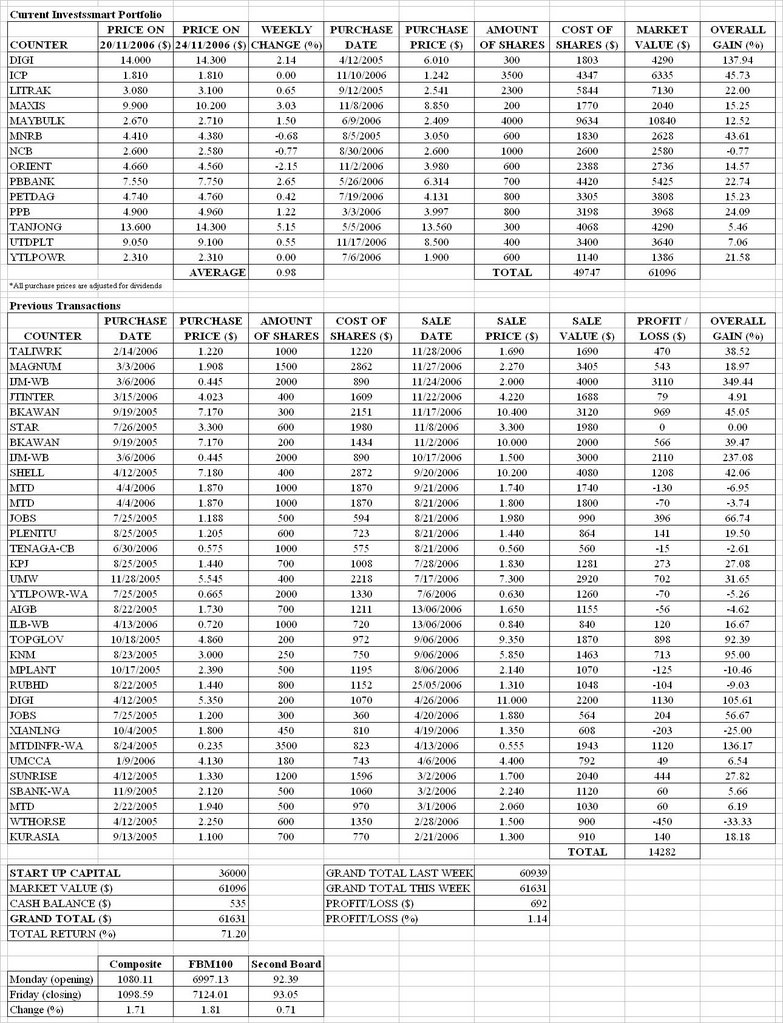
Investsmart blogsite is still a good useful resource for serious investors
http://investssmart.blogspot.com/
Investsmart blogged on his investing in the KLSE for a short while. He had an impressive record. He started blogging at the time when the market was low and was just on the way up. His reasoning and analysis were very educational and sound. His blog remains a good site to visit to learn of the way he picked and analysed the stocks he invested in.
A Better Way to Calculate Earnings Yield
Value Stock Investing - A Better Way to Calculate Earnings Yield
By Lee Franzen Lee Franzen
Value stock investing is a favorite method used by many long term investors to generate profits that regularly beat the stock markets annual returns. Value investors generally look for stocks that are currently out of favor with Wall Street, but also have an underlying value that should make them worth more in the future. Put another way, value stocks are currently relatively cheap - you may even want to call them temporarily on sale.
One of the primary screens that can be used in value stock investing to find candidates to buy is earnings yield (EY). This screen is available on some of the free money research sites. On the surface, EY is a simple concept - take a company's net earnings per share (EPS), divide that EPS by the price per share, multiply by 100%, and you have a percentage that equates to what the stock would yield if it distributed all of it's earnings. If you cannot find this indicator on your favorite stock screening web site, just take the P/E ratio (which is contained on nearly all of those screening web sites), and invert it - or multiply it by 1/x. Obviously, the higher the number, the cheaper the stock is relative to it's earnings.
Another way that you should consider calculating earnings yield is more complicated, but will give you a much better view of the way a company is valued relative to it's earnings. This alternate form of the EY calculation was discussed by Joel Greenblatt in his book, "The Little Book That Beats the Market". The alternative EY that he wrote about is useful in comparing stocks that have different tax rates and different levels of debt. Greenblatt's alternative formula is:
EY = pre-tax operating profit (EBIT) / Enterprise Value
First, the numerator in this value stock investing equation (EBIT) is derived from the company's income statement, and the equations denominator (Enterprise Value) is determined by adding the value of all common and preferred equity (number of shares outstanding multiplied by price per share) to the value of all interest bearing debt that the company owes. Interest bearing debt is located on the company's balance sheet.
This alternative way of calculating earnings yield is better than the much more popular E/P method highlighted at the beginning of this article, since it gives a more accurate view of what is happening with cash flows inside of a company, and also gives a more balanced view when comparing multiple companies to each other. Think about it - if a company is using debt to finance it's growth, and you are comparing it to a company with little or no debt, this method of calculating earnings yield clarifies which company is yielding better earnings relative to it's overall financial structure, and is clearly superior for value stock investing.
http://ezinearticles.com/?Value-Stock-Investing---A-Better-Way-to-Calculate-Earnings-Yield&id=3528291
By Lee Franzen Lee Franzen
Value stock investing is a favorite method used by many long term investors to generate profits that regularly beat the stock markets annual returns. Value investors generally look for stocks that are currently out of favor with Wall Street, but also have an underlying value that should make them worth more in the future. Put another way, value stocks are currently relatively cheap - you may even want to call them temporarily on sale.
One of the primary screens that can be used in value stock investing to find candidates to buy is earnings yield (EY). This screen is available on some of the free money research sites. On the surface, EY is a simple concept - take a company's net earnings per share (EPS), divide that EPS by the price per share, multiply by 100%, and you have a percentage that equates to what the stock would yield if it distributed all of it's earnings. If you cannot find this indicator on your favorite stock screening web site, just take the P/E ratio (which is contained on nearly all of those screening web sites), and invert it - or multiply it by 1/x. Obviously, the higher the number, the cheaper the stock is relative to it's earnings.
Another way that you should consider calculating earnings yield is more complicated, but will give you a much better view of the way a company is valued relative to it's earnings. This alternate form of the EY calculation was discussed by Joel Greenblatt in his book, "The Little Book That Beats the Market". The alternative EY that he wrote about is useful in comparing stocks that have different tax rates and different levels of debt. Greenblatt's alternative formula is:
EY = pre-tax operating profit (EBIT) / Enterprise Value
First, the numerator in this value stock investing equation (EBIT) is derived from the company's income statement, and the equations denominator (Enterprise Value) is determined by adding the value of all common and preferred equity (number of shares outstanding multiplied by price per share) to the value of all interest bearing debt that the company owes. Interest bearing debt is located on the company's balance sheet.
This alternative way of calculating earnings yield is better than the much more popular E/P method highlighted at the beginning of this article, since it gives a more accurate view of what is happening with cash flows inside of a company, and also gives a more balanced view when comparing multiple companies to each other. Think about it - if a company is using debt to finance it's growth, and you are comparing it to a company with little or no debt, this method of calculating earnings yield clarifies which company is yielding better earnings relative to it's overall financial structure, and is clearly superior for value stock investing.
http://ezinearticles.com/?Value-Stock-Investing---A-Better-Way-to-Calculate-Earnings-Yield&id=3528291
Shariah-compliant companies
Shariah-compliant companies can’t run casinos or sell tobacco, alcohol, pork, or pornography. Also, debt can’t exceed 30 percent of equity.
http://www.businessweek.com/news/2010-01-13/mobius-says-templeton-may-set-up-shariah-compliant-equity-fund.html
http://www.businessweek.com/news/2010-01-13/mobius-says-templeton-may-set-up-shariah-compliant-equity-fund.html
Wednesday, 13 January 2010
Winners Keep on Winning
Winners Keep on Winning
By Rick Aristotle Munarriz
January 12, 2010
Some of last year's biggest winners aren't showing any signs of slowing down in 2010.
From resurgent automaker Ford (NYSE: F) to comeback kid Sirius XM Radio (Nasdaq: SIRI), many of the stocks that thrilled investors by doubling, tripling, or taking even bigger steps through 2009 are off to races again this year.
Take Dollar Thrifty Automotive Group (NYSE: DTG), for starters. Auto rental agencies were scorchers last year after being left for dead in 2008. Dollar Thrifty and Avis Budget (NYSE: CAR) appreciated several times over after bottoming out early last year. In Dollar Thrifty's case, the stock that began 2009 priced at a mere $1.09 closed out the year revving up to $25.61.
Dollar Thrifty now finds itself fetching $27.58. A nearly 8% gain may not seem all that scintillating, but keep in mind that we're just six trading days into the new year. Whole Foods Market (Nasdaq: WFMI), Ford, and Sirius are off to even better starts in 2010.
Company
2009
2010
Ford
337%
21%
Sirius XM Radio
400%
15%
Dollar Thrifty
2,250%
8%
Whole Foods
191%
8%
Source: Yahoo! Finance.
The momentum is impressive, since this could have been a logical time for many giddy investors to cash out. Instead of a hefty capital gains hit in 2009, many could have punched out at the start of 2010.
Why are they still hanging on? Well, the prospects are a whole lot brighter for these four companies now than they were a year ago.
Ford hit a new 52-week high yesterday. Technically speaking, it's closer to a 250-week high, since Ford hasn't traded this high since March of 2005. It's hard to bet against the automaker, especially after its head-turning 33% surge in December sales.
Sirius XM Radio had a prosperous 2009, particularly in the latter half of the year, when subscriber growth resumed and cash flow growth accelerated. Like many of last year's winners, Sirius XM had the luxury of an easy starting line -- its stock began the year at a just $0.12 a share -- but its surprising breakeven third-quarter results and renewed optimism for auto sales, where most of its new subscribers are coming from these days, find the satellite-radio monopoly sitting pretty.
Analysts see Dollar Thrifty earning $1.52 a share this year. Yes, it's expected to earn more than its entire market cap at the start of 2009. An economic recovery has lifted hopes for upticks in corporate and leisure travel, and Dollar Thirfty is a clear beneficiary.
Whole Foods is another company positioned for a big bounce if the economy continues to improve. Shoppers cut back on expensive organic groceries during the recession, but they should storm back soon.
So why are 2009's winners among the stocks with the healthiest starts in 2010? That's easy. They're earning it.
http://www.fool.com/investing/general/2010/01/12/winners-keep-on-winning.aspx
By Rick Aristotle Munarriz
January 12, 2010
Some of last year's biggest winners aren't showing any signs of slowing down in 2010.
From resurgent automaker Ford (NYSE: F) to comeback kid Sirius XM Radio (Nasdaq: SIRI), many of the stocks that thrilled investors by doubling, tripling, or taking even bigger steps through 2009 are off to races again this year.
Take Dollar Thrifty Automotive Group (NYSE: DTG), for starters. Auto rental agencies were scorchers last year after being left for dead in 2008. Dollar Thrifty and Avis Budget (NYSE: CAR) appreciated several times over after bottoming out early last year. In Dollar Thrifty's case, the stock that began 2009 priced at a mere $1.09 closed out the year revving up to $25.61.
Dollar Thrifty now finds itself fetching $27.58. A nearly 8% gain may not seem all that scintillating, but keep in mind that we're just six trading days into the new year. Whole Foods Market (Nasdaq: WFMI), Ford, and Sirius are off to even better starts in 2010.
Company
2009
2010
Ford
337%
21%
Sirius XM Radio
400%
15%
Dollar Thrifty
2,250%
8%
Whole Foods
191%
8%
Source: Yahoo! Finance.
The momentum is impressive, since this could have been a logical time for many giddy investors to cash out. Instead of a hefty capital gains hit in 2009, many could have punched out at the start of 2010.
Why are they still hanging on? Well, the prospects are a whole lot brighter for these four companies now than they were a year ago.
Ford hit a new 52-week high yesterday. Technically speaking, it's closer to a 250-week high, since Ford hasn't traded this high since March of 2005. It's hard to bet against the automaker, especially after its head-turning 33% surge in December sales.
Sirius XM Radio had a prosperous 2009, particularly in the latter half of the year, when subscriber growth resumed and cash flow growth accelerated. Like many of last year's winners, Sirius XM had the luxury of an easy starting line -- its stock began the year at a just $0.12 a share -- but its surprising breakeven third-quarter results and renewed optimism for auto sales, where most of its new subscribers are coming from these days, find the satellite-radio monopoly sitting pretty.
Analysts see Dollar Thrifty earning $1.52 a share this year. Yes, it's expected to earn more than its entire market cap at the start of 2009. An economic recovery has lifted hopes for upticks in corporate and leisure travel, and Dollar Thirfty is a clear beneficiary.
Whole Foods is another company positioned for a big bounce if the economy continues to improve. Shoppers cut back on expensive organic groceries during the recession, but they should storm back soon.
So why are 2009's winners among the stocks with the healthiest starts in 2010? That's easy. They're earning it.
http://www.fool.com/investing/general/2010/01/12/winners-keep-on-winning.aspx
Profit whether up or down
Bull or Bear, Profit Anyway
By Jeff Fischer
January 12, 2010 |
Following last year's record rebound, and awaiting economic data along with January and February earnings reports, everyone is on pins and needles waiting to see if stocks can continue their enthusiastic climb.
Will there be a recovery in the United States? Or will we just muddle along? We'd all like to see a recovery, but that's far from assured. And even if we enjoy a broad economic recovery, it may not lead to more stock gains in the near term, because the market has already soared in anticipation of a stronger economy.
The market is usually a few steps ahead like that, which makes predicting it nearly impossible. Thankfully, we don't need to know what it will do next. We have strategies that can profit whichever way stocks turn.
Profit whether up or down
Most of us have favorite stocks that we've been comfortable with for a long time, stocks we don't expect to soar anytime soon, but which we wish to own regardless. Maybe you'd like to buy more, too, if the price declined.
But it all depends on the market, right? If it goes down, you'll buy. If it goes up, you'll sit on what you have or sell at a higher price.
What you may not know is that those stocks could be generating profit for you even if the price they're selling for barely changes. In fact, this unclear market situation may be perfect for setting up income-generating option strategies called ... drumroll, please ... strangles and straddles.
Strangle profits from the market
Let's assume you own at least 100 shares of networking giant Cisco Systems (Nasdaq: CSCO), recently $24.30 per share. If the shares declined, you would be happy to add another 100 shares to your position. (All options contracts work in 100-share lots.) If the price appreciates, you'd be willing to sell your existing stock. This situation is ideal for writing (or selling) a strangle option strategy.
Writing a strangle, you sell put options on a stock at a strike price below the current share price, and sell covered call options on your shares, too, at a higher strike price -- selling the same number of contracts of each.
The puts obligate you to buy more shares if the stock falls by expiration, and the calls obligate you to sell your existing shares at a higher price if the stock appreciates by expiration.
You're paid for selling both options, putting significant income in your pocket:
Selling Puts
Cisco Systems
Selling Calls
Combined Options
July $23 strike pays you $1.18
$24.66
July $26 strike pays you $1.15
$2.33 payment to you, or 9% of the share price
Source: TD AMERITRADE quotes, Jan. 11.
This strangle trade pays $2.33 per share today, or $233 for every $2,466 in stock that you own. This 9% income is yours to keep.
Your obligations? If Cisco shares are below $23 by the July expiration date, your puts obligate you to buy more shares. Since you keep the $2.33 you were paid, your effective net buy price is $20.67 -- far below today's price. On the flipside, if Cisco is above $26 by expiration, you're obligated to sell your existing shares. Your net sell price equates to $28.33 -- a good sell price.
If Cisco is anywhere between $24 and $26 at expiration, both options you wrote expire, you keep the full payment, and you have no further obligations -- you just made great income even while the stock was flat. In fact, if Cisco is anywhere above $20.67 and below $28.33 by expiration, you can close your option trades for a partial profit and still not have any other obligations. That's a wide profit range.
Straddle your way to profits
Another way to squeeze profits from a stock is to write a straddle. The concept is the same as the strangle that we just explained, but here you use the same strike price on your calls and puts.
You generally use this strategy if you believe a stock is going to be less volatile over time, staying in a tight price range.
For example, Netflix (Nasdaq: NFLX) was up more than 80% last year. If you believe the stock is due to settle down, but you'd be happy to buy more shares cheaper or sell your shares higher, you could straddle the $53.30 shares with options today (this trade is ideal when the stock is right near an option's strike price, but here it's just $0.80 higher). Take a gander:
Selling Puts
Netflix
Selling Calls
Combined Options
March $52.50 puts pay you $3.60
$53.30
March $52.50 calls pay you $4.60.
$8.20 payment to you, or 15% of the stock price
Compared to a strangle, the straddle has much higher odds of resulting in a stock transaction, since you're using strike prices that nearly equal the current share price. If Netflix is below $52.50 by March expiration, you get to add to your position. Your effective net buy price would be $44.30. If Netflix is above $52.50, your existing shares would be sold, resulting in a net $60.70 sell price including everything the options paid you.
However, if Netflix is anywhere above $44.30 and below $60.70 by expiration, you can close your options for a partial profit, and keep your shares with no other obligations. That's another wide range for profits. Finally, if Netflix ends the expiration near $52.50, you'd make most of the $8.20 closing your options early.
Or, if you owned a position in Buffalo Wild Wings (Nasdaq: BWLD), the $40 stock offers a June $40 straddle that pays $8.80 right now. Would you be happy to buy more shares at a net $31.20 or sell your existing shares at $48.80? Or just make option profits as long as the stock is within this range? Bull or bear, it gives you plenty of room to earn option income. Other stocks with options that pay well include GlaxoSmithKline (NYSE: GSK), Hasbro (NYSE: HAS), Under Armour (NYSE: UA), and Apple (Nasdaq: AAPL).
Strangles and straddles summed up
To use a strangle or straddle strategy, you have to own at least 100 shares of a stock, you have to be willing to buy at least 100 shares more, and you have to be ready to sell your existing shares.
So, while the media and most investors obsess over the market's next move, you can set up strategies that will profit whether it's up or down. And if stocks stay in a range, as they eventually will following this record ascent, you'll be ready to keep right on profiting anyway.
http://www.fool.com/investing/general/2010/01/12/bull-or-bear-profit-anyway.aspx
By Jeff Fischer
January 12, 2010 |
Following last year's record rebound, and awaiting economic data along with January and February earnings reports, everyone is on pins and needles waiting to see if stocks can continue their enthusiastic climb.
Will there be a recovery in the United States? Or will we just muddle along? We'd all like to see a recovery, but that's far from assured. And even if we enjoy a broad economic recovery, it may not lead to more stock gains in the near term, because the market has already soared in anticipation of a stronger economy.
The market is usually a few steps ahead like that, which makes predicting it nearly impossible. Thankfully, we don't need to know what it will do next. We have strategies that can profit whichever way stocks turn.
Profit whether up or down
Most of us have favorite stocks that we've been comfortable with for a long time, stocks we don't expect to soar anytime soon, but which we wish to own regardless. Maybe you'd like to buy more, too, if the price declined.
But it all depends on the market, right? If it goes down, you'll buy. If it goes up, you'll sit on what you have or sell at a higher price.
What you may not know is that those stocks could be generating profit for you even if the price they're selling for barely changes. In fact, this unclear market situation may be perfect for setting up income-generating option strategies called ... drumroll, please ... strangles and straddles.
Strangle profits from the market
Let's assume you own at least 100 shares of networking giant Cisco Systems (Nasdaq: CSCO), recently $24.30 per share. If the shares declined, you would be happy to add another 100 shares to your position. (All options contracts work in 100-share lots.) If the price appreciates, you'd be willing to sell your existing stock. This situation is ideal for writing (or selling) a strangle option strategy.
Writing a strangle, you sell put options on a stock at a strike price below the current share price, and sell covered call options on your shares, too, at a higher strike price -- selling the same number of contracts of each.
The puts obligate you to buy more shares if the stock falls by expiration, and the calls obligate you to sell your existing shares at a higher price if the stock appreciates by expiration.
You're paid for selling both options, putting significant income in your pocket:
Selling Puts
Cisco Systems
Selling Calls
Combined Options
July $23 strike pays you $1.18
$24.66
July $26 strike pays you $1.15
$2.33 payment to you, or 9% of the share price
Source: TD AMERITRADE quotes, Jan. 11.
This strangle trade pays $2.33 per share today, or $233 for every $2,466 in stock that you own. This 9% income is yours to keep.
Your obligations? If Cisco shares are below $23 by the July expiration date, your puts obligate you to buy more shares. Since you keep the $2.33 you were paid, your effective net buy price is $20.67 -- far below today's price. On the flipside, if Cisco is above $26 by expiration, you're obligated to sell your existing shares. Your net sell price equates to $28.33 -- a good sell price.
If Cisco is anywhere between $24 and $26 at expiration, both options you wrote expire, you keep the full payment, and you have no further obligations -- you just made great income even while the stock was flat. In fact, if Cisco is anywhere above $20.67 and below $28.33 by expiration, you can close your option trades for a partial profit and still not have any other obligations. That's a wide profit range.
Straddle your way to profits
Another way to squeeze profits from a stock is to write a straddle. The concept is the same as the strangle that we just explained, but here you use the same strike price on your calls and puts.
You generally use this strategy if you believe a stock is going to be less volatile over time, staying in a tight price range.
For example, Netflix (Nasdaq: NFLX) was up more than 80% last year. If you believe the stock is due to settle down, but you'd be happy to buy more shares cheaper or sell your shares higher, you could straddle the $53.30 shares with options today (this trade is ideal when the stock is right near an option's strike price, but here it's just $0.80 higher). Take a gander:
Selling Puts
Netflix
Selling Calls
Combined Options
March $52.50 puts pay you $3.60
$53.30
March $52.50 calls pay you $4.60.
$8.20 payment to you, or 15% of the stock price
Compared to a strangle, the straddle has much higher odds of resulting in a stock transaction, since you're using strike prices that nearly equal the current share price. If Netflix is below $52.50 by March expiration, you get to add to your position. Your effective net buy price would be $44.30. If Netflix is above $52.50, your existing shares would be sold, resulting in a net $60.70 sell price including everything the options paid you.
However, if Netflix is anywhere above $44.30 and below $60.70 by expiration, you can close your options for a partial profit, and keep your shares with no other obligations. That's another wide range for profits. Finally, if Netflix ends the expiration near $52.50, you'd make most of the $8.20 closing your options early.
Or, if you owned a position in Buffalo Wild Wings (Nasdaq: BWLD), the $40 stock offers a June $40 straddle that pays $8.80 right now. Would you be happy to buy more shares at a net $31.20 or sell your existing shares at $48.80? Or just make option profits as long as the stock is within this range? Bull or bear, it gives you plenty of room to earn option income. Other stocks with options that pay well include GlaxoSmithKline (NYSE: GSK), Hasbro (NYSE: HAS), Under Armour (NYSE: UA), and Apple (Nasdaq: AAPL).
Strangles and straddles summed up
To use a strangle or straddle strategy, you have to own at least 100 shares of a stock, you have to be willing to buy at least 100 shares more, and you have to be ready to sell your existing shares.
So, while the media and most investors obsess over the market's next move, you can set up strategies that will profit whether it's up or down. And if stocks stay in a range, as they eventually will following this record ascent, you'll be ready to keep right on profiting anyway.
http://www.fool.com/investing/general/2010/01/12/bull-or-bear-profit-anyway.aspx
Volatility is not risk. Avoid investment advice based on volatility.
Redefining Risk
Risk was the chance that you might not meet your long-term investment goals. And the greatest enemy of reaching those goals: inflation. Nothing is safe from inflation. It's major victims are savings accounts, T-bills, bonds, and other types of fixed-income investments.
Investors usually use Treasury bills as their benchmark for risk. These are considered risk-free because their nominal value can't go down. However, T-bills and bonds are in fact highly risky because of their susceptibility to inflation.
Realistic definition of Risk
A realistic definition of risk recognizes the potential loss of capital through inflation and taxes, and includes:
1. The probability your investment will preserve your capital over your investment time horizon.
2. The probability your investments will outperform alternative investments during the period.
Why Volatility is not Risk?
Traditionally, investors view "risk" as being synonymous with "volatility." They believe that to get higher returns, they must be willing to stomach bigger short-term swings in a stock's price.
There is no correlation between this volatility-related-risk and return.
Higher volatility does not give better results, nor lower volatility worse.
Studies have shown that there is not necessarily any stable long-term relationship between volatility-related-risk and return, and often there is no relationship between the return achieved and the volatility-related-risk taken.
Volatility is not risk. Avoid investment advice based on volatility.
So if volatility is not risk, what is?
The major risk is not the short-term stock price volatility that many thousands of academic articles have been written about. Rather it is the possibility of not reaching your long-term investment goal through the growth of your funds in real terms. To measure monthly or quarterly volatility and call it risk - for investors who have time horizons 5, 10, 15 or even 30 years away - is a completely inappropriate definition. (David Dreman)
Take Home Lesson
Using Dreman's definition of risk, stocks are actually the safest investment out there over the long term.
Investors who put some or most of their money into bonds and other investments on the assumption they are lowering their risk are, in fact, deluding themselves.
"Indeed, it goes against the principle we were taught from childhood - that the safest way to save was putting our money in the bank."
http://myinvestingnotes.blogspot.com/2009/05/redefining-risk.html
Risk was the chance that you might not meet your long-term investment goals. And the greatest enemy of reaching those goals: inflation. Nothing is safe from inflation. It's major victims are savings accounts, T-bills, bonds, and other types of fixed-income investments.
Investors usually use Treasury bills as their benchmark for risk. These are considered risk-free because their nominal value can't go down. However, T-bills and bonds are in fact highly risky because of their susceptibility to inflation.
Realistic definition of Risk
A realistic definition of risk recognizes the potential loss of capital through inflation and taxes, and includes:
1. The probability your investment will preserve your capital over your investment time horizon.
2. The probability your investments will outperform alternative investments during the period.
Why Volatility is not Risk?
Traditionally, investors view "risk" as being synonymous with "volatility." They believe that to get higher returns, they must be willing to stomach bigger short-term swings in a stock's price.
There is no correlation between this volatility-related-risk and return.
Higher volatility does not give better results, nor lower volatility worse.
Studies have shown that there is not necessarily any stable long-term relationship between volatility-related-risk and return, and often there is no relationship between the return achieved and the volatility-related-risk taken.
Volatility is not risk. Avoid investment advice based on volatility.
So if volatility is not risk, what is?
The major risk is not the short-term stock price volatility that many thousands of academic articles have been written about. Rather it is the possibility of not reaching your long-term investment goal through the growth of your funds in real terms. To measure monthly or quarterly volatility and call it risk - for investors who have time horizons 5, 10, 15 or even 30 years away - is a completely inappropriate definition. (David Dreman)
Take Home Lesson
Using Dreman's definition of risk, stocks are actually the safest investment out there over the long term.
Investors who put some or most of their money into bonds and other investments on the assumption they are lowering their risk are, in fact, deluding themselves.
"Indeed, it goes against the principle we were taught from childhood - that the safest way to save was putting our money in the bank."
http://myinvestingnotes.blogspot.com/2009/05/redefining-risk.html
What's in store for investors next?
If we should have learned anything from the past 10 years, it is that valuation matters.
In a dynamic world, a static portfolio is by definition a fatally flawed strategy.
The price of investment success is constant vigilance.
The advice to buy and hold long term begs a critical question: buy and hold what?
In a dynamic world, a static portfolio is by definition a fatally flawed strategy.
The price of investment success is constant vigilance.
The advice to buy and hold long term begs a critical question: buy and hold what?
Younger generation of M'sians not active in stock market. Why?
Wednesday January 13, 2010
Younger generation of M'sians not active in stock market. Why?
By TEE LIN SAY
KUALA LUMPUR: Bursa Malaysia needs to address the low retail participation among the younger generation in the stock market or risk losing out on a huge investor base, said CEO Datuk Yusli Mohamed Yusoff.
There is data to prove it. Based on a survey spearheaded by Bursa and conducted by Synovate Malaysia to understand the investing attitudes and perceptions of Malaysians, it was revealed to StarBiz that only 12% of investors represent the 20-29 age group, while 59% involve those 40 years and above.
In addition, those in the younger and older age groups make up merely 4% and a staggering 61% respectively of the total number of dealers in the market.
“We need to enhance our current business model. The younger generation will not wait for us. If we don’t capture them, they will invest in other products and other markets in the future,” said Yusli at Bursa’s industry leadership forum entitled Rethink Retail yesterday. With 67% of the Malaysian population aged below 25, Yusli said there was tremendous potential in attracting the younger segment.
“We at Bursa are out of touch. If we don’t tap the right age group, we will be in trouble,” said chief operating officer Omar Merican. He highlighted that there was a generation gap between young potential investors and ageing investors and dealers and that half the population used the Internet to monitor share prices.
Yusli also said that one of Bursa’s main tasks in attracting investors was to convince them that it had good products to offer. “There are good companies listed on Bursa ... the only problem is convincing people on that,” he told StarBiz.
The survey also revealed that of an addressable market of 1.2 million, almost 50% of potential investors reject shares while 26% sit on the fence when it comes to shares.
“People are spending on property, cars and going for movies. We want to take some of that spend to the stock market,” said Yusli.
AirAsia X CEO Azran Osman Rani, who participated in the forum, said that wooing greater retail participation had less to do with infrastructure and more to do with content.
“You need to get people excited. If you get people excited, they will walk through cut glass to obtain it. In AirAsia X, we create the demand. Because of our cheap prices, customers fly to locations they had not initally planned on going.”
Synovate Malaysia research director Ben Llewellyn said many viewed investing in shares as requiring very high capital over a short investing period and also having a higher risk premium.
“People shy away from investing because they feel there is a high risk attached and they do not have enough money and don’t know how to invest. Clearly these reasons show a lack of knowledge and can be addressed by education,” he said.
http://biz.thestar.com.my/news/story.asp?file=/2010/1/13/business/5458288&sec=business
Younger generation of M'sians not active in stock market. Why?
By TEE LIN SAY
KUALA LUMPUR: Bursa Malaysia needs to address the low retail participation among the younger generation in the stock market or risk losing out on a huge investor base, said CEO Datuk Yusli Mohamed Yusoff.
There is data to prove it. Based on a survey spearheaded by Bursa and conducted by Synovate Malaysia to understand the investing attitudes and perceptions of Malaysians, it was revealed to StarBiz that only 12% of investors represent the 20-29 age group, while 59% involve those 40 years and above.
In addition, those in the younger and older age groups make up merely 4% and a staggering 61% respectively of the total number of dealers in the market.
“We need to enhance our current business model. The younger generation will not wait for us. If we don’t capture them, they will invest in other products and other markets in the future,” said Yusli at Bursa’s industry leadership forum entitled Rethink Retail yesterday. With 67% of the Malaysian population aged below 25, Yusli said there was tremendous potential in attracting the younger segment.
“We at Bursa are out of touch. If we don’t tap the right age group, we will be in trouble,” said chief operating officer Omar Merican. He highlighted that there was a generation gap between young potential investors and ageing investors and dealers and that half the population used the Internet to monitor share prices.
Yusli also said that one of Bursa’s main tasks in attracting investors was to convince them that it had good products to offer. “There are good companies listed on Bursa ... the only problem is convincing people on that,” he told StarBiz.
The survey also revealed that of an addressable market of 1.2 million, almost 50% of potential investors reject shares while 26% sit on the fence when it comes to shares.
“People are spending on property, cars and going for movies. We want to take some of that spend to the stock market,” said Yusli.
AirAsia X CEO Azran Osman Rani, who participated in the forum, said that wooing greater retail participation had less to do with infrastructure and more to do with content.
“You need to get people excited. If you get people excited, they will walk through cut glass to obtain it. In AirAsia X, we create the demand. Because of our cheap prices, customers fly to locations they had not initally planned on going.”
Synovate Malaysia research director Ben Llewellyn said many viewed investing in shares as requiring very high capital over a short investing period and also having a higher risk premium.
“People shy away from investing because they feel there is a high risk attached and they do not have enough money and don’t know how to invest. Clearly these reasons show a lack of knowledge and can be addressed by education,” he said.
http://biz.thestar.com.my/news/story.asp?file=/2010/1/13/business/5458288&sec=business
Subscribe to:
Posts (Atom)