Wednesday, 21 July 2010

Growing the worth of your Portfolio over the Long Term


This is what you should aim for as an investor over the long run.

Keep this vision in sight, always.

Watch Out: The Cyclical Stocks Are Trading At An Extreme, And This Could Portend Trouble


Watch Out: The Cyclical Stocks Are Trading At An Extreme, And This Could Portend Trouble
Eddy Elfenbein | Apr. 21, 2010, 5:31 PM

One of the quick-and-dirty metrics I like to look at is the Morgan Stanley Cyclical Index (^CYC) divided by the S&P 500 (^SPX). The Cyclical Index is composed on stocks that are closely tied to the economic cyclical. This means industries like autos, chemicals and mining.

When we divided these two indexes, we can tell if cyclicals are outperforming or underperforming. The thing about cyclicals is that they, well, move in cycles. Check out the chart below:

As you can see, there’s historically been a consistent up-and-down wave that averages a few years. This usually, but not always, corresponds with how well the economy is doing. Investors favor cyclicals during the good times, and flee them during the rough patches.

I urge you not to place too much faith in this metric, but I want to show you that the market does, in fact, move in cycles. These are powerful and once the market is locked it, the cycle can last for some time. Therefore it’s important for us to understand where we are in a cycle.

On top of that, the cycle has a double-whammy effect since the market generally does much better when cyclicals are outperforming, meaning they’re outperforming a market that’s already doing well (note the bottoms in 1982, 1990 and March 2009).

You can really see how the last 18 months have dramatically impacted cyclicals. The ratio held up fairly well until September 17, 2009. Within six months, that ratio dropped from 0.7 to 0.42. The Cyclical Index dropped from 871 on September 19 to 283 by March 9. Youch, that’s a staggering loss so you can see that the non-cyclicals provided some shelter from the storm (though not as good as cash).

But once the ratio hit bottom, cyclicals put on an explosive rally. Although the Cyclical Index is still well-below its high from 2007, the ratio has surpassed its high and has gone on to make several all-time highs. That’s about the shortest cycle I’ve ever seen. In fact, it was more like a panic mini-cycle. Last Thursday (pre-Fab), the ratio made its most recent all-time high of 0.786.

Picking cycle peaks is a tricky business and I won’t attempt to do so now, but I’m on the lookout for a harsh drop off in the Cyclical Ratio. Once it gets going, it could down, down, down for a few years.


Read more: http://www.businessinsider.com/morgan-stanleys-cyclical-index-is-much-higher-than-normal-2010-4#ixzz0uHxXiKpl

Importance of Earnings Growth

Cyclicals versus Non-Cyclicals


The Value of Stock


The Value of Stock
A stock's value can change at any moment, depending on market conditions, investor perceptions, or a host of other issues.

A stock doesn't have a fixed price, or value. When investors are buying the stock, the price tends to go up. But if they think the company's outlook is poor, or if the overall market is weak, they either don't invest or sell shares they already own. Then the price of the stock tends to fall.

But price isn't only one way to measure a stock's value. 
Return on investment — the amount you earn by owning the stock — is another. To assess return, you add any increase or decrease in price from the time of purchase and any dividends the stock has paid over that time. Then you divide by the amount you invested to find percent return. As a final step, you can find the annualized return by dividing the return by the number of years you owned the stock.

chart

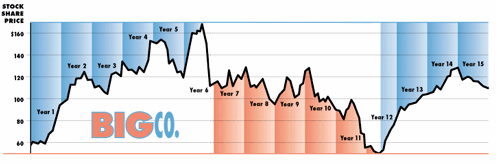
THE BLUES AT BIGCO.
The peaks and valleys in the price of a stock dramatically illustrate how value changes. 
Year 2
Usually a stock climbs in price when the overall stock market is strong, the company's products or services are in demand, and its earnings are rising. When the three factors occur together, the increase can be rapid.
Year 4
A stock's price may change dramatically within a few days, or a pattern of gradual gains or losses may continue over a month or a year. A price is most likely to drop when the market is weak, a competitor introduces a new product, or earnings slow or decline.
Year 5
Nothing ultimately dictates the highest price a stock can sell for. As long as people are willing to pay more for it, it will climb in value. But when investors unload shares or the market falls, prices can drop rapidly.


Years 7 to 10
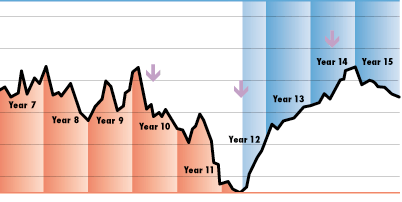
Following a price collapse, a stock can recoup its value or continue to decline, depending on its internal strength and what the markets are doing. In this example, the price moved up and down for several years at about $100, the level it had reached several years before.
Year 12
If a company is out of favor with its shareholders, has serious management problems, or is losing ground to competitors, its value can collapse quickly even if the rest of the market is highly valued. That's what happened here.
Year 14
However, strong companies can cope with dramatic loss of value and can rebound if internal changes and external conditions create the right environment and investors respond with renewed interest.


CYCLICAL STOCKS 
All stocks don't act alike. One difference is how closely a company's business is tied to the condition of the economy. Cyclical stocks are shares of companies that respond predictably to the economy's ups and downs. When things slow down, their earnings typically fall, and so does their stock price. But when the economy recovers, earnings rise and the stock price goes up. Airline and hotel stocks are typically cyclical: People tend to cut back on travel when the economy is slow. In contrast, stock prices for companies that provide necessary services and staples, such as food and utilities, tend to stay fairly stable.


Stocks that pay dividends regularly are known as
INCOME STOCKS, 
while those that pay little or no dividend while reinvesting their profit are known as 
GROWTH STOCKS
GETTING THE TIMING RIGHT 
The trick to making money, of course, is to buy a stock before others want it and sell before they decide to unload. Getting the timing right means you have to pay attention to:
  • The rate at which the company's earnings are growing
  • Competitiveness of its products or services
  • The availability of new markets
  • Management strengths and weaknesses
  • The overall economic environment in which the company operates
BETTING WITH THE ODDS 
Investing may be a bit of a gamble, but it's not like betting on horses. A long shot can always win the race even if everyone bets the favorite. In the stock market, the betting itself influences the outcome. If lots of investors bet on Atlas stock, Atlas's price will go up. The stock becomes more valuable because investors want it. The reverse is also true: If investors sell Zenon stock, it will fall in value. The more it falls, the more investors will sell. 


If you're buying stocks for the quarterly income, you can figure out the dividend yield — the percentage of purchase price you get back through dividends each year. For example, if you buy stock for $100 a share and receive $2 per share, the stock has a dividend yield of 2%. But if you get $2 per share on stock you buy for $50 a share, your yield would be 4% ($2 ÷ $50 = 0.04, or 4%).
Purchase PriceAnnual DividendYield
$100$22%
$ 50$24%
MAKING MONEY WITH STOCKS You may make money with stocks by selling your shares for more than you paid for them or by collecting dividends on the stocks — or both.
The profit you make on the sale of stock is known as a capital gain. Of course, it doesn't all go into your pocket. You owe taxes on the gain as well as a commission on the sale, but if you've owned the stock for more than a year, it's a long-term gain. That means you pay the tax at a lower rate — sometimes substantially lower — than you pay on your earned income or on interest income.
Dividends are the portion of the company's profit paid out to its shareholders. A company's board of directors decides how large a dividend the company will pay, or whether it will pay one at all. Typically, large, mature companies pay dividends, while smaller ones tend to reinvest their profits to fund growth. From your perspective, one of the advantages of dividend income is that through 2010 qualified dividends are taxed at your long-term capital gains rate — 15% if your marginal tax rate is 25% or higher and 0% if it's 10% or 15%.
Most dividends paid by US corporations are qualified, as are dividends paid by a number of international firms. So is most dividend income that mutual funds pass along to you. But dividends from real estate investment trusts (REITs) and mutual savings banks are not qualified. You should check the year-end 1099 statements you receive from financial institutions and discuss which income qualifies for the lower rate with your tax adviser.

Life Cycle of a Growth Stock

A comeback for value investing


Though growth stocks have made the most of the bull market momentum, value stocks did much better in containing falls during the inevitable reversal. The result: a better long-term record.

http://www.thehindubusinessline.com/iw/2009/04/26/stories/2009042650500700.htm

Growth vs. value: annualized range of returns for the two strategies

Sales Growth. We seek to grow sales organically by building market share


Sales Growth. We seek to grow sales organically by building market share

World Economies GDP per Capita

Core Value Equity - Security Selection Process

Protected, Secure, Balanced and Growth Funds.

Tabulating the Gain/Loss in Your Portfolio

Income Statement Format with EBIT and EBITDA

What to Invest?