http://google.brand.edgar-online.com/EFX_dll/EDGARpro.dll?FetchFilingHTML1?ID=5907159&SessionID=DN8fWFq_OCAC9s7
Keep INVESTING Simple and Safe (KISS)***** Investment Philosophy, Strategy and various Valuation Methods***** Warren Buffett: Rule No. 1 - Never lose money. Rule No. 2 - Never forget Rule No. 1.
Wednesday, 28 July 2010
Intro to REITs Investment
What are REITs?
REITs stand for Real Estate Investment Trusts. They are specialized companies that invest in commercial, industrial, residential and healthcare real estates. Examples on the Singapore Stock Exchange includes CapitaCommerical Trust (Commercial), Cambridge Industrial REIT (industrial), Saizen REIT (residential) and Parkway Life REIT (healthcare). These companies buy and manage properties including shopping malls, offices, hotels, hospitals.
REITs usually pay a generous dividend because they are required by law to distribute most of their earnings to shareholders. In exchange, they receive tax incentives.
Perhaps, we can view REITs as an instrument to buy and own a small portion of a property, while at the same time shared fundings with many other shareholders to employ someone to manage that piece of property. With REITs, we can invest in real estate with no leverage, no property and no need for any stress in finding tenants and collecting rent from them.
REITs investment generally focus on dividend yield. Also, like any stocks on the exchange, investing REITs can also result in capital gain. The same can be said of investing in real properties. However, because REITs are traded on the stock exchange, it's liquidity is much higher than the actual property itself.
So how do we choose what types of REITs to invest in? I'm not an expert in it, but I shall share some basics of what I think.
The factors that are important to me are:
1) Dividend yield with regards to current stock price, as with how we choose most dividend stocks
2) Gearing
3) Growth potential
4) Sector
5) Sponsor/Backer
1) Dividend yield
Basically, I will be happy with any dividend yield from 6~8% considering that I do not need to actively monitor the stock price. Choosing and buying those with dividend yield of >6% will mean that should anything unforseen occurs, a reduction in DPU would perhaps still beat putting the money in the bank anytime. Of course, reduction in DPUs would likely bring about a drop in the share price as well till the dividend yield is back to the 'acceptable' range. This should not matter if we are taking a longer term investment view as the dividends would eventually pay itself off.
2) Gearing
With the recent credit crisis, there are companies who have to stop dividend payouts, do placement, issue rights, etc, in order to remain in business. If the gearing is low, refinancing of debts is usually a problemless affair. However, if the gearing is high, as in Saizen REIT and Rickmers Maritime, the ability to refinance debts at critical juncture is hampered. The ability to remain as a going concern would be cast in doubt, and this would make it even harder for refinancing.
3) Growth Potential
A REIT which is actively, but conservatively, acquiring properties would in the long run benefit the shareholders with increasing NAV and increasing dividend yield.
4) Sector
The different sectors mentioned earlier, commercial, industrial, residential and healthcare are different in nature. Industrial and healthcare related properties are usually more defensive in revenue, hence the dividend yield would be more consistent. For commercial and residential sectors, the rents could vary more as the tenants are much more mobile. Hence, the dividend yield could fluctuate. However, for the risk, the yield is usually higher.
At the moment, for REITs, I have only CapitaCommercial Trust and Starhill Global REIT, both in the commercial sector. I hope to eventually include the other 3 sectors so that there will be some diversification.
5) Sponsor/Backer
A strong sponsor like Temasek Holdings, Capitaland, or YTL Corporation would be key to the success of the REIT in refinancing its loans.
REITs stand for Real Estate Investment Trusts. They are specialized companies that invest in commercial, industrial, residential and healthcare real estates. Examples on the Singapore Stock Exchange includes CapitaCommerical Trust (Commercial), Cambridge Industrial REIT (industrial), Saizen REIT (residential) and Parkway Life REIT (healthcare). These companies buy and manage properties including shopping malls, offices, hotels, hospitals.
REITs usually pay a generous dividend because they are required by law to distribute most of their earnings to shareholders. In exchange, they receive tax incentives.
Perhaps, we can view REITs as an instrument to buy and own a small portion of a property, while at the same time shared fundings with many other shareholders to employ someone to manage that piece of property. With REITs, we can invest in real estate with no leverage, no property and no need for any stress in finding tenants and collecting rent from them.
REITs investment generally focus on dividend yield. Also, like any stocks on the exchange, investing REITs can also result in capital gain. The same can be said of investing in real properties. However, because REITs are traded on the stock exchange, it's liquidity is much higher than the actual property itself.
So how do we choose what types of REITs to invest in? I'm not an expert in it, but I shall share some basics of what I think.
The factors that are important to me are:
1) Dividend yield with regards to current stock price, as with how we choose most dividend stocks
2) Gearing
3) Growth potential
4) Sector
5) Sponsor/Backer
1) Dividend yield
Basically, I will be happy with any dividend yield from 6~8% considering that I do not need to actively monitor the stock price. Choosing and buying those with dividend yield of >6% will mean that should anything unforseen occurs, a reduction in DPU would perhaps still beat putting the money in the bank anytime. Of course, reduction in DPUs would likely bring about a drop in the share price as well till the dividend yield is back to the 'acceptable' range. This should not matter if we are taking a longer term investment view as the dividends would eventually pay itself off.
2) Gearing
With the recent credit crisis, there are companies who have to stop dividend payouts, do placement, issue rights, etc, in order to remain in business. If the gearing is low, refinancing of debts is usually a problemless affair. However, if the gearing is high, as in Saizen REIT and Rickmers Maritime, the ability to refinance debts at critical juncture is hampered. The ability to remain as a going concern would be cast in doubt, and this would make it even harder for refinancing.
3) Growth Potential
A REIT which is actively, but conservatively, acquiring properties would in the long run benefit the shareholders with increasing NAV and increasing dividend yield.
4) Sector
The different sectors mentioned earlier, commercial, industrial, residential and healthcare are different in nature. Industrial and healthcare related properties are usually more defensive in revenue, hence the dividend yield would be more consistent. For commercial and residential sectors, the rents could vary more as the tenants are much more mobile. Hence, the dividend yield could fluctuate. However, for the risk, the yield is usually higher.
At the moment, for REITs, I have only CapitaCommercial Trust and Starhill Global REIT, both in the commercial sector. I hope to eventually include the other 3 sectors so that there will be some diversification.
5) Sponsor/Backer
A strong sponsor like Temasek Holdings, Capitaland, or YTL Corporation would be key to the success of the REIT in refinancing its loans.
The Power of Increasing Dividends
How can increasing dividends build phenomenal wealth?


By harnessing the power of compound interest...
Reinvested dividends magnify an investment's typical return by making use of the power of compound interest.
Need an example?
Let's look at a traditional savings vehicle which takes advantage of compound interest...
A savings account.
Let's say your savings account pays 2.0% annually on a $34 initial deposit (in a moment, you'll see why I chose $34 as an example). Here's what that looks like...
Now, imagine how much money you would've earned in year ten if the 2.0% rate also increased on an annual basis along with the principal balance...
You would have a lot more. Right?
Well, that's typically what happens when you invest in a great company with consistent and increasing dividend payouts.
Need an example?
Below is a chart of actual dividends paid by PepsiCo, Inc. from 1999 to 2008. $34 would have purchased 1 share of Pepsi (PEP) in 1999 (this is why I used $34 in the savings account example).
In this case, PepsiCo stock is the perfect illustration of the power of compounding dividend returns...
Notice the "dividends paid" figure in year ten?
Also notice the yield in year one is substantially less than the year one savings account rate in the previous example. But the 2% savings account rate doesn't change, while the dividend yield on the initial investment in PepsiCo stock more than triples. By year six, it eclipses the yield on the savings account and keeps growing and growing.
From 1999 to 2008, the effective dividend yield for PepsiCo stock increased on an annualized basis of 13.57%...! That means, on average, your dividend yield just about doubles every five years. Now, imagine if you continue to hold your PepsiCo stock for another ten years while the dividend payments increase and increase and increase...
In the initial years, you do better with a savings account. But in the long term, you do far, far better with a great company's dividends.
That's the power of compound interest, and you can harness and amplify that power by investing in great companies with a history of consistent and increasing dividends.
So if you want to substantially increase your odds of beating the market and building a successful Roth IRA portfolio, find companies with a track record of increasing dividends...
http://www.your-roth-ira.com/dividend-payout-ratio.html
Graphic representation of Cash Flows
Strong Cash Flows

Competitive Dividends

http://www.faqs.org/sec-filings/091210/NORTHWESTERN-CORP_8-K/ex99-1_westcoastpres.htm
Competitive Dividends
http://www.faqs.org/sec-filings/091210/NORTHWESTERN-CORP_8-K/ex99-1_westcoastpres.htm
Income investing, especially when coupled with a dividend reinvestment strategy, is an effective way to generate income from and also grow a portfolio.
How to Earn 26.5% on $20,000
Boost Your Income from $1,400 to $5,299 in Just a Few Years
Even the younger generation is paying heed to the wisdom of diversifying with income investments. They are starting to realize that income investing, especially when coupled with a dividend reinvestment strategy, is an effective way to not just generate income from -- but also grow -- a portfolio.

The chart above shows your potential annual income stream assuming a $20,000 initial investment in stocks with an average yield of 7%. Thanks to the power of reinvested dividends and dividend growth, after 10 years your portfolio could be generating $5,299 in annual income -- that's +278.5% more income when compared to an investor who doesn't reinvest. In fact, it could be generating an effective yield of 26.5% based on your initial $20,000 investment.
If you have even a little bit more time on your investment horizon (or more money to invest, or additional dollars to invest each year), then the numbers only get better. And keep in mind that these are conservative estimates.
http://www.streetauthority.com/a/how-earn-265-20000-1029
Boost Your Income from $1,400 to $5,299 in Just a Few Years
Even the younger generation is paying heed to the wisdom of diversifying with income investments. They are starting to realize that income investing, especially when coupled with a dividend reinvestment strategy, is an effective way to not just generate income from -- but also grow -- a portfolio.
The chart above shows your potential annual income stream assuming a $20,000 initial investment in stocks with an average yield of 7%. Thanks to the power of reinvested dividends and dividend growth, after 10 years your portfolio could be generating $5,299 in annual income -- that's +278.5% more income when compared to an investor who doesn't reinvest. In fact, it could be generating an effective yield of 26.5% based on your initial $20,000 investment.
If you have even a little bit more time on your investment horizon (or more money to invest, or additional dollars to invest each year), then the numbers only get better. And keep in mind that these are conservative estimates.
http://www.streetauthority.com/a/how-earn-265-20000-1029
A look at a great dividend growth company JNJ
APRIL 06, 2010
JNJ Dividend Hike Could be Substantial
Johnson & Johnson (JNJ) raises its dividends like clockwork, and it's that time of the year. As you can see in the chart below (data provided by Intrinsic Reseach), dividend growth at JNJ has grown at a compounded 14% over the past two decades, though it has tailed off over the past couple of years:
It is worth noting that over the past 7 years, the payout ratio (dividends relative to earnings) has increased rather steadily from 34% to 42%, which is still a rather low number for such a mature company. It is in line to slightly lower than most of the large-cap pharma names.
Last year, the company hiked the dividend from an annual rate of 1.82 t0 1.96, just 7.7%. I think that they can afford to be much more generous this year, as their balance sheet has improved as has their expected earnings. At the end of 2008, the company had a small amount of net cash, with cash and short-term investments of $12.8 billion exceeding the total debt of $11.8 billion. A year later, they had $19.4 billion in cash/s.t. investments and $14.5 billion in debt. Looking ahead, the balance sheet should improve further given the large generation of FCF as well as the incoming payments from BSX. What a great problem with which JNJ must contend: how to spend all of that operating cashflow!
Historically, the company has reinvested in the business with capital expenditures and acquisitions, repurchased stocks and paid dividends. Share repurchases dropped last year and account for the build-up in net cash.
JNJ is expected to earn a record $4.91 in 2010. Applying a 44% payout ratio, which is slightly higher than the current ratio but in line with the progression over the past several years, I get a dividend of 2.16. which would be a boost of 10%. With the stock trading at about 65.00, that works out to what I consider a relatively attractive 3.3% dividend yield.
While perhaps I am too optimistic in my base-case assumption of a nickel-per-quarter add, I think that we should see an increase that at least matches last year's boost (so a hike to 2.11). If I had to take the over or under, though, I will go with the over. I think that it would be a great message to shareholders to raise the dividend in line with the 20-year historical growth rate of 14%, or to $2.24.
http://ab.typepad.com/ab_analytical_services/2010/04/jnj-dividend-hike-could-be-substantial.html
Dividend Growth Investing: A Look at 10 Year Dividend Growth Rates of some Companies
The screening criteria applied toward the S&P Dividend Aristocrat index was:
1) Current yield of at least 2.50%
2) Dividend payout ratio no higher than 60%
3) Price/Earnings Ratio of not more than 20
4) 25 years or more of consecutive dividend increases
http://www.dividendgrowthinvestor.com/2010/04/16-quality-dividend-stocks-for-long-run.html
Dividend Growth Investing: Acquire Great Franchises on Dips
13 dividend stocks to enter on dips
Aug 13, 2009 9:27 AM
Ever since the markets hit a multi year low in March, investors have been wondering how sustainable the advance is. Some claim that the bear market is over, while others believe that the worst is yet to come in the grand scheme of events.
Intelligent dividend investors are not worried about short-term fluctuations in the markets however. They understand that if they follow a rigorous screening process and acquire a diversified mix of the best dividend paying companies in the world, their distributions would provide a positive return in any market. In a previous post I identified 12 attractively valued dividend stocks to acquire now. It is important however not to overpay for stocks, even those with exceptional moats, as this could lead to underperformance relative to their benchmark over time.
If the markets were truly overstretched, then a slight retracement from markets recent highs would be a welcoming sign for income investors, who are looking to exploit these conditions by acquiring great franchises on dips. Pockets of opportunity allow dividend investors to buy solid businesses at reasonable prices, decent yields and acceptable dividend growth rates.
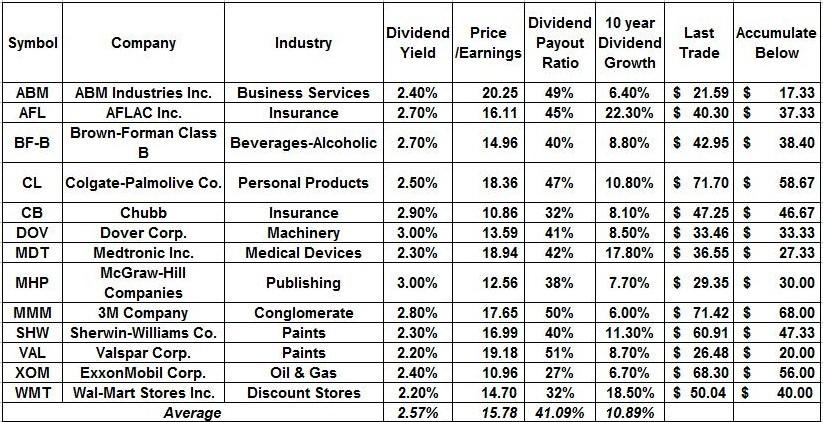
In order to capitalize on such opportunities, I have screened for companies, which have raised their dividends for more than 25 consecutive years. My criteria were are follows:
1) Stock has increased dividends for more than a quarter of a century
2) Price/Earnings Ratio of less than 20
3) Dividend payout ratio of less than 50%
4) Dividend yield is more than 2%, but no more than 3%
The companies, which I identified in the screen, are listed below:
(Open as a spreadsheet)
I require a 3% initial dividend yield before initiating a position in a stock. Thus the above-mentioned stock list should be acquired only on dips below the target price. Another strategy for enterprising dividend growth investors is selling cash secured puts on the stocks below, with strike prices close to the target price mentioned above. I have provided some explanation why I require at least some yield below.
Investors often overpay for stocks because of the recency phenomenon, where they discount double-digit growth indefinitely. This leads to purchasing stocks with unacceptably low dividend yields, high P/E ratios and rosy predictions for strong dividend growth for eternity. Such conditions are simply unsustainable.
Thus by buying a stock with a dividend yield of at least 3% an investor’s income is relatively well covered in a scenario where the company stops growing its distributions. With this margin of safety the investor still generates some dividend income until they manage to sell the stock and re-invest the proceeds in a more promising dividend growth stocks. With a 1%-2% yielder, it would take forever for our enterprising dividend investor to earn a reasonable dividend income if distribution growth slows down or grinds to a halt.
http://seekingalpha.com/instablog/152225-dividend-growth-investor/22570-13-dividend-stocks-to-enter-on-dips
Intelligent dividend investors are not worried about short-term fluctuations in the markets however. They understand that if they follow a rigorous screening process and acquire a diversified mix of the best dividend paying companies in the world, their distributions would provide a positive return in any market. In a previous post I identified 12 attractively valued dividend stocks to acquire now. It is important however not to overpay for stocks, even those with exceptional moats, as this could lead to underperformance relative to their benchmark over time.
If the markets were truly overstretched, then a slight retracement from markets recent highs would be a welcoming sign for income investors, who are looking to exploit these conditions by acquiring great franchises on dips. Pockets of opportunity allow dividend investors to buy solid businesses at reasonable prices, decent yields and acceptable dividend growth rates.
In order to capitalize on such opportunities, I have screened for companies, which have raised their dividends for more than 25 consecutive years. My criteria were are follows:
1) Stock has increased dividends for more than a quarter of a century
2) Price/Earnings Ratio of less than 20
3) Dividend payout ratio of less than 50%
4) Dividend yield is more than 2%, but no more than 3%
The companies, which I identified in the screen, are listed below:
(Open as a spreadsheet)
I require a 3% initial dividend yield before initiating a position in a stock. Thus the above-mentioned stock list should be acquired only on dips below the target price. Another strategy for enterprising dividend growth investors is selling cash secured puts on the stocks below, with strike prices close to the target price mentioned above. I have provided some explanation why I require at least some yield below.
Investors often overpay for stocks because of the recency phenomenon, where they discount double-digit growth indefinitely. This leads to purchasing stocks with unacceptably low dividend yields, high P/E ratios and rosy predictions for strong dividend growth for eternity. Such conditions are simply unsustainable.
Thus by buying a stock with a dividend yield of at least 3% an investor’s income is relatively well covered in a scenario where the company stops growing its distributions. With this margin of safety the investor still generates some dividend income until they manage to sell the stock and re-invest the proceeds in a more promising dividend growth stocks. With a 1%-2% yielder, it would take forever for our enterprising dividend investor to earn a reasonable dividend income if distribution growth slows down or grinds to a halt.
http://seekingalpha.com/instablog/152225-dividend-growth-investor/22570-13-dividend-stocks-to-enter-on-dips
High Dividend Payout Ratio = High Earnings Growth Rate (??)
I have always been under the impression that a dividend payout ratio must not be too high because it can limit the ability of the company to grow. I look for a dividend payout ratios that are at least below 60%, preferably even lower. I have selected this target because I have believed that the lower payout ratio will provide the company with a sizable chunk of earnings to grow the business and with a lower than 60% dividend payout ratio a company can continue to grow its dividend even during time of economic slowdowns or reduced earnings.
It appears that this theory and fundamental analysis principle has been refuted in a study by Robert D. Arnott and Clifford S. Asness (pdf document). Their theory is that higher dividend payouts actually have lead to higher earnings growth. And with higher earnings growth, share prices tend to go up over time which is better for all of us investors. Let’s have a look at their research and findings.
But First a Definition of the Payout Ratio
The payout ratio is the percentage of a company’s earnings that are paid out as dividends. In a nutshell, the payout ratio provides an idea of how well earnings support the dividend payments. More mature companies tend to have a higher payout ratio.
The crux of the Arnott and Asness research really boils down to one chart. Have a look and it is clear that there is a trend happening here.

As you can see, for a high number of companies, the higher the payout ratio is the better earnings growth the companies experienced. Here are some comments from the authors:
So what do we, the average investors do with this data?
My view is that I am going to continue to use my 60% payout ratio benchmark, but will not scoff at a higher dividend payout ratio as quickly. I still believe that it is the average historical payout ratio that an investor must be concerned with – any recent jumps in the payout ratio need to be examined to determine why the change occurred.
http://www.thedividendguyblog.com/high-dividend-payout-ratio-high-earnings-growth-rate/
But, do read the article below which contradicts the above findings.
----
High Yields and Low Payout Ratios
The above post has covered high dividend stocks and the fact that they have been better market performers than low yield stocks. However, it has not been simply buying all the high dividend stocks that has been the most powerful. A study conducted by Credit Suisse Quantitative Equity Research looked at high yields and payout ratios. Their study found that it is high yields coupled with low payout ratios that have provided the best gains over lower yield investing. Although the study used a shorter time frame (1980 – 2006) than many of the other studies we have looked at, the data is pretty clear in its messaging. Take a look at the chart below:

It is interesting to see that the stocks that had a high payout ratio as a whole produced worse gains than the S&P 500, but the stocks that either paid no dividends, had a low yield, or had a high yield did better than the S&P 500. That payout ratio is certainly more important than I thought it was based on this study. A high payout ratio can certain indicate trouble in a company and must be watched closely.
http://www.thedividendguyblog.com/day-5-the-dividend-key-high-yields-and-low-payout-ratios/
It appears that this theory and fundamental analysis principle has been refuted in a study by Robert D. Arnott and Clifford S. Asness (pdf document). Their theory is that higher dividend payouts actually have lead to higher earnings growth. And with higher earnings growth, share prices tend to go up over time which is better for all of us investors. Let’s have a look at their research and findings.
But First a Definition of the Payout Ratio
The payout ratio is the percentage of a company’s earnings that are paid out as dividends. In a nutshell, the payout ratio provides an idea of how well earnings support the dividend payments. More mature companies tend to have a higher payout ratio.
The crux of the Arnott and Asness research really boils down to one chart. Have a look and it is clear that there is a trend happening here.
As you can see, for a high number of companies, the higher the payout ratio is the better earnings growth the companies experienced. Here are some comments from the authors:
- In general, when starting from very low payout ratios, the equity market has delivered dismal real earnings growth over the next decade; growth has actually fallen 0.4 percent a year on average–ranging from a worst case of truly terrible –3.4 percent compounded annual real earnings for the next 10 years to a best case of only 3.2 percent real growth a year over the next decade.
- From a starting point of very high payout ratios, the opposite has occurred: strong average real growth (4.2 percent), a worst case of positive 0.6 percent, and a maximum that is a spectacular 11.0 percent real growth a year for 10 years.
So what do we, the average investors do with this data?
My view is that I am going to continue to use my 60% payout ratio benchmark, but will not scoff at a higher dividend payout ratio as quickly. I still believe that it is the average historical payout ratio that an investor must be concerned with – any recent jumps in the payout ratio need to be examined to determine why the change occurred.
http://www.thedividendguyblog.com/high-dividend-payout-ratio-high-earnings-growth-rate/
But, do read the article below which contradicts the above findings.
----
High Yields and Low Payout Ratios
The above post has covered high dividend stocks and the fact that they have been better market performers than low yield stocks. However, it has not been simply buying all the high dividend stocks that has been the most powerful. A study conducted by Credit Suisse Quantitative Equity Research looked at high yields and payout ratios. Their study found that it is high yields coupled with low payout ratios that have provided the best gains over lower yield investing. Although the study used a shorter time frame (1980 – 2006) than many of the other studies we have looked at, the data is pretty clear in its messaging. Take a look at the chart below:
It is interesting to see that the stocks that had a high payout ratio as a whole produced worse gains than the S&P 500, but the stocks that either paid no dividends, had a low yield, or had a high yield did better than the S&P 500. That payout ratio is certainly more important than I thought it was based on this study. A high payout ratio can certain indicate trouble in a company and must be watched closely.
http://www.thedividendguyblog.com/day-5-the-dividend-key-high-yields-and-low-payout-ratios/
Biscuit and Sweets Counters in KLSE.
My reader posted in the chat box:
"oub: overweight biscuit and sweets guanchg,hwatai, kheesan, lonbisc..singapore oub is buying"
Earnings in this group of companies are volatile. Their earnings are better in recent years.
Over the last 5 years, the prices of their stocks have either been flat or tending downwards.
Their dividends have been cut in recent years compared to the earlier years.
Well, what has changed in this sector that is exciting my reader 'oub'?
Subscribe to:
Posts (Atom)
![[AztechDividends.gif]](https://blogger.googleusercontent.com/img/b/R29vZ2xl/AVvXsEjuXvHz5aR0PCJ-ldWIUjWLqK-qKJdYngRmE2R5VBCMslLTIdOFDxH71ORZo6vAPdwkNiJefLBN0AMSAB71QUKDRAYf0vy92MYLM5fPKelWKegX3TKpoRdyMKb1qNpvktOxY5xXJ6ywXDzo/s640/AztechDividends.gif)