Tuesday, 3 November 2009

Malaysia has lost its way, says Ku Li


Malaysia has lost its way, says Ku Li

Tengku Razaleigh says many Malaysians are losing faith in their future despite the evidence of material progress. — File pic

KUALA LUMPUR, Nov 2 — Tengku Razaleigh Hamzah has urged the country to shed “crude nationalism” and come to terms with the reality that many Malaysians are losing faith in their future despite the evidence of material progress.

The veteran Umno man told the British Graduates Association at a dinner here last night that it was a fact that those Malaysians who “can stay away and settle overseas do so with the encouragement of their parents”.

“Their parents tell them to remain where they are, there is nothing for them here. The illusion of nostalgia does not explain why parents fight to send their children to private and international schools rather than the national schools they themselves went to.

“The very same politicians who recite nationalist slogans about our national schools and turn the curriculum into an ideological hammer send their own children to international schools here or in Australia and Britain.

“They know better than anyone else the shape our schools are in. It is no illusion that people do not have the faith in our judiciary and police that they once had,” said Tengku Razaleigh.

The former Finance Minister pointed out that the country inherited at independence a functional country with independent institutions.

These included “the Westminster model of parliamentary democracy, civil law grounded in a Constitution, a capable and independent civil service, including an excellent teaching service, armed forces and police, good schools, sophisticated trade practices and markets, financial markets”.

While he pointed out that the challenges of nation building were serious, but the country “faced them with an independent judiciary, a professional civil service and a well-defined set of relationships between a federal government and our individually sovereign states.”

Indeed we were able to face these challenges because these institutions functioned well.

“Institutionally, we had a good start as a nation. Why is it important to recall this?

“For one it makes sense of the feeling among many Malaysians and international friends who have observed Malaysia over a longer period that Malaysia has seen better days. There is a feeling of wasted promise, of having lost our way, or declined beyond the point of no return.”

He said that such a feeling was too pervasive to be put down to the nostalgia of always finding the good old days best.

Malaysians, Tengku Razaleigh contends, are losing faith in their future despite the evidence of material progress.

“We have lots of infrastructure. Lots of malls and highways. Especially toll highways. It is not for want of physical infrastructure, dubious as some of it is, that we feel we languish. It is a sense that we are losing the institutional infrastructure of civilised society.”

He said that if Malaysians felt a sense of loss, or tell their children not to come home from overseas, or are making plans to emigrate, it was not because they did not love the country, or were ungrateful for tarred roads and bridges.

“It is because they feel the erosion of the institutional infrastructure of our society. Institutional intangibles such as the rule of law, accountability and transparency are the basis of a people’s confidence in their society.”

He said it was time to shed the “crude nationalism” which refuses to acknowledge things “not invented here”.

He pointed out that Malaysia had a good start because it had inherited from the British a system of laws, rights and conventions that had been refined over several hundred years.

Malaysia, he said, also inherited the English language, and with that a strong set of links to the English-speaking world.

“There should be a rethinking of our attitude to the English language. By now it is also a Malaysian language. It would be sheer hypocrisy to deny its value and centrality to us as Malaysians.

“Do we continue to deny in political rhetoric what we practice in reality, or do we grasp the situation and come up with better policies for the teaching and adoption of the language?”

He urged Malaysians to reconnect with Britain as it is today instead of recycling stale colonial era stereotypes.

New Chinese stock exchange opens with a surge

New Chinese stock exchange opens with a surge
China’s GEM has been likened to a “VIP table on top of a big casino”. — Reuters pic

SHANGHAI, Nov 2 — The highly anticipated opening of China’s new Nasdaq-style stock exchange last Friday is already being seen as a watershed moment for the country’s capital markets, providing new opportunities for Chinese investors and an alternative source of financing for upstart companies.

Investors went on a wild buying spree during the first day of trading Friday on the Growth Enterprise Market, or GEM, sending the shares of some companies soaring as much as 210 per cent.

“This is potentially a major game changer in China’s high-tech industry,” said Yu Zhou, a professor at Vassar College in Poughkeepsie, NY “For about 10 years, the biggest problem for China’s innovative companies was finance. You know it is very hard for them to get loans from state-owned banks.”

The buying was so feverish that regulators, trying to calm the market, temporarily suspended trading in the shares of all 28 newly listed companies at different points on Friday, and analysts warned about the risks posed by excessive speculation and inflated stock prices.

Stocks on the GEM opened sharply lower today, with many shares down 10 per cent.

Still, the first batch of companies listed on the GEM — including film producers, software makers and pharmaceutical companies — raised about US$2 billion (RM6.8 billion) in their initial public offerings, far more than the companies had hoped.

By the end of trading Friday, the combined market value of the newly listed companies was more than US$20 billion, creating fortunes for the founders and investors in those companies.

China is already the world’s biggest market for initial public offerings, and its resurgent economy is flush with capital and investors with a big appetite for risk.

But trading experts have long complained that this country’s market system is seriously flawed, partly because of a misallocation of capital.

State-run banks lend primarily to state-owned companies, which tend to be inefficient. Listings on the Shanghai and Shenzhen stock exchanges are dominated by government enterprises. Young private Chinese companies generally list their shares overseas, in Hong Kong or on the Nasdaq or New York Stock Exchange, because there are few opportunities for stock listings inside the country.

But the government hopes to change that with the creation of the GEM, which is based in the southern boomtown of Shenzhen. The government is seeking to create a more efficient capital market system, one that would steer investment capital to small and midsize private enterprises — companies that can help reshape the economy through technology and innovation, rather than low-price exports.

Although the GEM, which is also known here as ChiNext, is tiny when compared with the Shanghai and Hong Kong stock exchanges, regulators hope it will eventually compete with Nasdaq and entice more Chinese companies to list with GEM.

The GEM is also expected to give a boost to China’s venture capital and private equity markets, which have been hampered by a system that until now has not provided wealthy investors with what industry insiders call an exit strategy, or a way to eventually cash out of their investments in small companies through a domestic stock market.

There are big hurdles to creating a stock exchange similar to Nasdaq, which includes companies like Microsoft, Intel and Google. For instance, volatile stock prices and high valuations could hurt the new bourse’s credibility with entrepreneurs and investors.

Chinese investors are known to speculate, favouring momentum buying and selling rather than the underlying fundamentals of a company, analysts say. Indeed, the casino-like nature of the Shanghai and existing Shenzhen exchanges, combined with government intervention, have added to the volatility of the Chinese markets.

Analysts warn that the GEM could also be prone to similar speculative frenzies.

Andy Xie, an economist who formerly worked at Morgan Stanley, is already calling the GEM a “VIP table on top of a big casino.”

Chang Chun, an expert on financial markets at the China Europe International Business School in Shanghai, said that China needed a market to serve start-ups, but “the issue is the maturity of Chinese investors.”

Before trading opened Friday, he said, regulators created rules to guard against excessive volatility and even warned investors that they would crack down on aggressive speculation. Still, Friday’s opening — with 28 companies beginning to trade at once — was marked by wild price swings.

One cause of concern was the huge valuations of the first batch of stocks listed Friday.

The average GEM-listed company has a price-to-earnings ratio of about 100 — meaning investors are paying about US$100 for every US$1 of 2008 earnings. By comparison, the Standard & Poor’s 500-stock index of big American companies trades at closer to 20 times earnings.

GEM stocks are also priced far above Shanghai stocks, which have long been considered inflated by United States standards.

Still, hundreds of Chinese companies are eagerly awaiting their turn to list on the GEM, and many analysts say the exchange will fill an important need: directing financing toward smaller start-ups that help rebalance economic growth. Zhou at Vassar said she had heard that there were over 1,000 companies in Beijing’s high-tech district alone that met the requirements to list shares on the GEM exchange.

Analysts say many more start-ups will be eager to list after seeing the riches made by the first group of companies to go public on the GEM.

For instance, Wang Zhongjun and his brother Wang Zhonglei are the founders of Beijing-based Huayi Brothers Media, one of the country’s leading film producers. Shares in their company jumped 148 per cent Friday, for a valuation of about US$1.7 billion. — NYT

Wednesday, 28 October 2009

Sector Timing is a process of continuous upgrading your investment holdings to maximize portfolio returns.

A simple strategy for keeping your portfolio invested in the strongest sectors of the stock market at all times. The strategy behind the Sector Timing Report is a process of continuous upgrading your investment holdings to maximize portfolio returns. Our upgrading strategy works because as economic and market conditions change, new sector leaders rise to the top of our proprietary sector scoring system. We buy these top ranked sectors and hold them for as long as they outperform their sector peers. When a holding starts to drop in rankings we sell it and move on the the next hot sectors in the market. Rebalancing our holdings monthly keeps us in the latest leadership sectors at all times.

Market Timing: Taking advantage of the periodic bouts of market madness

The most important use of past information is to tell us when the market has moved too far out of line. 

By looking at the chart, you would have noticed that the price rises of 1972 or 1981 or 1987 (or 1993 or 1996 or 2007) were excessive and could not possibly be sustained.  If we were rational at that time, we should have liquidated our holding and got out of the market.  (wishful thinking!! worth a serious look into!!!)

Similarly, in 1975 or 1976/1978 or 1986 (or 1998 or 2008), by looking at the chart, we could have seen that the market had become very undervalued and we should have increased our holding, even if it meant that we had to borrow money to do so.  (shocking!!hmmm!!!)

For the rest of the time, we should buy individual shares as and when we believe they have become undervalued, keeping the chart in the background as a point of reference when we evaluate individual shares.  So long as the market as a whole is not too far above the trend line, we can purchase shares which are undervalued according to our computation.  Provided we are reasonably good in our valuation, the long-term improvement in the market should ensure that we make money over the long run.  (very sound advice indeed)

At times, the market may fall below or even well below the level at which we have made our purchases.  This should not worry us because we have based our purchases on good dividend yield and we do not need to sell.  Furthermore, we can take the opportunity to buy more shares and average down the prices of our investments. 

Occasionally, we may even stand to make a lot of money by selling out if our chart tells us that the market has gone mad, as it is prone to now and again. 

We are therefore practising a very defensive strategy, only buying if the shares are undervalued and quickly selling to take advantage of the periodic bouts of market madness when they occur.


Ref:   Stock Market Investment in Malaysia and Singapore by Neoh Soon Kean

Market timing: The relative position of a share's price to its own intrinsic value is of greater importance.

The market's movements are not perfectly reflected in the movement of the individual share. 

  • Even during the sharpest decline, some of the shares hold their value very well. 
  • During the bull run, some of the shares do not go anywhere. 
  • At the same time, some shares magnify the movements of the market by two or three times, while others (mainly blue chips) only partially reflect the market movements. 
  • Thus even if we get the market timing right, it is not possible to match exactly what is achieved by the market. 
  • The relative position of a share's price to its own intrinsic value is of equal if not of greater importance. 

Market timing is more an art than a science. 

  • There are some people who are highly gifted and are able to make good market timing decisions.  And yet precisely because market timing decisions only have to be made once every 5 years, it is critical that they are made in the correct way.  
  • One wrong decision can either leave one out of the market for several years (i.e. after missing the start of a new bull run) or suffer heavy losses (i.e. missing the start of a new bear run).  
  • There are few of us who can be like Warren Buffet who made two timing decisions in 15 years and both of them were nearly spot on. 
  • We can never hope to be like Warren Buffett but we can use records of past market movements to help our investment decision making.

Market Timing is difficult

Some of you may be tempted to think that it is easy to carry out market timing.  They may think that all one has to do is to take an index chart and draw in the trend line, making purchases or sales whenever the market price gets too far from the trend. 

There are, however, two enormous difficultites in trying to make market timing decisions based on past prices.

1.  First, there is the problem of future changes in the companies' business and political environment.

  • The world of business is never static.  There will always be changes, some small and some large to the environment which the companies operate in. 
  • In order for the stock market to perform as well as it had done in the past, the country must continue to prosper and the political climate has to be stable.  How can we be sure that the future growth trend will be the same as in the past? 
  • In order to be a good forecaster, one must have a very good knowledge of economics and political science.  This is hardly a qualification that is within the reach of laymen.  Even with such qualifications, forecasting can still be very difficult.  Professional economists and moneymen can make collective forecasting errors very frequently.

2.  Second, there is the problem of not knowing in advance how far will the market move above or below the trend. 

  • As we have seen from past records, the distance the market moved from the trend had been irregular and unpredictable. 
  • We can take the 1983, 1987, 1993, 1996 and 2007 booms as examples.  Many professional market-watchers, did not anticipate correctly the heights to which the market went. 
  • Similarly, very few market-watchers anticipated the severe market declines of 1973, 1985, 1987, 1997, 2001 and 2008.

Find Your Financial Style -- and Avoid Its Pitfalls

Find Your Financial Style -- and Avoid Its Pitfalls
by Jonnelle Marte
Tuesday, October 27, 2009
provided by The Wall Street Journal


There are few relationships more complicated than the one we have with money.

Some of us are intimate with our finances, endlessly doing research and keeping track of every penny. Others are more distant; they have a general idea of where their money is going, but aren't sure if it's the right move or if it's enough. Then there are the emotional ones, those who cling to money at the wrong times and make impulsive decisions.

So, what kind of investor and saver are you?

Not sure? Ask yourself these questions: Do I consistently keep track of my spending? And do I do so weekly, monthly or annually? Do I feel that I'm OK financially as long as my checks don't bounce? Do I plan and save for big purchases or do I buy on a whim?

There also are online quizzes, such as J.P. Morgan Chase's "Financial Styles" found at ChaseFinancialStyle.com, that can help you determine your investing and saving profile.

Once you determine your style, you can use certain strategies and tools to reinforce the positive aspects of your approach -- and contain the negative ones.

Understanding your financial approach can help you figure out where your "strategy is most vulnerable to pitfalls or problems," says Hersh Shefrin, a professor of behavioral finance at Santa Clara University who helped J.P. Morgan Chase develop its quiz.

The Analytical Investor

You're a stickler for details and data. And while it's good to be thorough with your research, if taken to an extreme people can forget to take their personal situation and goals into account when making financial and investment decisions.

This type of investor can get hit with what some advisers call "analysis paralysis," where they have trouble making decisions because they can't help thinking there is always more research to be done.

"They're what I call 'see mores' -- they always want to see more," says Bryan Place, founder of Place Financial Advisors, a financial-planning firm in Manlius, N.Y. "Rather than overwhelming themselves and spending too much time digging through content," they should limit themselves to three or four reliable sources, he says.

If you have a tendency to delay acting on your financial goals, Mr. Place says, make a list of the pros and cons and give yourself a deadline to decide -- and stick to it.

While you may be great at budgeting, you might benefit from online expense-tracking tools offered by Mint.com or financial-planning software from Quicken (quicken.intuit.com) that can help you distance yourself from your day-to-day transactions to recognize spending and saving trends over time.

At Mint.com, you can build graphs that show how your spending, income, debt or net worth has changed over a specific period. You also can see changes in spending in certain categories, such as groceries.


The Big-Picture Investor

You know your bottom line, but you don't keep track of every transaction or plan every action or expense. While this approach can be less stressful if you're able to consistently save and meet your financial goals, it can leave you unsure about exactly where your money is going and where you can cut back.

To avoid falling into a set-it-and-forget-it routine and ending up with outdated and unsuccessful strategies for investing and saving, review your strategies at least once a year. For instance, the retirement-savings plan you started five years ago might not be on pace to fund the lifestyle you live today given the recession, so re-evaluate allocations at least once a year, says Carlo Panaccione, a financial planner in Redwood Shores, Calif.

Break down your expenses into two categories: "necessities," which would include mortgage payments, utility bills and food; and "lifestyle," optional costs such as cable television and gym memberships, says Larry Rosenthal, a financial planner near Washington, D.C. Tools at Mint.com and Quicken's software allow you keep track of spending in each category.

To monitor your spending, use a debit card or credit card instead of cash, says Mr. Place, and look at your accounts online at least once or twice a week. But make sure to pay off the credit-card balance each month.

Meanwhile, online calculators such as the one offered by Discover Financial Services, discoverbank.com/calculators.html, can help you devise a monthly plan for reaching a long-term savings goal.

The Emotional Investor

Emotional investors are reactionary, often making financial decisions based on what's happening at the moment and ignoring long-term needs and goals.

"They might look at it as 'Gee, my kid's education is really coming up soon, I have to focus on that and kind of put their retirement on the back burner," says Mr. Panaccione.

For such investors, he suggests creating two lists: one with short-term goals, such as a vacation or car purchase, and one with long-term goals, such as saving for retirement.

Then, set up savings or investing accounts for each goal -- one account for, say, the purchase of a house, one for retirement and another for college tuition. To ensure that each portion is funded consistently, set up automatic deposits to each account, says Mr. Rosenthal.

Matt Havens, partner at Global Vision Advisors, a financial-services firm in Hingham, Mass., suggests forcing yourself to plan for emergencies by building a cash reserve to cover at least six months of expenses. Having that safety net will help you avoid an impulsive move.

And when it comes to investing, don't make drastic changes to your asset allocation. "A main weakness of this group is that they tend to buy high and sell low because of emotion and fear," says Bryan Hopkins, a financial planner in Anaheim Hills, Calif. It might help to sit down with a planner to create a long-term investment plan.

http://finance.yahoo.com/banking-budgeting/article/108022/find-your-financial-style-and-avoid-its-pitfalls;_ylt=Aue6pPmm7eT0U980IRHY3ha7YWsA;_ylu=X3oDMTFhYjhrOGtsBHBvcwMzBHNlYwNwZXJzb25hbEZpbmFuY2UEc2xrA3NtYXJ0d2F5c3Rvcw--?mod=oneclick

Past Market Movements: Big Booms Are Irregular

Examination of Past Market Movements of Malaysia KLSE
What can we learn from the history of overall market movements in the Malaysia KLSE?

1. Generally Upward Trend
2. Trends Not Consistent
3. Irregular Price Patterns
4. Prices Can Be Very Volatile
5. Prices Move Volatile Upward
6. Big Booms Are Irregular

-----

6. Big Booms Are Irregular

It appears that the big booms take place somewhat irregularly.

There have been three in the last 18 years from 1970 to 1988; 1972/1973, 1980/1981 and 1986/1987.

Not only are they irregular but they are of short duration, one to two years appears to be the usual length.

This means that it is difficult to catch a big boom at its beginning.

If one goes in after the market has already moved up a great deal, there is a big risk that the market will crash shortly after.

Past Market Movements: Prices Move Volatile Upward

Examination of Past Market Movements of Malaysia KLSE
What can we learn from the history of overall market movements in the Malaysia KLSE?

1. Generally Upward Trend
2. Trends Not Consistent
3. Irregular Price Patterns
4. Prices Can Be Very Volatile
5. Prices Move Volatile Upward
6. Big Booms Are Irregular

----

5. Prices Move Volatile Upward

It appears that prices can move very much further from the trend line on the up side than on the downside.

Except for a short period at certain times in severe bear market or market crash, the prices do not move very far from the trend line on the down side.

But it can move a considerable distance on the up side.

It would appear also that there are more up years than down years. This means that the prices tend to build up slowly over several years and then fall much faster than they rise.

However, big upward movements tend to be followed by sharp downward movements. It is thus a lot safer to buy when the prices are below their intrinsic value than when they are high.

Past Market Movements: Prices Can Be Very Volatile

Examination of Past Market Movements of Malaysia KLSE
What can we learn from the history of overall market movements in the Malaysia KLSE?

1. Generally Upward Trend
2. Trends Not Consistent
3. Irregular Price Patterns
4. Prices Can Be Very Volatile
5. Prices Move Volatile Upward
6. Big Booms Are Irregular

-----

4. Prices Can Be Very Volatile

The price movements even within a year can be considerable - the average is 38%.


The minimum movement within a year is still 19% from the highest to the lowest which is about six times greater than the average dividend yield.

This means that price changes can very quickly wipe out any return provided by dividend.

This means that the value of one's investment can vary considerably from year to year.

One must be able to sustain such losses if one wishes to invest in shares.

Past Market Movements: Irregular Price Patterns

Examination of Past Market Movements of Malaysia KLSE

What can we learn from the history of overall market movements in the Malaysia KLSE?

1. Generally Upward Trend
2. Trends Not Consistent
3. Irregular Price Patterns
4. Prices Can Be Very Volatile
5. Prices Move Volatile Upward
6. Big Booms Are Irregular

----

4. Irregular Price Patterns.

Although the price movements appear to be centered around the trend lines, they do not appear to be regular. Small troughs can be followed by big peaks and vice versa.

The period in which the market prices stay above or below the trend line is not regular either.

The market can stay under or overvalued for some years.

This means that it is probably very difficult to predict accurately the direction of market movements over the short run.

Past Market Movements: Trends Not Consistent

Examination of Past Market Movements of Malaysia KLSE
What can we learn from the history of overall market movements in the Malaysia KLSE?

1.  Generally Upward Trend
2.  Trends Not Consistent
3.  Irregular Price Patterns
4.  Prices Can Be Very Volatile
5.  Prices Move Volatile Upward
6.  Big Booms Are Irregular

----

2.  Trends Not Consistent
It is very difficult to draw trends to fit stock market movements. 

The main problem is determining the starting point of the trend. 

While it is true that statistical programmes can be used for trend determination, one still has to rely on subjective judgement to determine the beginning and ending point of a trend.  The trend lines shown in charts are drawn based on the best available projected knowledge.

Past Market Movements: Generally Upward Trend

Examination of Past Market Movements of Malaysia KLSE
What can we learn from the history of overall market movements in the Malaysia KLSE?

1. Generally Upward Trend

2. Trends Not Consistent
3. Irregular Price Patterns
4. Prices Can Be Very Volatile
5. Prices Move Volatile Upward
6. Big Booms Are Irregular

-----


1.  Generally Upward Trend

We can see that although there are peaks and troughs, the overall tendency is for the market to be moving upwards.  From 1970 to 1981, the Malaysian market was growing at an annual rate of about 12% (Singapore market 15%).  From 1981 to 1987, the trend appears to be much less, around 4% per annum for the Malaysian market (6% for Singapore market).  The reason for the slowdown in the growth trend from 1981 to 1987 was deflation and the negative growth experienced during the first half of the Eighties. 

These trend lines may be regarded as equivalent to the intrinsic value of an individual share for they mark the inherent value of the market as a whole.  The market seems to fluctuate around these trend lines. 

In the future, the upward tendency of the market is most likely to continue although we are not sure what will be the actual growth rate. 

However, by projecting a trend which is conservatively drawn we can have some idea where the market is heading.  If we buy our shares when the market is at a reasonable level (that is when the index is around the trend line or below), we can rely on the long term rising trend to obtain our gain from the market. 

Unless we buy shares near the top of the peaks, we should be able to profit from buying shares after a few years.  It is therefore important to go for the long run.

Past Market Movements: Malaysia KLSE

By using an index, we can very quickly have an idea of how much the market has moved within a noted period. 

For example, if the index stood at 800 and it is now standing at 1200, we can say that the market as a whole has moved up 50%  [(1200-800) divided by 800)].

Click: http://finance.yahoo.com/echarts?s=%5EKLSE#symbol=%5EKLSE;range=my
This figure shows graphically the movements of the KLSE for the years 1999 to 2009. 

What can we learn from the history of the overall market movements in the Malaysia stock market?

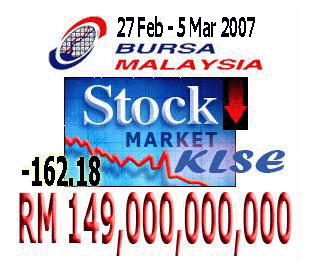
RM149 billion KLSE losses in 5 days


RM149 billion KLSE losses in 5 days

http://blog.limkitsiang.com/2007/03/06/rm149-billion-klse-losses-in-5-days-pmministers-not-stock-market-consultants/

What is a stock market index?

A stock market index is a measure of the average price level of the shares traded in the market.  Its use is analogous to the use of degree of celcius to measure the temperature.  It is constructed by comparing the current price of a sample of shares with their prices at some earlier date. 

The organization which is setting up the index (e.g. KLSE) has to make two decisions regarding the design of the index. 

First, what are the companies to be included in the index?

Second, what is to be the starting point of the index?

Both decisions would involve a certain degree of compromise.

In general, 30 companies is a good compromise to represent the actual situation at the stock market.  KLSE Indices have the starting date of 1st January 1970.  The KLSE Indices are given the base value of 100 as at 1st January 1970. 

There are various ways of computing an index but the easiest way to understand is probably the one using the market value of the companies included in the index. 

The KLSE Industrial Index has a based value of 100 at 1st of January 1970.  It stood at 700 at the end of August 1988.  This means that the market value of the companies chosen for the index had increased their total value by 600 per cent since 1970 (an average annual increase of 11.5 per cent). 

It is worthwhile to remember how indices are calculated and remind ourselves how much the market has gone up in the bull run.  When the market is next in a manic phase, we have to ask ourselves if it is feasible for the market to continue its performance in the future.

Click:
http://finance.yahoo.com/echarts?s=%5EKLSE#symbol=%5EKLSE;range=my
FTSE Bursa Malaysia KLCI Index (^KLSE)


http://blog.limkitsiang.com/2007/03/06/rm149-billion-klse-losses-in-5-days-pmministers-not-stock-market-consultants/
RM149 billion KLSE losses in 5 days

Market Timing

The fundamental approach to investment requires one to work out the intrinsic value of a share before its purchase. 

"Why don't we just wait until the whole market is low enough and then go in and buy a wide selection of shares?" 

This question suggests that one invests by means of "market timing". If practical, it will surely save us a lot of time and effort. 

  • Is it possible to carry out consistently correct market timing? 
  • How easy or difficult is the art of of market timing?

KLSE 1994 to 2009

http://finance.yahoo.com/echarts?s=%5EKLSE#symbol=%5EKLSE;range=my

Is there a correct time to buy and sell?

Tuesday, 27 October 2009

Insiders' actions in 3-A Resources


The share price of 3A rose rapidly to a high level recently.  What actions did the "smarter" insiders in 3A take?

Click here:
http://www.klse.com.my/website/bm/listed_companies/company_announcements/changes_in_s_holding/index.jsp

Type of transaction Date of change No of securities Price Transacted ($$)
Disposed 15/10/2009 2,448,002
Disposed 16/10/2009 2,300,000

Always INVESTigate before you INVEST