Tuesday, 2 February 2010

Listed and Unlisted companies.

You can hold shares in companies that are
  • listed on the stock market or
  • in unlisted companies. 
The bulk of equity investments are in listed shares. 
  • Companies list on a stock exchange in order to gain access to more capital, and
  • they must comply with stringent criteria set by the stock exchange to protect investors.

Be very careful when you invest in unlisted shares. 
  • Unlike the listed companies, the unlisted companies are not scrutinised that closely. 
  • Shares in unlisted companies therefore carry a bigger risk and
  • are also much more difficult to sell as there is no open market.

Inflation is your ultimate enemy. Your other enemy: IMPATIENCE

Inflation is your ultimate enemy.  But impatience can be an even worse enemy when it comes to equity investing.

The important thing when you invest in equities is time.

Over the long term - 10, 20, 30 years of longer - equities offer you the best chance to generate returns that will beat inflation. 

To buy equities only to keep them for a short while is a guaranteed recipe for failure.

You therefore have to be aware of
  • your time horizon and
  • your risk appetite
when you decide to invest in equities.

You should be aware that huge fluctuations can occur and that the portion of your equity holdings should decrease the closer you get to retirement.

Equities carry the highest risk. Why, then, invest in equities?

You can also make a lot of money investing in equities.

During the long term, US stocks gave a historical compound annual return of 11% to its investors.  During the period January 1960 to December 2000, you could have earned a compound after tax return of 16.9% a year on your shares on the South African stock market.

Equities are one of the few asset classes that give you a real chance to fight inflation over the longer term.

The reason for this lies in the nature of equities.  Equities are investments that give you part-ownership in a company.

Companies issue shares because they need money (or capital) to expand. 
  • When you buy shares, you own part of the company, including its assets. 
  • That explains why, although the value of money decreases with inflation, your investment in a good company can increase as the company grows and the value of its assets increases. 

Note that we say a 'good' company
  • Not all companies are good companies and not all share prices will increase over time, simply because not all companies will expand and grow. 
  • That is why it is important to be clever when you make equity investments.

Besides your share in a company's capital (i.e. its assets less its liabilities), you can also share in its profits by way of dividend payments to the company's shareholders.  This is another reason why investment in equities provides one of the few opportunities to safeguard the REAL VALUE of your capital.  The term 'real' is very important in investment terminology.  It means that you have taken the impact of inflation into account.

The risk involved in equities

You can lose a lot of money investing in equities. 

That is why it is the asset class carrying the highest risk. 

If you had bought shares during the height of the Internet boom in March 2000, you would have lost 72% if you had sold them 18 months later!

Equities are affected by many risks, including:
  • commercial risk, for example, interest rate changes and trade cycles
  • political risk, for example, negative sentiment about Third World countries
  • market risk, for example buying shares at the top (when they are too expensive) and selling them at the bottom (just before prices start to increase again).
Anyone who has invested in equities over the past few years knows how it feels to be on a roller-coaster ride. 
  • In the end of the last century, investors witnessed huge stock market crashes (in 1987, and again in 1998), interspersed with a spectacular rise in share prices as investors started to become hyped-up about the new economy and Internet stocks. 
  • Then, of course, a major downswing was experienced in September 2001 after terrorist attack in the USA. 
  • Due to low interest environment for many years following 911, the US stock market crashed in 2008 due to the subprime credit crunch.

Equity investing: Every time one man buys, another sells, and both think they are astute.

Investing in equities can be compared to an exciting, if scary, roller-coaster ride.

You will need to learn about the dangers of equity investing, but also why you should nevertheless invest in equities.

One of the funny things about the stock market is that every time one man buys, another sells, and both think they are astute. (William Feather)

Monday, 1 February 2010

Reviewing the basics of getting my timing right

If your time horizon, risk tolerance profile and investment objectives remain unchanged,
  • it is better not to change your investment portfolio in times of uncertainty, when it may be a temptation to consider selling investments and reinvesting when prices are lower. 
  • This technique is known as market timing and is a high-risk strategy simply because nobody knows what the future holds.

Patient investors will be rewarded:  research has shown that missing out on the performance of the stock market for only a few days could have a significant effect on performance.

The techniques of dollar cost averaging and phasing in can be preferable to market timing.

Two techniques for Getting your timing right: 'dollar cost averaging' and 'phasing in' your investments

Experience has shown that investors can benefit from being patient.  Impatience is your big enemy. 

Too often investors panic and sell their shares and equity unit trusts at a low, which could result in substantial losses.

There are two techniques:
  • dollar cost averaging, and
  • phasing in
which can diminish the negative impact of buying and selling at the wrong times.


Dollar cost averaging

Those who continue investing at regular intervals in the expectation that the market will recover, benefit from dollar cost averaging.

Dollar cost averaging can be used to great effect with unit trusts, because as you buy more units for the same amount as prices fall (or fewere units as prices rise), you will ultimately pay a lower average price for your units.


Phasing in your investments

In times of uncertainty new unit trust investors are faced with a tough choice: 
  • should they invest a lump sum, or
  • should they phase in their investment over a period? 
They have two possibilities:

A lump-sum investment can be made in
  • unit trusts with a large cash element,
  • a share component that does not correlate with the general direction of the stock market, and
  • a portfolio manager who does not hesitate to take action.

Phasing in:  Prudent or less experienced investors can consider
  • phasing in their investments over some months,
  • potentially benefiting from lower prices because of downward reactions.

Time, and not timing, is the key to successful investment.

So who has the best chance of success?

Another approach is to disregard the risks of market timing and to ask how great the benefits would have been if an investor's timing had been right.

Let us take a hypothetical situation of 3 people who invested a fixed amount every year for 20 years.
  • Person A is extremely lucky and annually invests at a market low, as determined by a particular Stock Market Share Index (JSE All Share Index). 
  • Person B is unlucky and annually invests at a market high.
  • Person C invests on a 'random' date every year, in this case 31st January.

The compound return earned by
  • person A over the period is 14.0% a year,
  • while in the case of person B it amounts to 11.3%. 
  • person C achieved a return of 12.9% a year. 
(Dividend income was not taken into account in the research.)

It is
  • not surprising that an investment at a market low achieved a better return than an investment at a market high, but
  • the difference in return between the high and the low/'random' date is less than expected.

Although there are times when you should be more heavily invested,
  • the risk of underperformance increases considerably if you are continually with-drawing from and returning to the market. 
Investors who buy and hold have the best chance of being successful.

How does market timing impact on investments?

An analysis of the daily returns of a particular Share Market Index for the period 1991 to 2000 (dividend income excluded) showed that missing out on performance of the equity market for only a few days could have a significant effect.

DIFFERENT RETURNS IF YOU MISS OUT ON A FEW DAYS

Strategy========================Return per annum
Always fully invested===============11.8%
Miss out on 10 best days============7.1%
Miss out on 20 best days============3.9%
Miss out on 30 best days============1.3%
Miss out on 40 best days============(-1.0%)

(Source:  Plexus Asset Management)

The table shows that:
  • by missing only 10 days (equal to only 1 day a year), the annual return was reduced by nearly 40%.
  • by missing 40 days (only 4 days a year), the return became a loss.

Instead of reducing investment risk, market timing can, in fact, be a high-risk strategy.

Market timing sounds good in theory. It seldom works consistently in practice.

Market timing is an investment strategy that relies on:
  • your being able to predict the future so that you can protect your capital by not getting caught in any market downswing. 
  • You must also know when the market is going to turn around, so that you can effectively exploit any new upswings.
A market timer must always make two correct decisions:
  • when to withdraw and
  • when to re-enter the market.
A major issue regarding stock market or unit trust investment is the question of whether or not market timing works.  Buying low and selling high is easier said than done.

A fund that applies market timing - buys or sells depending on the direction in which the market is moving -
  • can prevent you from losing money in bear markets, but
  • can also result in your missing out on bull markets.
Research has shown that although market timing sounds good in theory, it seldom works consistently in practice.

How do I get my timing right?

The time of maximum pessimism is the best time to buy and the time of maximum optimism is the best time to sell.

Sir John Templeton

How does investor psychology affect timing?

Investors are inclined to become over-enthusiastic during a bullish phase on the stock market and to become despondent when the market declines.

In order to be a successful investor, it is important to distance yourself from the herd mentality and to take objective decisions based on fundamental reasons.

The typical behaviour of investors is linked to the so-called psychological cycle of investors (Source:  Adapted from Geld-Rapport, 18 March 2001).


Contempt: According to the cycle, a bull market typically starts when a market is at a low and investors scorn stocks.

Doubt and suspicion: They try to decide whether what they have left should be invested in a safe haven, such as a money market fund. They've burnt their fingers on stocks, and vow never to invest again.

Caution: The market then gradually starts showing signs of recovery. Most remain cautious, but prudent investors are already drooling at the possibility of profit.  Now is the best time to buy shares.

Confidence: As stock prices rise, investors’ feeling of mistrust changes to confidence and ultimately to enthusiasm. Most investors start buying stocks at this stage.

Enthusiasm: During the enthusiasm stage, prudent investors are already starting to take profits and get out of the stock market, because they realize that the bull market is coming to an end.

Greed and conviction: Investors’ enthusiasm is followed by greed - often accompanied by numerous new listings or IPOs on the stock market.

Indifference: Investors look beyond unsustainably high price-earnings ratios.

Dismissal: As the market declines, investors show a lack or interest that quickly turns to dismissal.

Denial: They then reach the denial stage, where they regularly affirm their belief that the market definitely cannot fall any further.

Fear, panic and contempt: Concern starts to take hold; fear, panic and despair soon follow. Investors again start scorning the market. Once again, they vow never to invest in stocks again.


Also Read:


Sentiment curves
http://myinvestingnotes.blogspot.com/2009/05/sentiment-curves.html


Sunday, 31 January 2010

Dealers say one of the biggest casualties of the margin calls is Resorts World at Sentosa operator Genting Singapore PLC.

Mid-Week Comment Jan 27: Margin calls, S-chip woes drag down STI

Tags: China Milk Products Group | China Printg & Dyeing Hldg | Delong Holdings | Ferrochina | Genting Singapore Plc | Ks Energy Services | New Lakeside Holdings | Sunshine Holdings
Written by Goola Warden
Thursday, 28 January 2010 09:16

ON WEDNESDAY, ‘forced selling’ by local traders on margin calls hit the market and drove the benchmark Straits Times Index down a further 34 points to close at 2,706.26. In all, the STI has fallen 187 points since last Wednesday, and 227 points from its Jan 11 high of 2,933.

Dealers say one of the biggest casualties of the margin calls is Resorts World at Sentosa operator Genting Singapore PLC. Its share price is down almost 20% since the start of the year. According to a report by DBS Group Research, there could be a potential share overhang from the “mandatory conversion of remaining $321 million Convertible Bonds 2 at 95 cents (338 million shares) on Feb 9”.

Separately, KS Energy Services, the offshore oil & gas and marine services and support company run by Indonesian millionaire Kris Wiluan, announced it plans to issue $50 million in principal amount of 3% convertible bonds due 2015 at an issue price of 89.34% of the principal. The $44.67 million raised will be used to refinance existing debts. The initial conversion price is $1.60 per share, representing a 30% premium to its last traded price of $1.23. KS Energy may also undertake a further issue of convertible bonds worth up to $57 million if required.

According to OCBC Investment Research, the funds are likely to be used because bondholders of the previous tranche of convertible bonds issued in 2007 might opt for early redemption. The bonds issued to Stark funds were at a conversion price of $4.05. “Early redemption would require a yield to maturity of 5.5% for Stark, and we therefore estimate KS Energy would need about $113 million ready,” OCBC says. The report believes that KS Energy could come to the market with new shares “at any time, given the capital-intensive nature of its business” and has a “hold” recommendation.

Convertible bonds have been a poisoned chalice of sorts for some stocks, particularly S-chips. On Monday, the South China Morning Post said six of 11 S-chips which sold convertible bonds between 2005 and 2008 have insufficient funds to repay their convertible bondholders. The S-chips named were China Milk Products Group, steel coil maker Delong Holdings, property developer Sunshine Holdings, China Printing & Dyeing Holding, waste treatment services provider Sino-Environment Technology Group and steel group FerroChina.

Meanwhile, a local broker report says S-chip New Lakeside Holdings, the producer of apple concentrate, could be insolvent, following the company’s decision to make an RMB22.75 million ($4.7 million) provision for its liability to Bank of China. This may also force the other two principal bankers China Construction Bank and ICBC to demand immediate repayment of RMB14.5 million and RMB10 million. As a result of these claims, the company’s liabilities will exceed its assets.

To be sure, Singapore stocks weren’t the only ones being sold down. Markets everywhere in Asia reeled, largely because of China’s credit-tightening measures. According to a Citigroup Research report dated Jan 25, Asian fund inflows were down 94% week-on-week to US$29 million ($40.7 million) last week. Month-to-date, net inflows to Asian funds barely rose above US$670 million, the report says. This is much smaller than average inflows of US$2.1 billion in the month of January between 2004 and 2007. Asian fund inflows were dampened by China tightening and the strong dollar, the report says.

CHART VIEW
The market is becoming increasingly “oversold” based on short-term oscillators. For the STI, the 21-day RSI is at 34% and the 14-day RSI at 24%. These are at their lowest levels since March last year. Support appears in the 2,700 area which was tested several times before the index eventually broke out. On the flip side, the STI is below its still rising 100-day moving average now at 2,748 and the 200-day moving average at 2,539. With support appearing soon, and indicators — including the five-day stochastics — at extreme lows, the market should attempt a rebound at resistance level to 2,748. A stronger upmove would only develop after a series of positive divergences, which would take four to five weeks to develop.

http://www.theedgesingapore.com/blog-heads/goola-warden/12036-mid-week-comment-jan-27-margin-calls-s-chip-woes-drag-down-sti.html

Rubber glove companies enjoy pricing power and steadily rising sales

Judging from the capacity expansion by rubber glove companies, it appears that larger glove companies like Top Glove, Supermax and Sempermed (Thailand) have more moderate expansion plans as a percentage of existing capacity, while smaller ones like Latexx and Adventa have more aggressive expansion plans and are likely to show higher earnings growth in 2010. 

An oversupply of rubber gloves is unlikely in 2010 but could be a worry in 2011 when more capacity comes onstream. Assuming that the 150 billion-a-year medical glove market grows by 8% a year, an additional capacity of 12 billion gloves will be required per year.  Rubber glove companies have been able to pass on higher costs arising from rising latex prices, with Top Glove increasing prices again in January 2010. 

Nevertheless, producers of nitrile gloves may now enjoy better margins as the cost advantage that latex gloves enjoy over nitrile gloves may have narrowed as latex prices have risen faster than nitrile prices.  Ratings of Malaysian rubber glove companies are still cheaper than those of Ansell, SSL International and the Malaysian market.

The Edge
1.2.2010
By Choong Khuat Hock


Comments:

The whole glove industry is growing.  Due to capacity expansion and their smaller sizes, the smaller glove companies are expected to show faster earnings growth than the bigger glove companies.

The industry business is still resilient.  Profit margin is either maintained or improving.  Glove companies are still able to pass the cost to the customers.  How long will this last?

This industry is highly competitive.  The business is driven by volume and price.  When capacity to supply outstrips demand, those companies with durable competitive advantage are expected to survive.  Those low cost producers will be the big winners and leaders.  Those companies that automate their production with good quality control will probably be able to lower their costs per unit through increasing productivity.  It is possible that those leveraging on low human labour costs now with no or few plans for increasing automation of the manufacturing processes, may eventually lose out to the former in the future both in terms of quality, productivity and costs.

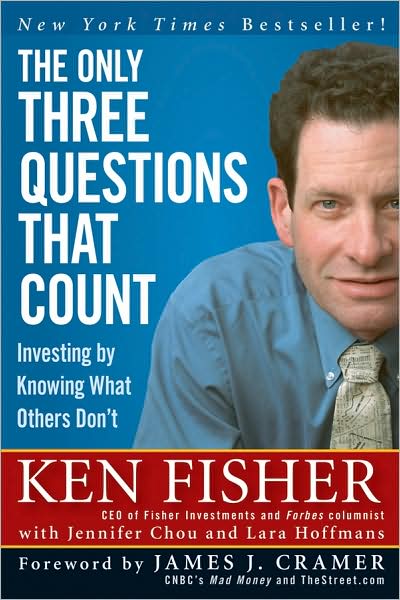
The Only Three Questions That Count: Investing by Knowing What Others Don't

Investing is far more complex than that.

The idea is to get us to think more deeply.
The three questions are:
  • What do you believe that is actually false? Test the received wisdom to see if it is really true. 
  • What can you fathom that others find unfathomable? Look for unusual areas of competitive advantage that you have that are possessed by few. 
  • What the heck is my brain doing to blindside me now? Your emotions will often lead you astray: Look for opportunity amid fear; look for shelter amid wild abandon.

Competitive advantage in investing is an elusive thing.
  • The clever idea that you might discover is just one journal article away from an academic toiling in obscurity, but will go to a hedge fund two years from now.
  • Patterns that work in one market should work in most markets. If your discovery seems to work in most places, it might work well, until it is discovered and used heavily.
Fisher uses E/P relative to bond yields to try to estimate whether markets are rich or cheap.

Now, in the intermediate-run, most things that people are scared about don’t affect the market much.
  • Government deficits? Seem to be a positive for stocks in the short run.
  • Trade deficit? Little effect on stocks.
  • Weak dollar? Little effect.
This book debunks a number of common worries.

Ref:
The Only Three Questions That Count: Investing by Knowing What Others Don’t
(Fisher Investments Press)
 http://seekingalpha.com/article/182970-fisher-s-the-only-three-questions-that-count?source=hp_wc